30 days of human comms #73: Giving dignity in death in Stoke-on-Trent

At the start of the pandemic there was the central message.

Then came the local message.

Then came messages from the frontline from the staff themselves.

This tweet caught my eye.

But then there was the story as it was covered on the Reach title Stoke-on-Trent Live and this comment:

There is something far more powerful in hearing the story unpolished from frontline staff. This may worry NHS comms colleagues on some levels but as a recipient of the tweet it lands every time.

But I’m not surprised, as that was the hospital where my own Dad died.

COVID COMMS #35: Marking 100,000 dead and reaching the point to say: ‘enough’

There is a moment in the history of the First World War that never ceases to hit me for six.

It comes not on in a muddy trench but in Whitehall in 1920. A mother has brought her son on a long journey from Scotland with flowers picked at home to lay on the Cenotaph. This memorial was thronged with people from across Britain on a similar trip. Their grief also had no body to focus on.

A newspaper account tells the story.

The boy and his Mum surveyed the field of flowers that surrounded the Cenotaph all left by grieving families who had made the same pilgrimage.

“Oh mummy,” the boy says to her Mum, “doesn’t Daddy have so many flowers in his garden?”

And a strapping Police Sergeant who was shepherding the crowds past the monument overhears, turns away and covers his face with a handkerchief. It broke him in grief. And the innocence of the boy’s comment always gets to me, too.

The Cenotaph was only supposed to be temporary but the overwhelming public response made it permanent.

Nearby, at Westminster Abbey lies the body of an unknown soldier. This corpse was selected at random from three bodies brought from three British sectors. One was chosen at random. It was carried home by gun carriage and by battleship and was given the status in burial of a King. He was buried with a sword from the Royal collection that Henry V had used and thevact of ceremony caught the nation’s mood. It still does. After every Royal wedding since the bride leaves her bouquet on the grave. It is Holy ground.

Marking grief

This week in the UK, we passed the sombre landmark of 100,000 dead in the COVID-19 pandemic.

Psychotherapist Julia Samuel, whose area is grief, spoke about the need for a national marking of these deaths on the BBC Newscast podcast.

“There is a very individual and collective shock and trauma.

“We find it difficult to think let alone talk about death. We want to turn away yet we can’t. The circumstances of the death have an enormous impact of your ability to grieve without complexity.”

But people have not had space to grieve, she said.

“The underbelly of the corona pandemic is the mental health pandemic and this bereavement aspect is a very sign aspect and they’ve travelled alongside each other,” she added.

Once this is over, ritual is badly needed to mark the country’s significant loss, she said.

Every village after the Great War marked death with memorials and we remember those on November 11. But what of the death from the Spanish Flu pandemic? Not a single memorial got built to the sons, daughters, brothers, sisters, aunts, uncles or grandparents who died.

Why?

History shows that we would rather put pandemics behind us and move forward with our lives. That’s what we did in Shakespeare’s time and what we did in the 20th century. It’s likely what we’ll do this time, too.

In the First World War we applauded people off to the dangers of the front just as we clapped the carers in the first weeks of lockdown. But then when those men came back from the war how quickly we forgot them.

I hope we don’t.

Each death grieves nine

For each of the 100,000 dead there are an average of nine people whose lives have been affected who can’t grieve. Across the country there are people often in low paid jobs facing risk every day who are unable to pull near to the ones they love. Some are carers and some are not.

Yet there is absolutely a need for a national day of mourning where we can properly grieve and there’s a need for something like a cenotaph, too.

The doctors and nurses on the frontline and those who have lost loved ones deserve all the memorials and recognition in the world. It’s quite right that they get this.

The ‘we’re fine’ myth

But behind this are public sector communications people who can count the extra distance they’ve travelled not by extra yards but in the thousands of extra miles.

The mental health pandemic runs parallel with the disease. But its not just grief that causes strain. Working under stress for months does that too.

Outwardly, people say they’re fine but inwardly they’re not. A survey I’m running shows more than 70 per cent of public sector comms people talking about deteriorating mental health. That worries me sick.

It feels as though in this chapter of the pandemic people need to say ‘enough’ if enough has been reached. If and when they do they won’t be alone in that. One regular poster on the Public Sector Comms Headspace made such an admission. There was a lot of recognition in the room for it.

I don’t have much advice in this blog, I’m sorry.

Just don’t be afraid to say ‘enough’ if you feel that point has been reached in yourself or with a colleague.

I don’t know what else to say.

The NHS Every Mind Matters page can be found here.

TRACKER SURVEY: Would you spare two minutes?

Hey public sector comms people how are you feeling?

Back in June 2020 I asked the question by running a survey and blogged the results here.

Three months later I repeated the exercise and blogged the results here.

Now we’re in January I’m keen to repeat the exercise with the latest version of the tracker survey.

If you are fire, police, local government or central government would you take two minutes to let me know how you are faring?

The survey link you’ll need is right here.

As an extra incentive, there’s a box of Gower Cottage chocolate brownies on offer in a prize draw.

Thanks in advance.

SURVEY NUMBERS: As the pandemic drags on public sector comms mental health is suffering

If you’re working in public sector communications seven months into the COVID-19 outbreak your mental health is suffering, a survey shows.

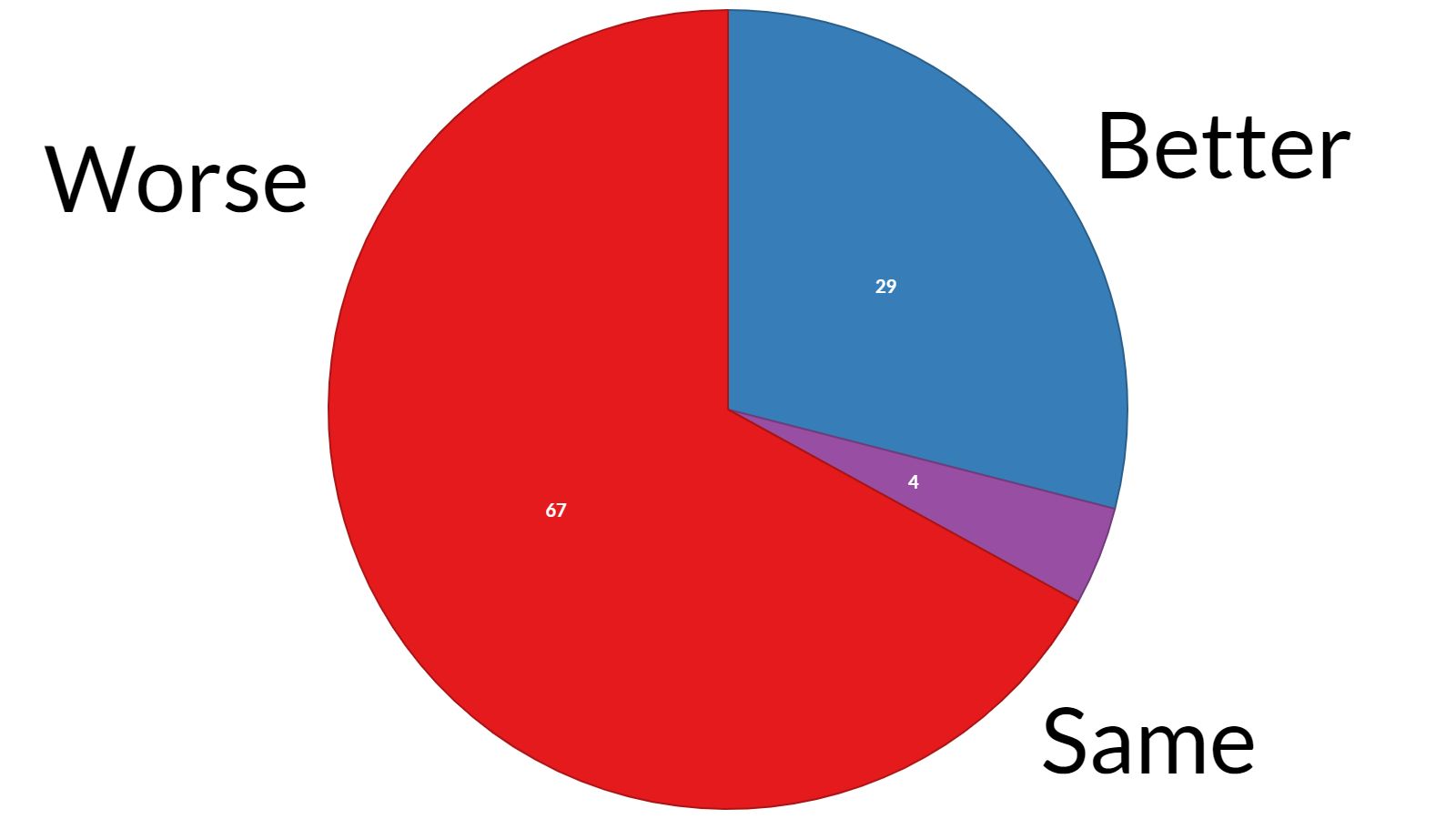
Almost seven in ten of government, fire, police, NHS and local government communicators say their mental health is worse now than before the pandemic struck.

The data from a survey of almost 300 communicators carried out in October and November 2020 show the long term effects of working under pressure is starting to tell.

However, almost eight out of 10 reported that they still feel as though they are working for the common good – an increase of three per cent compared to June 2020.

In truth, the results are alarming.

But the hidden downsides to the work are increasing. Feeling isolated are 47 per cent of respondants – up from 34 per cent in June.

In addition, 53 per cent said their physical health was worse compared to before the pandemic.

Feedback given anonymously in the survey is also disturbing.

“I do find that I feel anxious about work. I feel stressed constantly looking at everything as a task and feeling failure if not done quickly.”

“My line manager hardly checks in to see if I am ok, the workload has increased and I can’t see an end to it currently.”

“COVID has been my introduction to anxiety. And its getting worse as the months go on, and the professional pressure keeps rising.”

fig 1. How is your mental health compared to working before the pandemic?

Positives remain

However, data collected in October and November do point to a communicators believing in what they were doing. There has been a three per cent increase to 77 per cent of people who feel they are working for the common good.

In addition, 45 per cent of communicators felt as though they were working as part of a team.

So, what does this mean?

When I first surveyed public sector communicators in June it was as a one-off but this has now developed into a tracker survey to plot the progress as the panedmic goes on.

In truth, the results are alarming.

On the surface, people often get through their day and their tasks but this is coming at a price.

I’m no expert, but if you are feeling stressed then ask for help.

If you are a manager, a head of communications or a director of communications this needs to be something you look at. Your staff believe in what they are doing but they are suffering.

If you’re public sector do me a favour. The NHS has a good web page with resources here. Take a look and do something. You are not alone. The survey shows this and the chances are there are people in your team feeling the same.

You could also contact Samaritanscall: 116 123 or email: jo@samaritans.org if you need someone to talk to.

If you are public sector and want to take part in the January iteration of the survey click here.

TRAINING UPDATE: Quickety quick, two more online start dates are up

Hey, pop-pickers.

It struck me this morning that I haven’t blogged about the online training I’m doing for a while so here’s a heads-up of some new dates I’ve posted.

The ESSENTIAL COMMS SKILLS BOOSTER is five different blocks each of an hour in length delivered online so they fit more easily into busy days. It’s designed to be a crash course in the things you’ll need to get to grips with 2021.

The five elements

MEDIA LANDSCAPE AND COMMS PLANNING. The landscape is changing and its useful to know how people are consuming content. What worked last year may not mean it works this year. You may not know that WhatsApp is now the third largest channel in the UK.

CREATING CONTENT AND UNDERSTANDING THE ALGORITHM. It’s fine to create content but what if it goes against the algorithm? It won’t reach as many people. You may not know that adding a link to Twitter is penalised.

UNDERSTANDING NEW CHANNELS. We’ll look at TikTok, WhatsApp and Nextdoor. You may not know that that there are 12 million TikTok users in the UK.

WORKING WITH FACEBOOK GROUPS. Facebook is the second largest channel in the UK. Two thirds of users use groups. So how best to connect? You may not know that you can join a group as a page but its always down to the admin whether they let you in or not.

HOW TO HANDLE COMMENT, CRITICISM AND ABUSE. The theory is fine. But what happens when people shout? Relax, there’s a flowchart I’ll take you through. You may not know that a set of house rules that govern your social channels make taking action far easier.

So far I’ve posted 11 sessions. There’s two more on the website.

programme #11 starting 4.3.21

programme #12 starting 10.2.21

Shout if you want to chat about running the session in-house.

More will follow.

Shout if you’re interested.

← Back

Thank you for your response. ✨

GUEST POST: How and why the ‘Don’t be a Dick’ public health campaign was created

It’s always good to hear the story behind amazing campaigns. As public health fight tooth and nail to get their message across the more direct route was adopted by Lincolnshire Resilience Forum. SHAUN GIBBONS communications manager of South Holland District Council explains how it emerged.

Hello, how are you?
Let’s be honest: framing a public health messaging campaign around calling someone out for acting a dick comes with a fair amount of risk. Calculated risk… but risk, nevertheless.

In these heightened, sensitive ‘age of panic’ times the ability for people to find offence in anything that they’ve seen or read online is a headache for anyone working in communications.

This becomes even more relevant when communicators are searching for new ways to say the same thing. Just how many ways are there to say, “Stay at home”, “Wash your hands”? (It must be noted here that UK Government really need to develop the “how” and “when” messaging and consider employing more of the “why” …something they’ve been criticised for in the past).

It’s aimed at those younger, thumb-activated and more risk-relaxed individuals

who have turned away from the stayed messaging that often gets little online traction.


So why the dick?

Cutting through the social media noise and the ‘vanilla’ messaging (a colleague’s phrase, not mine) was Dick’s primary objective. And with nearly half a million views in the first few days of the campaign, this spiky little individual did just that.

Remember the why? Well, we wanted to root this campaign in a particular (give it some bollocks, you might say). Dick represents, according to a UK Government’s Behavioural Insights Team survey, 8 per cent of people who are thought to be responsible for 60 per cent of the total transmission risk.

Put bluntly, Dick is a dick and his actions – and the inherent risks to everyone associated with him – need to be called out. And I believe that was done with a fair dose of humour which seemed to be appreciated by the vast majority who’ve shared and commenting on the campaign’s first
introductory post. Some are suggesting Channel 4’s The Last Leg parodied the campaign on its show last night.


Will this campaign change Dick’s behaviours?

Maybe, maybe not. Is Dick aware that his actions have consequences? Almost certainly. But does Dick know to what extent? I don’t think so, no. And if this campaign does nothing else it highlights the butterfly effect that even the smallest of behaviours can have a large affect.
But that’s enough about Dick.

What about Tom and Harriet?

These two heart-warming individuals represent those who continue to play their part in keeping the virus under control. These two need a voice and need to be championed for the sacrifices they’ve made. These are the majority who quietly go about their lives making a positive contribution to their communities. We need to hear more about the Tom and Harriet’s of this world. (Again, it’s worth noting that behavioural messaging lands much better when they are framed in a more positive sense rather than negative. Again, something the UK Government has been criticised for).

How did you manage to get this signed off?

Working in a multi-agency organisation with a number of instinctively command and control structures is often difficult and demanding, I won’t lie. As is the political dimension. But there’s three reasons why this campaign got off the ground.


Number 1: having a flexible communications strategy that said to partners: “Hey, if you don’t want to share our content, then that’s cool. We’re down with that. We understand you have your parameters and own audiences to consider. It’s all gravy.” All good content will stand on its own two feet.

Number 2: Gaining the trust of your team and those around you and being able to influence those you need to quickly, quietly and efficiently was key. I work with a fantastic group of individuals who know I’ve got their back and I know they’ve got mine. So, if you’re going to tiptoe around a minefield be sure-footed and know where the bombs are buried.

Number 3: Trust your own instincts and hold the line. As I said earlier, it was a calculated risk. But my instincts told me there was a very good chance this would land well with the audience it was intended for. Yes, of course there was pressure for me to take it down and stop the campaign – and I respect those individuals and the organisations they represent who asked for that to happen. But I kept telling colleagues hold the line and it worked out.

So what’s next?

Let’s face it: this campaign won’t appeal to every Tom, Dick and Harry…the curtain twitchers from number 7 down the road probably WILL find it either offensive or downmarket. But this campaign isn’t aimed at those. It’s aimed at those younger, thumb-activated and more risk-relaxed individuals
who have turned away from the stayed messaging that often gets little online traction.


Stay safe and thanks for reading.

Shaun Gibbons is communications manager at South Holland District Council.

COVID COMMS #34: ‘We need dramatic stories of compliance.’

Right now we are in the eye of the storm of the pandemic and we are running through the tools we have available to us.

Government messaging has become blunted over time.

I’ve blogged about the need for local messages with a local accent and the need for tough local stories to cut through.

Language needs looking at, too.

The situation is not ‘challenging’. A Rubik’s Cube is challenging. It is 70,000 dead and that, my friends, needs more direct language.

I was listening to BBC Radio 4 when Professor Stephen Reacher, of the University of St Andrews’ school of Psychology and Neuroscience was interviewed.

We are communicating this all wrong, he said.

If you tell people ‘everyone is doing this, stop it’ what you communicate is ‘everyone is doing it.’

In a British Medical Journal blog he advances the research that most people are sticking to the rules. He goes onto say that reporting individual acts of minor transgressions just builds a picture where EVERYONE is playing fast and loose with the rules.

Aside from being inaccurate, he said, it has the dangerous affect of normalising not sticking to the rules and it allows people to decide to more easily break them.

In short, no-one else is doing it, why should I?

On BBC Radio 4 Today he explained his position further:

A lot of time we see headlines about people breaking the rules and we see politicians saying to people: ‘Look, it’s up to you. You’ve got to obey the rules.’ Of course, everyone does need to obey the rules. We’ve all got to take responsibility for it but it’s not there that the problem lies.

“If you look at all the evidence it shows by and large most people are to a very high degree obeying the rules. It’s about 80 or 90 per cent and that’s stayed pretty constant throught the pandemic.

“The problem is we imply the public is the weak link when the evidence shows we’re not. The reason why it is counter-productive is two fold. Firstly, if you tell people ‘everyone is doing this, stop it’ what you communicate is ‘everyone is doing it.’ You set a ‘negative norm’ and people think ‘everyone else is doing it, why shouldn’t I?’

“The second thing is, if we are going to get through this pandemic it’s got to be as a partnership between the Government and the public. Government have got to support the public and the public has got to go along with what the Government asks of them. If you blame people you break that partnership Government starts to be seen as ‘them’ and their influence starts to drop.”

Professor Reicher added that reporting focusses on the abnormal not the normal wshen what we needed are ‘dramatic stories of compliance’.

The next day the Today programme featured some of those stories.

A couple who have taken to playing Scrabble via Zoom, for example.

Or Richard from Lincolnshire. He spoke of the funeral for his wife Sheila who passed away during lockdown of a non-COVID issue. There was no Wake and no thanking the 30 who attended.

Petra spoke of her Christmas plans being changed and the service station was full of people exchanging large bags of presents at a safe distance.

It makes me think of the deep well of stories that are out there and how it would be good to see them played out.

COVID COMMS #33: Direct content is punching through the COVID-19 fatigue

A few days ago I blogged about the need for direct communications to cut through to people.

I’m so pleased to see that others independently had reached the same conclusions.

Why this change of tack?

Because people have grown tired and the messages of last March have blunted with new ones needed.

Reasons to be cheerful

There are things to be encouraged by.

Trust in local institutions remains and there are lots of trust in local voices.

Besides, perhaps surprisingly, the number of people sticking to the rules hasn’t dropped that much. Ask the BMJ who have blogged the results of surveys that show this and also highlight the danger in the circulating the perception this isn’t true.

This means that the right messages can still land if they are refined.

In this stage of the pandemic, the message has become urgently more direct, hard hitting and human.

For me, this also confirms the ages-old truism that news is people. Or to rephrase it, people connect with people. The old lessons I learned in a newsroom as a junior reporter are still relevant.

The human story of the COVID-19 victim

This post from Telford &Wrekin Council punches you between the eyes. It is a real person, a resident of Telford, called Sharn telling her story in her own words in a post shared with pictures.

You see her healthy at Christmas and you see also the images of her deteriorating.

I was admitted last Sunday and Tuesday I thought I was leaving in a box as I couldn’t breathe unattended!! I have never been so scared and alone in my life thinking you are never going to see your children again is torture.Fortunately I’m getting stronger everyday so will be home soon. Sadly not everyone is as fortunate so many bodies leaving this hospital it’s awful… TAKE THIS VIRUS SERIOUSLY GUYS

Sharn, aged 34, Telford, January 2021.

In 20 hours the post has been shared 2,400 times and there have been 1,100 comments. Scrolling through them they look almost entirely positive with messages to Sharn wishing her a speedy recovery.

Sharn gave her permission for her story to be featured.

This is the kind of content that has cut through. Telford & Wrekin Council’s Kellie Thompson who is responsible for the content deserves enormous credit.

The human story of the workers at the temporary morgue

But it’s not just content for Facebook.

All age groups use traditional media the most to find out COVID-19 information, Ofcom say. Surprisingly, eight out of 10 16 to 24-year-olds turn to these channels for their pandemic updates.

In this BBC content, Surrey County Council worked with traditional media to feature the new temporary morgue built in woodland as an overflow as the morgues in the county’s hospitals are full.

In the footage, we see the construction, the empty racks for the dead bodies and interviews with staff who work there. The BBC in this clip are at pains not to film the bodies out of respect for the families of the dead.

The Local Resilience Forum spokesman sets out the big picture and Kirsty the re-deployed Surrey police detective talks about the numbers increasing not decreasing.

Credit to Andrea Newman’s team at Surrey County Council for this.

You can watch the clip on the BBC website here.

The human response in the Facebook post

Also in Surrey, Surrey Heath Borough Council are also in the eye of the storm with rising infection and death rates. Like many other public sector organisations they’ve been posting the official messages but have been facing the rising tide of abuse, frustration and conspiracy theories.

Credit to Joanne Atkinson and the team for using a very human approach. In the post they dispense with the well worn government graphics and throw their hands in the air. We get it, they say. We’re all fed-up. So are we. But because the rates are so high we have to keep playing our parts.

The response is positive. In 20-hours, there’s been 98 shares, 15 positive comments and 168 positive reactions. This is a good response.

Conclusion

These are three examples of content that capture the current direction of travel. I’m sure there are many more.

Directness can work.

The more direct and human appears to be cutting through to people online. It is, of course, a different matter as to whether or not these messages convert into action.

I’m so impressed at the work of public sector people right now. That needs to be repeated as sometimes those at the coalface don’t always see the bigger picture. If that’s you, thank you for what you are doing.

COVID COMMS #32: Icarus is falling but how do we warn people?

XIR3675 Landscape with the Fall of Icarus, c.1555 (oil on canvas) by Bruegel, Pieter the Elder (c.1525-69); 73.5×112 cm; Musees Royaux des Beaux-Arts de Belgique, Brussels, Belgium; (add.info.: Icarus seen with his legs thrashing in the sea;); Giraudon; Flemish, out of copyright

There is an oil painting I heard about shortly after 9/11 that is so perfect looking back I think I may have imagined it.

It was a landscape by 16th century Flemish artist Peter Breugel be Oude. A farmworker absorbed is stooped over his plough, a shepherd daydreams, a fisherman is wrapped in his work and sailors busy themselves with tasks.

In the mid-distance if you squint and unnoticed you’ll see a tumbling body fall into the sea.

That’s Icarus falling to earth after flying too close to the sun.

I heard of this painting not long after 9/11 to make the point that as big events happen we miss them because our lives are taken-up by detail.

Right now, we are at one of those moments. On January 8 2021, it was announced that London hospitals are within weeks of breaking point at the out-of-control wave of COVID-19 patients. Please act, the report said. Wash your hands. Stay at home.

Our NHS is about to shatter.

We are the ploughman in this scene and our grand children will ask what the heck we were doing.

We’ll tell them that we were tired of lockdowns, we were meeting friends, we were going to the supermarket and we were watching TV. Some of us were laughing at it all, saying it was not true and some journalists were too busy to take down the drip of misinformation that would kill some of us.

It’s not the job of communications people to wake people up it’s ALL our responsibility to wake up and warn our friends and family of the impending disaster.

As I was watching BBC ‘s Newsnight I was struck by the experts interviewed. The first was a man who has dedicated his life to his field and was clearly troubled at what he was seeing. His use of language was deliciously British. There is a thousand deaths a day, he said, and we can’t do that.

The second interviewee, a consultant, said that things are tremendously stretched. It’s language I recognise from the public sector. Things are challenging. It’s a worry, he said. Language always masks the reality. A thousand deaths a day isn’t a challenge, it’s 10 Hillsborough disasters stacked on top of each other stretching out into the future.

But the consultant is a prisoner of the language that he uses. It got me thinking that this language isn’t getting through.

It made me think of the Italian Mayors in the early stages of the pandemic. Footage of them going spare at people went viral.

Where are you going with these incontinent dogs? You need to stay at home. People are dying. Don’t you get it? Do you want us all to get ill? You are irresponsible idiots, colossal idiots.

– Massimillio Presciutti, Mayor of Gualdo Tadino, near Rome, March, 2020.

I hear that students are graduating and they want to have a party. We’ll send armed police and they’ll go along with flamethrowers.

– Regione Campagna, March 2020.

Now, releasing the Mayors to batter the crap out of people is one thing but it did make me think about use of language and of the content that we allow.

There was a debate this week online about access to intensive care units for journalists who are covering the story. There was frustration at the restricted access. There was counter-frustration from NHS comms people that access had been granted, that it was time consuming and anyway family are not allowed in so why should journalists? Besides, footage of dying people without their consent is deeply unethical.

I get both perspectives and I recognise the hours put in by hacks and communications people. They are now tired. Doctors are nurses are tired of shouting into the void only to be told by some that this is a fraud.

It made me think that maybe the only thing that can cut through now is dying patients, the voices of their families and the weary staff who are treating them.

Recent blogging has shown that the national message has blunted but local messages with local voices cut through.

Icarus is falling.

What tools do we have left to tell people?

And what will we tell our grandchildren?

Pic credit: Pieter Brueghel the Elder, Public domain, via Wikimedia Commons

DC RIOT: The really striking thing is that the rioters were creating content for social media. It’s where the power lay

Like many people I watched the scenes in Washington DC with a sense of shock.

A crowd pumped-up by President Donald Trump marched on the Capitol building – the US equivalent of the Palace of Westminster – broke their way in and forced the suspenion of the election of President Joe Biden.

To someone who grew up on American soft power the occasion was jaw-dropping. There was a sense of 9/11 about it. Stuff was happening that shouldn’t be happening.

I’m in no place to comment on US politics but I’ve found myself hoovering it up in the last six months. This is partly because the character of who is the Leader of the Free World has a bearing on British politics. Partly, this is because politics is a petri dish for experimental comms and partly pure escapism from the truly depressing state of British politics in 2021.

I wasn’t going to blog about the episode but this tweet caught my eye for its simple truth:

Real power lies in the content you create and the protestors got that instinctively.

In 1812, when the British Army sacked Washington had there been Instagram there would have been Red Coats LOL-ing in the Oval office too.

I’m not sure why that tweet has landed but it has.

In 2016, the Turkish military staged a failed coup by rolling tanks up to the airport and TV station. President Erdogan defeated it because he was still in possession of his iphone and Facetimed his country to demand his supporters take to the streets. They did.

There is truly a different rule book in the 21st century.