LONG READ: What you can learn from Andy Burnham’s early social media content strategy

There’s been a slew of posts about new Prime Minister Andy Burnham’s use of social media as a communications channel.

There’s been some interesting reads. He’s recruiting a dozen more social media posts for the 10 Downing Street operation. He may or may not be the UK’s first social media Prime Minister.

Let’s been honest, two weeks in and he’s on his honeymoon period.  

But there’s enough there to intrigue me into making me spend some time evaluating his content. 

I’m anticipating the training request ‘we’ve been asked to make our senior people look as good as Andy Burnham.’

How politicians used to communicate

Growing up, the set-piece TV interview was the way politicians would communicate their thoughts and policy detail. Journalist Rob Burley’s excellent ‘Why Is This Lying Bastard Lying To Me’ traces the rise and fall of the 40-minute Sunday morning political interview.

The trouble is nobody outside Westminster wants to watch.

So, with more than 80 per cent of the UK population having a social media account it makes sense to be good these channels as well as media relations, strategy, policy, public speaking and all the other things a successful Prime Minister needs. For a Labour politician facing a hostile media it also makes sense. 

Were I still in regional media, I’d be asking why local news journalists don’t get to interview the Prime Minister so much when he visits town. And yes, other politicians are available.

So a post of three parts. First some data then some learning points and then some content.
PART 1: Some data on Andy Burnham’s social media content

So, how are the numbers? I’ve taken a look at Andy Burnham’s own Instagram, TikTok and Facebook. I’ve not looked at the 10 Downing Street accounts.

At first, I looked at Instagram mapped content there. But exploring TikTok and Facebook it was clear there was content unique to those platforms. How come I haven’t looked at X? Hours in the day, mainly. X is still important to politicians and journalists but less so for the wider public. A quick glance over there shows much less engagement but strong reach. So, around 13,000 engagements on X for the two week and here’s what we’ve achieved listicle. That’s about half of the performance of the same content on Instagram.

I looked at engagements per post as a metric. Why? Because likes, comments and shares are a marker of people literally engaging of what is being said. They haven’t simply scrolled past. When people engage it also sends a signal to the algorithm to show it to more people. Not only that but they are more likely to be shown future content.

Instagram is his largest channel with 660,000 followers outranking Facebook (610,000) and TikTok (465,000). But follower numbers are less important. All of the platforms are showing you content from people you don’t follow if it performs well or you’ve shown an interest in related content.

I’ve also calculated the percentage reach for each of the channels. So, in other words, if you have an account with 100,000 followers reaching 5,000 would be five per cent. It’s a marker of how effective the content is. 

For Instagram this is 3.2 per cent. This is narrowly behind Hootsuite’s benchmark for Government of 3.5 per cent. For Facebook, Andy Burnham’s numbers are 4.1 per cent which is higher than the 1.5 per cent Hootsuite metric.

But its TikTok with a 16.6 per cent engagement rate that’s the real winner. That’s more than ten times the social platform’s suggested 1.5 per cent benchmark. That would be of interest no doubt to political pollsters.

The overall raw numbers pan out in a very similar shape for overall engagement numbers. On average, the 77,000 engagements for TikTok outrank the 25,000 engagements on Facebook and 21,000 on Instagram.

Part 2: What you can learn from Andy Burnham’s social media strategy

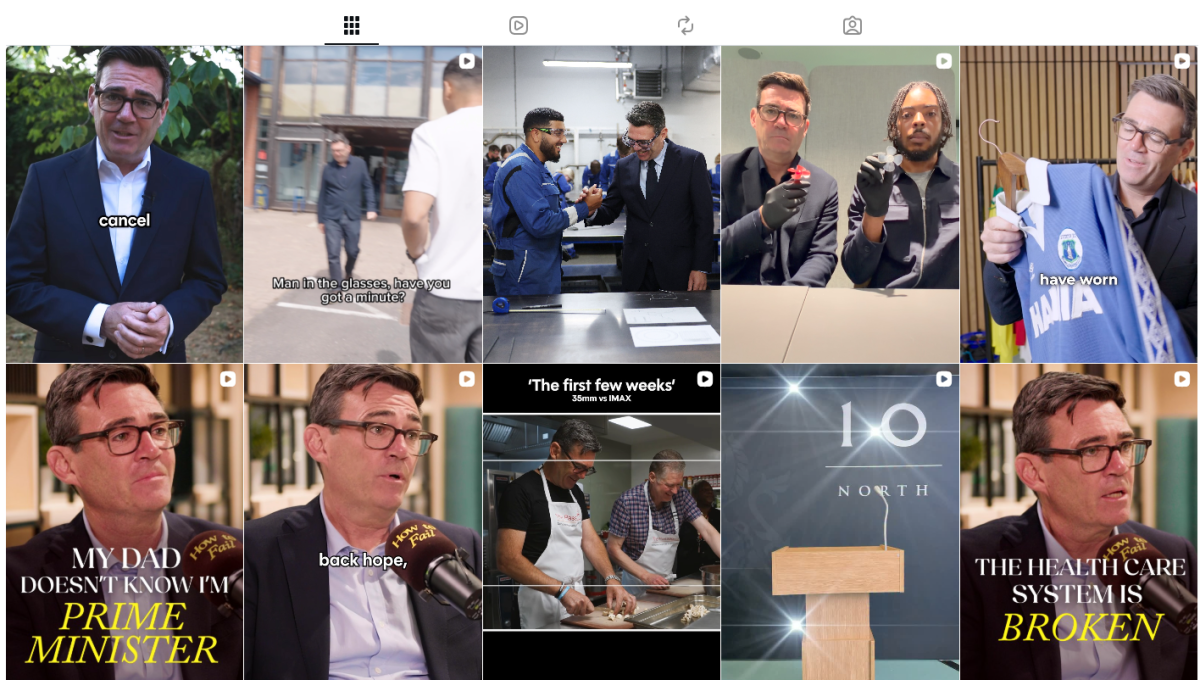
Collaborations, collaborations, collaborations. His team love to set him up with a collab. That’s working with an interviewee for a chat with content often being shared. Of the 25 posts, seven are collaborations. This works here to show a very human side. 4

He sits down with Elizabeth Day from the ‘How to Fail’ podcast which elicits an emotional moment where Andy Burnham reveals how his Dad’s Alzheimer’s disease is so advanced he doesn’t realise his son has been made Prime Minister. Imagine your crowning glory being taken away from you, you are invited to wonder. It’s a touching moment that probably wouldn’t work with a political interviewer. It reaches 100,000 engagements on Burnham’s Instagram but isn’t posted to TikTok or Facebook by his team. 

Instead, the ‘How to Fail’ channel is where you can find it on TikTok and Instagram along with eight other clips and a 54-minute podcast on Spotify and other providers. That’s the nature of collaborations.

He also meets @classicfootyshirts to talk about his love of Everton FC as well as the more heavyweight former diplomat Alexander Dragonetti. There’s also street voxpopper @robcolfer which allows him to talk about Sheffield music and science influencer Big Manny which has more than 100,000 engagements across Instagram and TikTok.

The basic sums of this is that he can break out of his own channel and reach other audiences who probably aren’t following much hardcore politics. It’s a smart move as part of a wider strategy. Critics may say this is not rigorous feet to the fire scrutiny.

Working with influencers will probably work in a honeymoon period. In times of crisis I’d expect this will probably be left in the toolbox.

Influencers. Yes, the public sector can work with influencers. But a bit of prep is needed to make sure you are not sitting down with a dark past or shady opinions.

It’s not posted across all channels. This is such an important lesson from this exercise. Content is posted to the platform where it’ll work best. So, stop the boats is reserved for Facebook. Posts about training for young people go to TikTok. That makes sense. Be aware of the channel.

Bespoke content. Sometimes there was Instagram-only, TikTok-only and Facebook-only content. I was surprised to see Andy Burnham’s admins experiment with text-only posts on Facebook which are also quite long form. Several hundred words on a topic is perhaps surprising. 

Softer content gets the audience for the drier policy stuff.. This is not the best performing content but posts which set out what the PM  has done that week. They feel like the meat and potatoes. They want you to know this. My guess is that softer content reels people in to create a bigger crowd for the more serious messages.

Video, video, video. There’s so much video. To someone who has been banging on about the importance of video this gladdens my heart. But it is not a cure all. There are times when it’ll work and times when it won’t. 

Not so much traditional politician content. The collabs by definition break outside of the politician at the Despatch Box or lectern. In fact, it’s notable how little traditional PMQs sound bite or lectern content there is. Why would he? He’s about doing things differently.

To camera and in conversation. Burnham sometimes delivers a piece to camera and sometimes is captured chatting to an interviewee. That feels deliberate. Mixing it up freshens it up and will deliver different results. The piece to camera can be the points he wants you to know. Counter intuitively, the conversations with interviewers reveal the most personal and intimate content. Revealing the point about his Dad’s dementia may feel a little too manipulative if it was in a speech. 

Hope. One of his early positions is the aim to restore a sense of hope. Indeed, there’s a video which captures this. So much of the internet can be powered by rage and there’s an absence of angry finger pointing here. In this snapshot of content he doesn’t mention his political enemies by name. They’re not even in the screen. His team would probably argue that the content reflects the hope message.

Speaking off the cuff. As an experienced politician he makes a lot of what he says look effortless. He has an ability to communicate without notes. This is rare. Warning: most politicians trying to emulate this will struggle. He has a well thought-out message and he delivers it in conversation rather than set piece soundbite from an autocue. There is no Tony Blair-style jarring of ‘This is no time for soundbites… but I feel the hand of history on my shoulder.’

All this will make it difficult for other politicians to replicate. The bright comms team will anticipate this. The more tightly scripted and tightly edited Oxford City Council approach feels a better route for the less experienced performer. 

Part three: the content itself

Dive in, have a look. It’ll change with time and events no doubt

VIDEO: A collaboration with @robcollfer (227k Instagram followers) who carries out voxpop interviews in the street. He stops ‘Man in glasses’ and asks Q: what is your favourite thing about Sheffield?  Answer: The Crucible for the snooker, Human League and Arctic Monkeys. Q: And least favourite? The transport links. A cunning way to talk about the poor transport links across the Pennines.

Likely to appeal to: Sheffield people, music and snooker fans and northerners fed-up with poor transport links.

Hook: “Man in the glasses, have you got a minute?”

Instagram engagements 10,200. 

TikTok engagements: not posted

Facebook engagements: not posted

Video length 1’25”.

PIC: A listicle of the week’s achievements with a shot of the PM meeting a factory worker. ‘My Government is getting things done’.

Likely to appeal to: Core audience of the page.

Hook: “My government is getting things done – here’s just some of the changes we’ve made this week.”

Instagram engagements 6,600.

TikTok engagements: not posted

Facebook engagements: not posted

VIDEO: A collaboration with @big.manny1 (1.5 million followers) an Afro-Caribbean man who makes science relatable to young people. In the clip, Manny narrates making a circuit breaker in the same way that the PM is making a circuit breaker by creating the Number 10 of the North in Manchester to make decisions outside London.

Likely to appeal to: Young people.

Hook: @andy.burnham is introducing a circuit breaker into UK politics with the new No. 10 North.

Instagram engagements: 51,500.

TikTok engagements: 68,800

Facebook engagements: not posted

Video length: 45 seconds.

TEXT: We’re changing the rules… are you creating British jobs?. This is text and Facebook-only. It’s also long form text. 

Likely to appeal to: Older Facebook natives.

Instagram engagements: not posted

TikTok engagements: not posted

Facebook engagements: 31,500

TEXT: We’ve all had some experience of struggles with mental health. Like the previous post, this is text and long form text.

Instagram engagements: not posted

TikTok engagements: not posted

Facebook engagements: 35,200

VIDEO: I’m back down at Ashton Bears. A selfie video shot in landscape in downtime revisioting the Rugby League club he visited during the recent by-election. 

Instagram engagements: not posted

TikTok engagements: not posted

Facebook engagements: 9,200

Video length: 1 minute 42 seconds.

VIDEO: AI is important so is engineering. A video direct to camera in hi-vis celebrating engineering and other jobs. This is related to the policy announcement also in this run about practical jobs being important.

Instagram engagements: not posted

TikTok engagements: 94,200

Facebook engagements: not posted

Video length: 1 minute 42 seconds.

VIDEO: Collaboration with @classicfootyshirts (1.5 million followers). The PM is shown a late 1970s Everton shirt, talks of his love of Everton and correctly names the player who would have worn the shirt.

Likely to appeal to: Football supporters especially Evertonians.

Hook: “What does Everton Football Club mean to you?”

Instagram engagements: 8,600

TikTok engagements: not posted

Facebook engagements: not posted

Video length: 33 seconds.

VIDEO: Collaboration #1 with ‘How to Fail podcast with Elizabeth Day’ (210,000 followers). In an emotional clip the PM describes how father’s alzheimers is sufficiently advanced that he doesn’t know he is PM.  

Likely to appeal to: Broad appeal but especially amongst those whose family have experienced Alzheimers.

Hook: “My Dad doesn’t know I’m Prime Minister.”

Instagram engagements: 100,000

TikTok engagements: not posted

Facebook engagements: not posted

Video length 1 minute 30 seconds.

VIDEO: Collaboration #2 with ‘How to Fail podcast with Elizabeth Day’ (210,000 followers). In this clip, its more a platform for the PM to explain what he is standing for and talks about the need to ‘bring back hope’.

Likely to appeal to: Core audience.

Hook: Bring back hope.

Instagram engagements: 5,000.

TikTok engagements: 11,200

Facebook engagements: 8,500

Video length 1 minute. 

VIDEO: A show reel of places the PM has gone in the first few weeks. Using ‘Can You Hear the Music’ from the film Oppenheimer plugging into the cinema meme of showing something in 35mm as opposed to the more expansive IMX shot.  

Likely to appeal to: Scrolling audience.

Hook: ‘The first few weeks.’

Instagram engagements: 12,800

TikTok engagement 25,200

Facebook engagements: 49,200

Video length: 29 seconds.

VIDEO: Ask me anything. Taking questions posted on a range of subjects some tricky and some not. While one shot with captions, it is made visually more interesting by jump cuts that crop in on each closer creating pace and intimacy. This plugs into the internet convention ‘ask me anything’ when famous people take questions from the public. 

Likely to appeal to: A scrolling audience.

Hook: ‘Ask me anything’.

Instagram engagements: 5,900.

TikTok engagement: 21,300

Facebook engagements: 10,900

Video length: 1 minute 30 seconds.

VIDEO: Collaboration with @ellisplatten (138,000 followers) the man who owns classicfiootballshirts. Ellis uses the Number 10 podium to joke how his first policy would be to make everyone wear a football shirt.

Likely to appeal to: Football fans.

Hook: ‘Good evening, Britain.’

Instagram engagements: 11,500.

TikTok engagements: not posted

Facebook engagements: not posted

Video length: 15 seconds.

VIDEO: Collaboration #3 with ‘How to Fail podcast with Elizabeth Day’ (210,000 followers). A major policy shift acknowledgiong the need to tackle social care.

Hook: The healthcare system is broken.

Instagram engagements: 16,000.

TikTok engagements: not posted

Facebook engagements: not posted

Video length: 1 minute 30 seconds.

VIDEO: It shouldn’t just be about University education. This is shot with an off-screen interviewer the PM is engaged with. It covers a significant policy change. Young people should be encouraged that vocational education is a good route foir their career.

Likely to appeal to: Parents and young people.

Hook: “For too long, young people have been told there’s only one route to success.”

Instagram engagements: 7,600. 

TikTok engagement: 22,000

Facebook engagements: 7,400

Video length: 52 seconds.

PICTURE: Andy Burnham in Downing Street. A recap on the first two weeks as a listicle.

Likely to appeal to: A scrolling audience. 

Hook: “Two weeks ago today, I admitted that politics has not been working for you and that we all need to raise our game.

Instagram engagements: 21,200

TikTok engagements: not posted

Facebook engagements: not posted

VIDEO: A press conference-style set-up. To tackle the issue of small boat crossings. 

Likely to appeal to: People for who the small boats issue is important. 

Hook: The number of crossings is down by 50 per cent. 

Instagram engagements: 9,700

TikTok engagement: 6,200

Facebook engagements: 21,500

Video length: 1 minute 30 seconds.

VIDEO: A super carousel of images shot in the opening weeks. Dozens of shots of the PM meeting a range of people from the King to members of the public. 

Likely to appeal to: Scrolling audience.

Hook: Behind the scenes – the first two weeks… 

Instagram engagements: 3,900

TikTok engagements: not posted

Facebook engagements: not posted

Video length: 20 seconds. 

VIDEO: A piece to camera summary of the first two weeks. A verbal listicle. 

Likely to appeal to: A scrolling audience.

Hook: Second week as Prime Minister .

Instagram engagements: 33,800

TikTok engagement: 187,000

Facebook engagements: 48,900

Video length: 1 minute 9 seconds.

VIDEO: The need to devolve power. A piece to camera celebrating the regional differences of a roll / barm / tea cake / cob to make the point that local people know what’s to be done locally.

Likely to appeal to: People from the Midlands and North.

Hook: Now this is a barm and no-one can tell me any different.

Instagram engagements: 36,100

TikTok engagement: 72,900

Facebook engagements: 27,900

Video length: 50 seconds.

VIDEO: Criticising online job interviews. A sit-down interview-style interview approach about online job interviews. 

Likely to appeal to: frustrated jobseekers and older people who don’t like technology.

Hook: I’m not a fan of this online job interview culture. 

Instagram engagements: 11,400

TikTok engagement: 35,100

Facebook engagements: 36,700

Video length: 30 seconds. 

VIDEO: Collaboration with former diplomat, columnist and influencer Alexander Dragonetti (240,000 followers) on tackling social care. A chat on benches with a two shot of the two of them.

Likely to appeal to: People who have experience of care for a family member.

Hook: “I would never forgive myself.”

Instagram engagements: 10,300

TikTok engagements: not posted

Facebook engagements: not posted

Video length: 1 minute 35 seconds.

VIDEO: The need for Number 10 North. An informal fireside-style interview to allow the main points to be delivered.

Likely to appeal to: People in Northern England.

Hook: “I think we need to be more ambitious.”

Instagram engagements: 4,800

TikTok engagement: 7,100

Facebook engagements: 8,000

Video length: 38 seconds.

VIDEO: Practical jobs are important. A TikTok-only piece to camera with mortar board and hard hat props to underline the importance of practical jobs.

Likely to appeal to: Young people.

Hook: “For decades, young people have been told a mortar board leads to success but this doesn’t. I’m not having that.”

Instagram engagements: not posted

TikTok engagement: 420,000

Facebook engagements: not posted

Video length: 38 seconds.

VIDEO: A speech given to real people without notes standing amongst a seated audience

Hook: “I speak from the heart…”

Instagram engagements: 22,500

TikTok engagement: 33,100

Facebook engagements: 29,200

Video length: 1 minute 25 seconds. 

That’s it. Thanks for reading. It would be interesting to compare to a figure on the right of British politics. If I can find the time, I may.

For more, I deliver training to help you make sense of the changing landscape. 

ESSENTIAL AI FOR PUBLIC SECTOR COMMS

ESSENTIAL COMMS SKILLS BOOSTER

ESSENTIAL MEDIA RELATIONS

ESSENTIAL VIDEO SKILLS REBOOTED.

UPDATED: UK social media statistics for 2025 and other helpful numbers

I must have said the line ‘more change in the last 12-months than the last 12-years’ dozens of times in the last 12-months. It’s still true.

There are rare chances to assess just how much change. One such opportunity is Ofcom’s Online Nations report which takes a chalk mark and compares it to previous years.

I’ve read it so you don’t have to.

Perhaps more has stayed the same than you may think but there are clear signs of movement around the increase in AI for search. 

As a former journo, I’m comforted that news consumption has stayed largely the same. 

The top 18 UK social media channels

Why 18? It’s an arbitrary number that allows me to capture BeReal which was top 10 a few years ago and has now dropped out of fashion.

YouTube is still largest. Some things don’t change. YouTube remains the largest UK platform reaching 66.9 per cent of the over 18 population. Facebook & Messenger is again edged into second place.

WhatsApp is huge. WhatsApp is in third place reaching 63.4 per cent of all adults with Instagram reaching more than half of all adults.

Reddit is what? Now the surprises. Reddit has moved up into 5th place growing 88 per cent over the last two years. However, as you go and Google what that platform actually is, the data shows people spend a mere four minutes a day there. Compare that to the 51 minutes on YouTube and almost three quarters of an hour that’s thin gruel.

X keeps falling but not as fast as you may think. Also worth a raised eyebrow is the decline of X. It’s been falling for several years but the surprise is that its only six per cent down year-on-year reaching 27.8 per cent of the UK population.

X rivals have not really taken up the challenge. Bluesky has plateaued atlas than three million users – that’s 3.9 per cent of the UK population. Meta-owned Threads still remains the largest X competitor but their numbers have levelled out at just over five per cent.

Elsewhere…

AI is having an impact on search. While Google is pre-eminent on three billion UK searches AI-powered ChatGPT has emerged as its rival with 252 million searches.

AI search is growing. Almost a third of all search has an AI summary. This includes Google and the AI providers. This wasn’t measured two years ago.

The internet continues to be everywhere but we’re alive to the fact it may not be always positive. We spend on average 4.5 hours a day online in our own time. A third of us think the web is overall good for society.

Almost four in 10 people have seen something upsetting online in the previous month. This includes misinformation, abuse or violent content.

We’re still using the web for news. Overall, 97 per cent of people have visited a news site. The BBC is the largest share with eight in 10 visiting it in the previous month. The Sun is in second place with The Guardian third. We spend 10 minutes a day consuming news online.

WhatsApp is trouncing its messaging rivals. Ninety per cent of people who use the internet use the platform. This is almost double Messenger in second place. 

WhatsApp is the most widely used app. Nine in 10 have used the tool beating Facebook into second and Google Maps intio third.

Children are spending time on the internet. A 13-year-old will spend four hours a day. That’s twice as much as an eight-year-old.
You can read the full report here.

WFH WTF: Fascinatingly, we are all different working from home

My son Joe is studying anthropology at University. I’m really envious of this. 

He looks at how people behave and organise. 

But its not just remote cultures in Papua New Guinea that are subject to anthropological study. Office cultures are too. 

In one such study, British, American and Japanese workers in the same Tokyo office were observed. Where were the most misunderstandings? Between Yanks and Brits, surprisingly. Why? Because the two nationalities thought their common language was enough but they knew they had to explain with clarity to Japanese colleagues.

I was surprised just how animated people were this week when I asked them about their own working from home practices and in particular how they stayed switched on.

More than 600 people took part in the unscientific study in Public Sector Comms as to what they use to get in the zone at home.

Almost half listen to nothing, a quarter listen to music, seven per cent the radio and four per cent listen to podcasts with the same number listening to natural noise like rain or the sea. 

So, we are all of us different. 

I started work in a noisy newspaper office with phones ringing, chatter and the sound of keyboards being typed. I never thought I’d be working as I do in an office by myself listening to Radio Lento for the natural noise when I’m having to think with podcasts and audiobooks when I’m doing admin..

The pandemic drove a coach and horses through so many different things and when people left the office in March 2020 with laptops under their arms and Teams newly installed.

We have never really gone back.

But what works best? The office or working from home? 

Academics would say that working from home is better for efficiency.

Working from home is harder for women and those with small children as the lines blur.

A hybrid of working from home and in the office two days a week is often optimal.

We are all of us different and the good manager will work with that.

GCS GUIDE: Your guide rope for using generative AI in public sector comms is here

When I was a kid Dad would take us to see my Gran and Grandpa in the Lake District where he was born.

At one end of Derwentwater, he’d point up at a rockface where little human specs with orange helmets could be seen hundreds of feet up. Trailing brown ropes trailed behind them. As we’d stop and watch those figures would carefully manoeuvre themselves and stretch an arm for a new grip on the crag in a slow motion drama.

“They’re rock climbers,” Dad would tell us. “They’re all a bit mad.”

Years later I would go on my own reading binge of rock climbing memoirs. Climber Joe Simpson whose climbing career was fired by such books tells of overcoming the deep fear by technique, clear thinking and process. Where any sane person would panic a climber would overcome their terror by calmly going through a check list and balance the risk.

In the climbing community, there is special respect for the climber who turns round just short of the summit because they can see from their check list it is the only safe thing to do.

With AI, like rock climbing it is perfectly acceptable to be both terrified and excited at the same time.

Thankfully, good ropes, carabiniers and orange helmets are now being supplied by UK Government. They can help keep communicators safe. Yes, it is scary. Yes, it can be done. There are risks and there is a checklist.

The latest piece of equipment to keep the AI Alpinist safe is the UK Government’s Government Communications Service generative AI policy. It is a profoundly useful addition to your rucksack of comms safety equipment.

When social media emerged in the public sector it was done through a band of militant optimists. I’m proud to be one of them. Our mantra was that it was better to ask forgiveness than permission. With AI, I think it’s now more demanding permission. These documents will help you climb safely.

This will keep you safe 

The most important thing about the GCS generative AI policy is that it will help keep you safe if you’ve got common sense.

At no stage is this a green light to go charging ahead with AI in any way you may dream of.

Firstly, the brass tacks. Generative AI basically means the tools that use AI that will help you create something. This includes text and images.

Let’s look at the key points. 

Always use generative AI in accordance with the latest official government guidance. 

This part of the policy links itself safely by a piece of climbing rope to the UK Government Generative AI Framework. I’ve blogged on this here. By securing it against Government policy this gives you an unbeatable scissors paper stone option.

Uphold factuality in our use of generative AI.

You can’t use AI to create something that misleads. This is a really important piece of policy equipment to be guided by. I can see this being useful to a communicator being put under any implied pressure to try and spin something that isn’t there. It’s also a public declaration of how to use it.

Engage with appropriate government organisations, strategic suppliers, technology providers, and civil society, around significant developments in generative AI, and the implications for its use in government communications.

It’s important that a dialogue is created and maintained to show the wider world how AI is being used. There is no doubt that doubt creates fear and misinformation which can damage hard won reputation.

Continue to review reputable research into the public’s attitudes towards generative AI and consider how this policy should evolve in response.

Again, this is important to root the work in a wider discussion and debate. For example, the Ada Lovelace Foundation have been a beacon of common sense in the field. Their 2023 research on what people in the UK think about AI should be part of your reading list

Government Communications may use generative AI where it can drive increasingly effective, and engaging government communications, for the public good, in an ethical manner.

This is an absolute winner of a paragraph. Print it out and memorise it. It is the starting pistol, the green light, the permission granted and the opening of the door. In days to come people will look at this and be baffled that there was a time before this technology. 

Interestingly, the document refers to first draft text visuals or audio. It can also be a useful tool in making content more accessible. Note that isn’t waving through the final draft sight unseen. To borrow the title of the CIPR document, humans are still very much needed in this process.

Government communications aims to build trust in our approach through acting transparently.

In this section, GCS say that permission will be sought before using a human as an avatar. In plain language, an avatar is a computer generated representation of a person. This can be entirely off-the-shelf and created using some of the tools that are already available. The problem with this is that they can have an American accent or come over as being insincere.

What this particular line also tackles is seeking the permission of people to have their likeness converted into an avatar. This could be useful for HR to create a training avatar to talk you through processes. Tools such as veed.io can do this although the cost of doing so is price on application. 

The benefit of having a human avatar is clear. If you’re in the Black Country, a Black Country accent will land better with the local audience. It can also speed up and cut the cost of training video production. However, while I can see this working in HR if it is marked as AI.

I’m really not sold on the idea of an avatar spokesperson tackling a thorny issue. 

We will clearly notify the public when they are interacting with a conversational AI service rather than a human.

This is essential. People have mixed views about AI and feel far happier when they are told they are speaking to a robot. This chimes with EU regulations that to me is common sense. We generally don’t mind talking to a customer service live chat pop-up if its marked as AI asking some basic questions a human operator can then use to help you.

Government communications will not apply generative AI technologies where it conflicts with our values or principles.

This makes sense but its probably worth spelling it out. Just because you can doesn’t mean you should.

Government communications will not use generative AI to deliver communications to the public without human oversight, to uphold accuracy, inclusivity and mitigate biases. 

Again, humans are involved with this process. 

A useful template for communicators

Of course, this is handy if you are a government communicator but its also useful if you are in the public sector or even third sector. 

So much hard work I’m sure has gone into this. It would be daft not to take advantage of the learning. To tie what you are looking to do in your own team to these principles or to base your own version on them is common sense. 

Huge credit for those involved with this.

I deliver training that now has the elements of AI that you need ESSENTIAL COMMS SKILLS BOOSTER and ESSENTIAL VIDEO SKILLS REBOOTED.

RIOT CONTENT: Some eye-catching content before and after disorder

It’s August 2024 and a number of foreign countries are posting travel warnings after the outbreak of rioting – let’s not call it protest – across England and Northern Ireland.

What started with the murder of three children in Southport became a riot fuelled by misinformation and then disorder in more than a dozen towns.

The Civil Contingencies Act requires UK police, council, fire and rescue and NHS to warn and inform.

I’ve gathered toghether some content that has lanfded. It’s important to stress that it’s not always the eye catching that works. Yes, there’s some arresting footage of police body-warn cameras but there’s also some very straight forward meat and potato communication that scores well because it is timely.

But alonngside the messaging, don’t forget media relations.

The conviction and sentencing of those accused of taking part in disorder is now an important part of the process.

Justice must seen to be done to deter those who could take part in future disorder.

Here’s some that’s caught my eye.

Communicating the incident

X, formerly Twitter, still has a role in a breaking news situation. Wisely, Merseyside Police limited who can reply to the original message. A similar message on Facebook has been shared 350 times in seven days.

Communicating loss

After the deaths of the girls in Southport comes remembering and honouring their lives. Mersey and West Lancs Teaching Hospital NHS Trust.

And also Sefton Council on Instagram lighting up a civic building.

Communicating disorder

But as the situation spread to a far right-inspired riot in Southport and to other towns in England the situation became more charged. Merseyside Police shared some shocking bodyworn camera footage.

Communicating condemnation

In other towns there was condemnation of the trouble caused such as here, Rotherham Council. Sometimes, attractive content isn’t needed. The simple text of it works here.

Communicating arrests

Putting through the door of one of the suspects accused of taking part in the rioting in Sunderland. Face obscured to not jeopardise a future trial from Northumbria Police.

And body worn content showing the arrest of suspects – with faces obscured so as not to jeopardise their conviction.

Communicating recovery

It’s important to show the recovery phase. Here, the people of Sunderland turned out to help with the clean-up operation in the city centre after violence. This post from Sunderland City Council.

And here, Liverpool City Council didn’t hide the deep impact of the violence. Here, library staff on TikTok talk of their shock after their building was targeted.

@lpoolcouncil

Mark and Debbie who work at #Spellow Hub, express their sorrow after the destruction of their community hub. The service gives vital support to the community and the devastation caused by the appalling criminal actions of a minority has left people in shock.

♬ original sound – Liverpool City Council

Again, residents taking part in the clear-up posted by Hull City Council.

A simple picture of gifts thanking Cleveland Police officers who tackled trouble in Middlesborough gets huge reactions.

Communicating recovery from the residents

As much as the content from official channels is important – and it is – there’s certainly something to be said for sharing other recovery content. After all, this shows powerfully that the community are on the side of law and order.

Here, a Southport football player Jordan Lussey offers free coaching to kids from the town.

Don’t forget media relations

It’s also important to remember the role that traditional media plays in these moments and that their content is shared back online. Here, a Liverpool Echo piece is shared back into the Southport Community Facebook group.

And this from South Yorkshire…

And court reporting which is an important part in the process…

On the subject of media relations…

Alison Hernandez, police and crime commissioner for Devon gives a masterclass in communicating restrained anger and praise on BBC TV. It’s five minutes but worth the watch.

LONG READ: Mustard, too much choice and definitive data on how UK local media is being consumed in 2024

When I was a younger man than I am now I loved mustard.

Our local Sainsbury’s had a choice of four and I would buy them to experiment. After all, what mustard would taste good on a ham sandwich was quite different to a barbeque sausage.

So, when our Sainsbury’s moved to a new site four times as big the mustard choice also expanded. There was now 16 different types of mustard. There wasn’t just one type of Dijon mustard. There was four. And English, spicy beer mustard and three types of American burger mustard.

Choice now paralysed me and the first time I went I left without buying any.

What I’d come across in this is something academics call ‘choice overload bias’. This means that when there is too much choice your satisfaction can actually decrease. We are tormented by the fact we may be buying the wrong thing.

Communicators who are looking to reach a local audience are faced with choice overload bias on a regular basis. What channel to use when there are so many?

When I started my career in local government the channels were a hard to use website, the local paper, local radio and quarterly residents magazines.

Social media obliterated all that and there are so many more places to get information.

Cutting through the noise is hard which is why Ofcom’s Review of Local Media Findings interim report is so useful.

I’ve gone through their 36,000 lines of data for you so you can better navigate the metaphorical supermarket shelves.

Key findings

Local newspapers are in an existential crisis. This time they really mean it. Print weekly paper readership across the UK has dropped 19 per cent in 12-months. Regional dailies have dropped 15 per cent in the same period.

Not only that, but there has been a loss of 271 titles between 2005 and 2022.

We already have news deserts. There are boroughs in London without a newspaper circulating and the same can be found in other parts of the country.

We don’t want to pay for local journalism. Not only do we not want to pay we don’t want to pay for ads. Digital or otherwise. Ad revenue is pouring out of the hole in the newspaper’s bucket.

There are experiments with local news. A spate of email-first news services that cover cities have taken off but all attempts at building a new form of journalism over the past 20 years has struggled. There are hyperlocal independent sites across the UK.

Struggling journalism is bad for democracy. The Government’s Cairncross review into local journalism and other academic research all point to this. There is a link between voter turnout and newspaper circulation.

Yet, the demand local news as an entity is surprisngly strong. Be that local politics, events, weather, sport or traffic, weather and travel we want to know about it. All of us. Not just the over 50s.

Local news and current affairs is surprisingly of interest. Almost half – 49 per cent – of 16 to 24-year-olds are interested in local news in their area. I know. I’m shocked as you are. This rises to 73 per cent of over 55-year-olds. This may be the roads that are being built, the cuts to the leisure centre or the event in the park.

But local campaigns not so much. One in five 16 to 24s is interested in a campaign on somethinmg like crime rising to a quarter of 55 to 64-year-olds.

And yes please to weather. Maybe its because we’re British but the category of local weather updates was the most popular with people. Six out of ten of younger demographics were interested rising to 80 per cent of over 65s.

But how we’re accessing this local news has splintered more than I could have imagined. If its not local newspapers then what?

This is where this handy illustration comes in.

I think of it as a dartboard with your street at the centre radiating out to your neighbourhood, city, town, village then your county then your nation.

In your street, it’s WhatsApp and Nextdoor you plug into then as you go wider its social media, newspaper’s social media and then as you approach the region and country its TV and radio too.

I like how they’ve made this visual.

In your street or neighbourhood, WhatsApp and the neighbourhood site Nextdoor are important. As you move towards the town or village and up through the country to the region or country then other platforms become important.

We often forget about TV and radio. There are 39 BBC stations and 250 commercial radio stations and in Wales the Welsh language S4C station plays an important regional role. But broadcasting only comes into play on stories that will reach broad audiences on the edge of the dartboard.

Local news is being consumed by social media with local groups like Facebook community groups now the biggest single place. The secret to good data, I find, is that it can challenge your own experience. I’ve been an advocate for Facebook groups for a long time but even I’m surprised to see that nationally it is now in pole position for local news.

The BBC. I often say in training that making friends with your BBC local democracy reporter (LDR) is essential. They are a trusted channel and that single LDR can shape content for multiple outlets.

Delve deeper and you’ll find newspaper’s digital footprint is important. The data shows 17 per cent for websites and apps of news outlets. Confusingly, it adds 9 per cent to other nmews websites such as Reach plc’s Birmingham Live. Reach fill prettty much all the top 10 for web pages with the highest audience.

People have left print for the web but sill trust local journalism.

Younger people consume through social media. The stat given is 16 to 34s are consuming news twioce as much on the socials compared to adults aged 55 and above.

Podcasts locally? Nah. Podcasts have enjoyed a boom in the 2024 General Election coverage but with five per cent using them for local news this isn’t a factor locally just yet.

What the data says

Firstly, the Ofcom Local Media Review is a useful tool.

While it breaks down into age demographics it also breaks down if you drill deep enough into regional differences. So, if you’re Scotland, Wales, Northern Ireland, West Midlands, South West, London or wherever a bit of time spent to refine the data would be time well spent.

A word of warning.

There is a top level summary of 56-pages and the data sets of 36,000 lines you can plough through.

When you break it down

I’ve selected one of the many data tables to include in its entirity. As you’ll see, there are some surprises.

Q: What sources do you get your local news from? By percentage (source: Ofcom)

Channel16-2425-3435-4445-5455-6465+
Social media (FB, Insta, X)63 6359564436
TV294350546469
Word of mouth454641495459
Radio273232343229
Print newspapers171517202432
Newspaper websites & apps141923212623
Messaging or neighbourhood apps (WhatsApp & Nextdoor141923212623
Email newsletters152216182018
Local news websites222223192018
Search engines343739312924

Conclusion

I thought the local news landscape was fractured but I had no idea it was as fractured as this. Of all of iot, I love the dartboard graphic that shows how local news can feel very different depending on your perspective.

So, if its your street or neighbourhood its one thing – WhatsApp or Nextdoor – but as you move out its social media then TV and radio.

Given that there is this change none of us can take things for granted.

I help deliver training to help communicators communicate better ranging from ESSENTIAL COMMS SKILLS BOOSTER which is the broad skills workshop to ESSENTIAL MEDIA RELATIONS and ESSENTIAL VIDEO SKILLS REBOOTED.

CAMPAIGN TIP: How to plan ahead to combat the trolls

Have you noticed? There’s some campaigns that lights the blue touch paper with some people.

During Pride events supported by fire, NHS, council or any organisation there’s often a minority of trolls.

‘Why are you doing X’, they’ll ask. ‘It’s a waste of money, it’s the Metropolitan elite, it’s the wokerati and you can’t say anything nowadays.’

But, let’s be honest, its not just the rainbow event is it? There’s a shortlist that triggers the easily triggered events that can include Christmas, International Women’s Day, Eid, Ramadan, Easter and any religious holiday. 

If anything doesn’t look exactly how they look then it’s a problem.

The decision for a public sector comms person is quite tricky. Do you post about it or don’t you? I’ve heard of people actively not posting because they’re so worried at the response. 

I understand that but I don’t agree with it.

So, what do you do? 

Well, the first thing is to get a set of social media house rules. I’ve blogged about this before and it’s good to see these becoming more mainstream. 

However, there is something else you can do. Think of it as a planned response list.

Basically, this list brings together all the things you can say in response to explain what you are doing. But the important thing is to get your broad response signed off so you know where you stand and you’re not 

Forward planning for the win 

West Midlands Police plan ahead on their socials. They’ve been doing this this since the English Defence League’s first trip to Birmingham. Then the extremist group sewed misinformation about a knife attack by a gang of Muslims on a white teenager. It never happened but the fall out raised tension.

So, next time the far right protestors came there was an officer armed with Twitter in Gold Control seeking and destroying the information. It worked effectively and became part of their regular response. 

The result was, a duty press officer could shoot down rumours in real time without having to go through the lengthy process of getting each tweet signed off. 

On International Women’s Day for many years, comedian Richard Herring would actively seek out those men – and they generally were men – who asked sarcastically when International Men’s Day was

November 19, he’d answer and sometimes be wittily robust while doing it.  

Edinburgh Zoo won praise for politely challenging homophobic responses on their Facebook page when they posted about Pride. The response attracted a lot of support in the community and also led to a surge in on-the-spot contributions. 

Royal British Legion have been excellent about this in the past. Poppy Day can bring out the bigots with evergreen disinformation around poppies being banned. They plan ahead and take a careful look at the comments on their channels.

Often, I find that the Police are the most on the front foot of all against trolls. NHS people are the most reticent. 

Timing when you make the post 

Help is at hand. The answer is to plan ahead.

When the Pope came to Coventry about a decade ago the council posted the news late on Friday. When they returned on Monday morning war had broken out over the weekend between the factions of people.

Nick from Leeds City Council has spoken about posting at 7am. Thinking about it, there’ll be a moderator around for the first few hours. People will be sober, too. 

Leaving it to a passer–by

Leaving it for a member of the public to step into has worked in the past. 

However, sometimes there just isn’t a member of the public around who can be like the Green Cross Code Man and save the day.  

This should be a bonus rather than your whole strategy.

Draw up your own list of lines to take 

If you are looking to post a campaign on a topic that may spark a needlessly unpleasant reaction here’s an approach to take.

Ask yourself these questions ahead of time:

  • Have you done this in the past? 
  • If you have, what comments have been said about this in the past and what did you learn? 
  • Has an event like this been done by others and what did they say in response?
  • If you haven’t, what’s the worst level that people can potentially stoop to and what would we say and do? 
  • What tone do you want to set? 
  • What key points do you want to make?
  • Do you need to make some assets in advance? 
  • If you have a set of social media house rules, under that, what comments do you allow and what don’t you allow? And where’s the line that if crossed you can start blocking people?

Once you ask yourself these questions you can start to build a list of responses that acts as your armoury ahead of the event.

In particular, deciding the tone in advance is useful. It gives you the confidence to operate on the day. Inevitably, comments like these can land outside office hours or when senior people aren’t around. 

Do all this and you can better navigate choppy waters.

GENNY LEC ’24: This time, there will be no one single image there will be social media ads, memes, screen grabs and trolls

General Elections in the UK used to be so simple. It was a party political broadcast, poster sites and leaflets. Not any more.

In 2024, there will be no defining ‘Labour isn’t working’ ad poster on every roadside poster site.

What’s happening instead is 14,000 tailored social media ads in the six weeks before the first three days. Each of those will be delivered to you based on your age, habits and beliefs as you scroll.

Much of what will drop through your timeline will be video. That’s certainly the message of an analysis of Labour and Conservative ad spend so far.  

As a communicator, elections are rather like the World Cup for football fans. Stories are told and new heroes and villains are made. But most of all I love that they are a petri dish for new communications tools.

In 2008, it was a creative use of email that gave the edge to Obama and social media that took him back to the White House.

But what will 2024 bring?

It’s absolutely not all about the posters

In 1979, analysts pointed to one single comms tool that made the difference for Margaret Thatcher. It was a roadside poster. Saatchi & Saatchi’s clever play on words ‘Labour Isn’t Working’ poster captured a national mood.

Even in 2010, the poster was still a vital part of the election armoury. Strategists of the governing party would book key poster sites to get a headstart and squeeze out the opposition.

The poster ‘We can’t go on like this. I’ll cut the deficit not the NHS’ was the defining image as Labour lost power. In the image, there is the fresh faced David Cameron. The Brexit vote was still ahead of him and everything seemed possible.

But in 2024, where are the posters? 

Have you seen any?

It’s all about the troll

Social media has democratised the information process. 

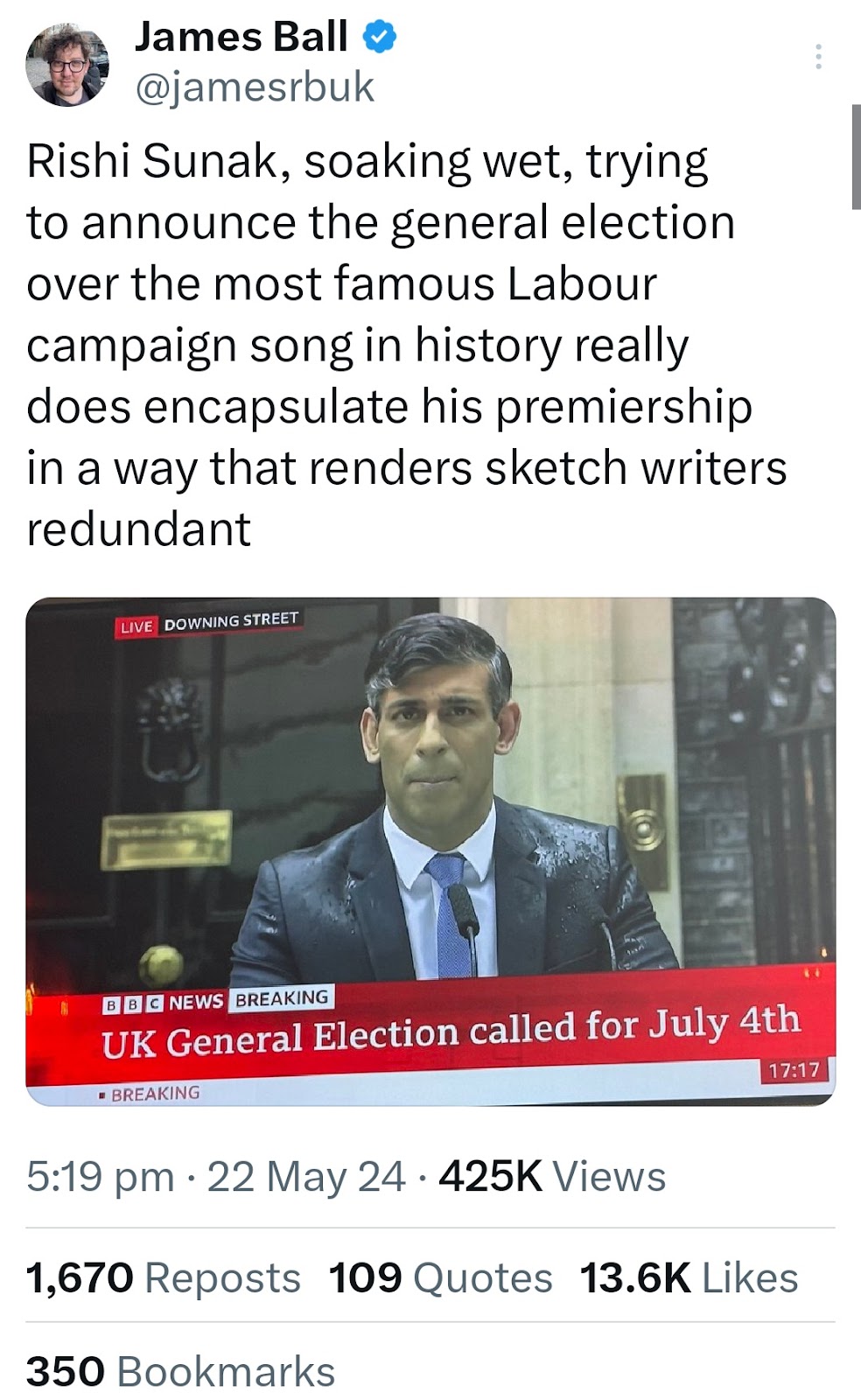
When Rishi Sunak called the snap General Election 2024 in Downing Street he did so in a downpour. Umbrella-less his words were drowned out by a soundsystem playing the 1997 Labour anthem ‘Things Can Only Get Better.’  

Of course, the footage of the Prime Minister being drowned out went truly global and truly viral. It’s noticeable that none of the main leaders have gone anywhere near members of the public. There have been no walkabouts through home countries shopping precincts. No wonder, with smartphones everywhere a heckler can command the news headlines.

This audio trolling only reflects the trolling and noises off that are posted across the broader internet. Sometimes this is good natured heckling. Sometimes it is abuse.  

It’s absolutely all about the meme 

Bleeding in from the Rishi Sunak announcement it’s clear that the internet meme has become a key way to shape opinion.  

There were many memes marking the damp Downing Street moment. 

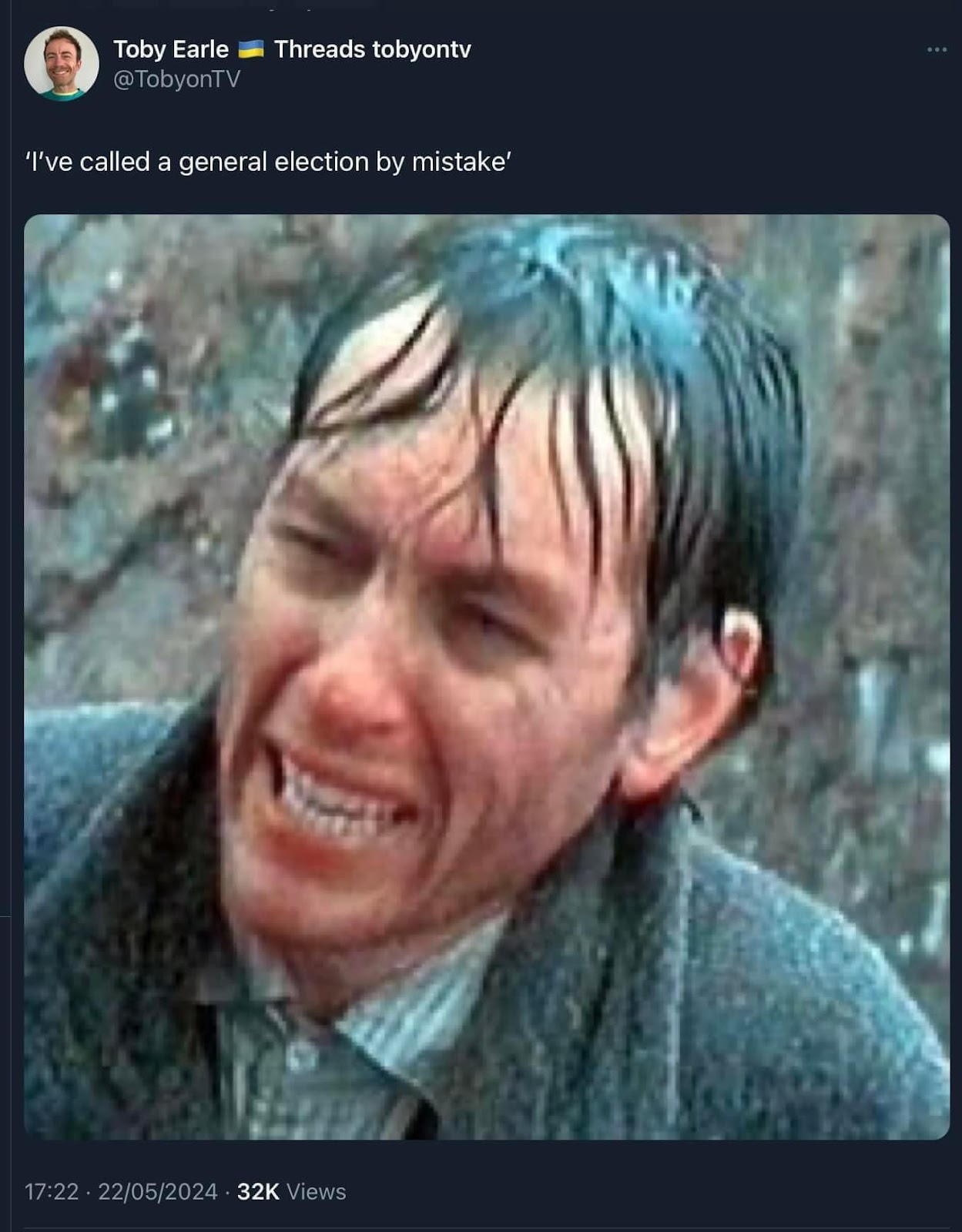
This one inspired by the cult British classic ‘Withnail & I’ caught my eye. 

In the film, a bedraggled Withnail, the unemployed actor flags down a passing farmer on tractor. “We’ve gone on holiday by mistake,” he says before begging for fuel and wood. He is the piteous city dweller out of his comfort zone and suffering from his lack of planning.

In the meme, it pokes fun at the Prime Minister’s rained on appearance.    

It’s fascinating to think that in 1979, it was ad execs who were capturing the mood visually. Now, its being done for free by a battalion of people armed with smartphones. 

Indeed, it’s not just people who are looking to tap into this instant and ephemeral way of communicating. They are not built to last. They are built to click. 

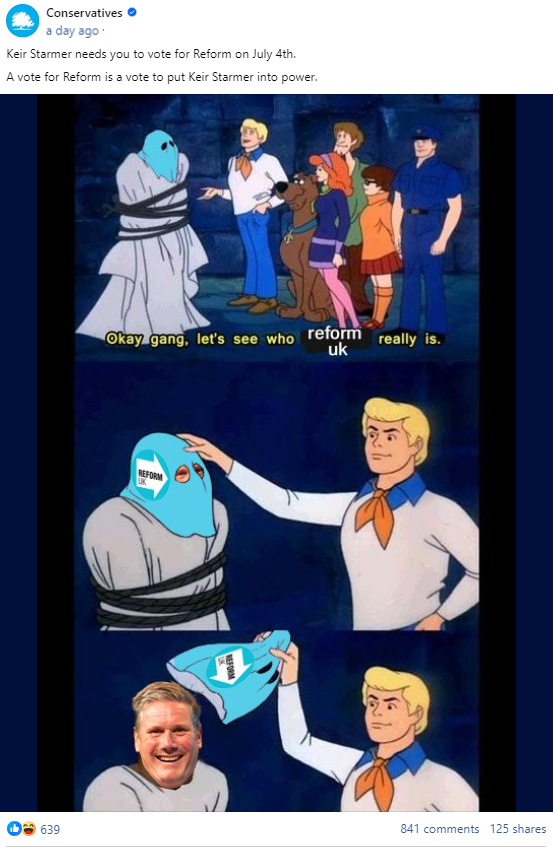
But, wait. The main parties are at it too. 

Here’s a piece of content from the Conservative Party that steals from the Scoobedoo meme where someone is unmasked as the real culprit. 

I’d say it saves on the bill for creatives. However, I’d expect that the sentiment captured in the meme will have been shaped by focus group feedback. Then the feedback will have gone through the creative process. The answer is different because we as media consumers consume differently. 

But stopping to think about it, this isn’t just a preserve of a political party. I’ve started to see this tactic used in other places online, too. TikTok is to blame. The platform is all about taking content and then remixing it. TikTok’s own editing tool Capcut allows you to do this easily by giving you a library of memes to work with. What may have taken hours now takes seconds.   

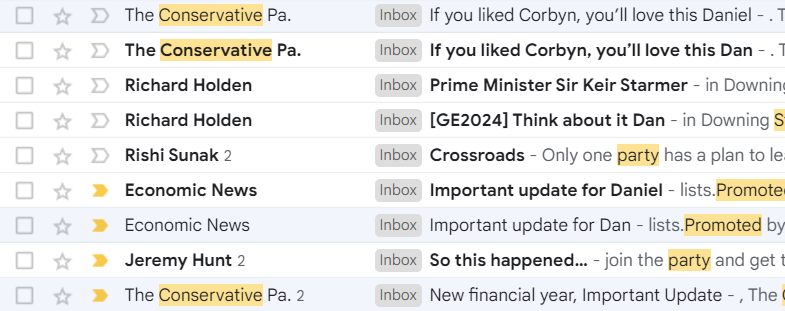
It’s about the email to supporters

Each political party uses a variety of channels. For supporters, the parties are using email to motivate the troops and encourage them to get their credit cards out.  

Every message has a call to action to donate. Which can be wearing.  

It’s about the screen grab

This is bad news for the Prime Minister but the launch image of the wet politician in Downing Street feels like it has the makings to be epoch-defining. The screen shot taken from the armchair is out running round the world before the rebuttal team have got their boots on. 

It’s not about  the party political broadcast 

Before the internet, the only way a political party could get a film in front of people was the party political broadcast. 

The main channels were obliged to carry a short film from the main parties. Like this on in 1997 by the Liberal Democrats featuring John Cleese.

They were, looking back,  almost universally loathed. The words from the channel announcer ‘there now follows a party political broadcast by…’ prompted mass channel switching. The themes of these films were more of interest to political correspondents than the average punter. 

Ofcom still regulates them under the Communications Act 2003 but I’m struggling to see the point. 

It’s absolutely about the social media ad 

The battleground for political messaging has never been stronger than with the political ad. 

However, Facebook’s ad library shows that this is not about one image to rule them all. This is about creating and posting multiple pieces if tailored content for different audiences. 

I run a report of the Conservative Party’s ad library. In less than two months they have created a staggering 2,887 ads across Facebook, Instagram and interestingly WhatsApp. Each one has a tailored audience and a tailored message. Some were aimed at 18 to 24 while others were marked 65+.

Meanwhile, the Labour Party have posted five times as many ads in the same period with 10,405. 

Annoyingly, there isn’t an easy way of seeing the level of spend as the data just gives upper and lower levels of ad spend. But a trawl through the data shows each ad is often supported by a few hundred pounds. 

The construction of such an effort requires science, money, research, ad creation skills and more money.

It’s possibly about AI

The smart money talks about elections being especially vulnerable to bad actors who may use tools to create fake content that can derail a campaign. Fake audio will be the biggest threat. But with the pace tools are developing it will be interesting to see how they may arrive.

Conclusion

Things are changing and continue to change. That’s just how it is. Communicators would be well served to be watching how the political parties use the platforms. What was once experimental can quickly become the norm.

But while our eyes are taken by the new approaches and new tools there remains an army of foot soldiers who are out delivering leaflets and knocking on doors. The actual landscape of streets, houses and flats is mapped and logged into supporters, don’t knows and absolutely nots. This off-line battle will be taking place alongside the online one.

EMOTIONAL STORY TELLING: Communications lessons from Jurgen Klopp

There are only two types of football manager, the famous line says, those who have been sacked and those who are about to be sacked.

Add to that is a rare third type of manager who calls time on himself.

In that gravity-defying list is Jurgen Klopp who has left Liverpool after nine years with a Premier League, Champions League and five other cups.

He is an astonishingly good communicator but what makes him so good? 

I thought I’d look at two set piece pieces of communication that bookend his time at Anfield. His first press conference and the Instagram post he made before leaving.

In football, there are three key audiences for a manager. The fans, the players and the board of directors. Perhaps uniquely, so much internal communications at a football club is done publicly. Tony Pulis was a master at this

The start: the first press conference

The new manager press conference is one of the traditions of football. An introduction to the new man at the wheel and a mix of easy and hard questions. Brian Clough used to talk about making all the hard decisions in the first three months because that’s when you are most powerful. 

Let’s look at what Jurgen Klopp said in his first press conference. 

“I’m not a genius. I don’t know more than the rest of the world. I need other people to get perfect information,” straight away he was calling from help from those inside the club. 

“It’s important that the player feels the difference from now on. They have to think they can reach the expectations. You have to change from doubter to believer,” he addressed the players.

“It is the biggest honour I can imagine. It is one of the biggest clubs in the world. It is a good moment to come here. How the people live football here. It is not a normal club it is a special club,” straight away identifying the fans.

“I’m a football romantic. I love all the stories and the histories. Anfield is one of the best places in the football world I thought about how it would be. We start to play emotional football. That’s important at Anfield, it has to work together,” he was sealing the deal with fans and those who love the club.

Merseyside is an emotional city. My Mum was from Liverpool, so I know this. It is also a city where community is at the heart. You work for each other not for yourself. Their club anthem ‘You’ll Never Walk Alone’ underlines this.

A Hillsborough disaster campaigner described their fight for justice as ‘they picked on the wrong city.’ It points to the emotion and working together to support in adversity as well as success.

“I’m the normal one. I was an average player, I was a trainer at a special club in Germany,” in perhaps his most famous line.

Football clubs are weird. Some managers fit and some don’t. I was a student on Tyneside when Kevin Keegan first became Newcastle United manager. His success was built on football knowledge plus the foundation of knowing how the fans thought. They were passionate and wanted a fighting spirit.

Barcelona’s slogan is ‘more than a club,’ because it represents Catalonia.

Same for Newcastle United and Tyneside. 

Keegan got this. Others haven’t.

The end: The Instagram post 

It’s telling that one of his last pieces of communication was an Instagram post on a freshly created @kloppo account. He wanted to create an account to stay in touch, he said, and gained more than a million subscribers in less than 24-hours.

He shot the video as a selfie alone in his office overlooking the training ground surrounded by boxes of things he was moving out. 

“So, here I am. Last day in the office. Last session done. It was kind of strange, I would say. A few coaches got emotional. I didn’t. I told myself ‘tomorrow is a game and then it is holiday.’ 

“Obviously, I decide what I think until I get overwhelmed tomorrow. So, I will leave this place today which is… an interesting experience I would say.”

There is a pause as he dwells on the emotion of leaving Liverpool.

“Aye, aye, aye, aye, aye… See you tomorrow.”  

The audience is primarily those who love Liverpool. He addresses those inside the club but makes it far wider. It’s the merging of the audiences here that’s most powerful. The fans and the players and the board are as one. 

He sets up the game ahead beautifully. He hints at bigger emotions and a bigger message but first there is a football match to play and a job to be done. 

Without him knowing it, Klopp has actually mimicked an earlier Liverpool manager in his pioneering use of communications channels. When he was starting out as a manager at Carlisle United in the 1950s Bill Shankly would use the tannoy to address the crowd to tell them what his plans were.  

For all Jurgen’s Klopp’s communications skills, it’s important to say that he also needed a football brain and an ability to communicate to his players and coaches what he wanted.

The announcement of his departure three months before the event was made by an emotional video.

His last days was a full on communications campaign from long form interview on the club’s YouTube and Facebook to a letter to fans in the Liverpool Echo a last press conference and of course programme notes.  

In his first press conference he spoke about the stories, the histories and the emotion of playing at Anfield and now it has come full circle and he is part of those legends.

If you can learn anything from Jurgen Klopp it’s the emotion and the story telling.

EMAIL ALERT: The ongoing wonder of Joe Biden Democratic Party subject lines

When I was a reporter I would spend two seconds working out whether that letter, email or fax was worth looking at. 

Yes, I know a fax. Well, I am very, very old as my daughter keeps reminding me. It’s not the only thing she’s right about. 

The two seconds I’d spend as a reporter would be looking to see if there was an answer to two questions:

Is this my patch?

Is this a story?

Now, the email inbox is the place where interesting stuff lands. If you are looking to send out email marketing then the subject line is the key to the door.

I’ve blogged about Democratic Party subject lines before. I’m returning to them because I find rhythm absolutely fascinating. 

In an election, channels can be a petri dish for communications. In 2008, Barack Obama’s campaign made a real difference by using email. Before this, political campaigns had email addresses that were never monitored that would send the same message from the candidate.

The joy of Obama’s 2008 campaign was that multiple emails were tailored to multiple types of supporters. 

Here’s a week in subject lines   

17.5.24 The Democrats / New Senate Polling

17.5.24 Team Joe / $1 before midnight.

16.5.24 Democrats.org / Less than six months out

16.5.24 Democrats.org / to flip the House blue?

16.5.24 Joe Biden / One thing my grandpop used to say 

15.5.24 Team Biden-Harris Alert / Show President Biden you have his back 

15.5.24 The Democrats / By the numbers…

15.5.24 Barack Obama / Sweetening the deal for you

15.5.24 DNC Headquarters / We cannot overemphasise how critical this is. 

14.5.24 Sam Cornale, Team DNC / An explanation

14.5.24 Joe Biden / I am inviting you to an event with some special guests

14.5.24 DNC HQ / You’re invited: May Supporter Briefing

14.5.24 Democrats.org / You (yes, you!) have a role to play this November 

13.5.24 Democratic HQ / A special day: 

13.5.24 Joe Biden / Because you’re a member of this team, we wanted you to to be the first to know about our new contest

12.5.24 DNC HQ / 23 states 

11.5.24 Team DNC / The good, the bad and the…  

11.5.24 The Democrats / Four quick sentences about the work we’re doing 

11.5.24 Team Joe / Any amount you can pitch in today 

What this can teach you

In seven days there’s 18 messages. Yes, you can contact supporters more than once ina  blue moon. However, to lessen the repetition, there are several senders.

They’re not always direectly asking for money. They’re showing that yes, you are part of this campaign too.

The routine admin is things like Democrats.org or Democratic HQ. The more personalised messages are from Joe Biden and Barack Obama.

The Joe Biden messages are especially interesting. They’re longer:

16.5.24 Joe Biden / One thing my grandpop used to say 

14.5.24 Joe Biden / I am inviting you to an event with some special guests

13.5.24 Joe Biden / Because you’re a member of this team, we wanted you to to be the first to know about our new contest

7.5.24 Joe Biden / Humbly asking, can you contribute $25 today?

3.5.24 Joe Biden / Me + Jill + Dan + ice cream

They’re not just longer but they’re the kind of messages you can imagine him hearing.

They’re human. You can sign-up for Democrat email alerts here.