When I was aged eight I secretly wrote off to Blue Peter for a kit to raise money for Cambodia.
What I really wanted to get my hands on was the sticker pack with hundreds of stickers with the programme’s cool ship logo.
But when it arrived, my Mum got to the package first. To my horror, I now realised I was committed to running my own fundraiser. Or rather, my parents were. I drew a leaflet, Dad photocopied it at work, me and Mum delivered it to the road I live in and we held a bring and buy sale in our garage. It raised about twenty quid but it got Biddy Baxter off my back.
I thought I’d start this post with an endearing childhood story because I’m going to talk about AI.
The problem
AI is scary isn’t it?. Myself, Bridget Aherne and Mandy Pearce and the CIPR Local Public Services group think we’ve found a way to make it less scary and we’d like you to come along.
There’s a reason that UK Government’s attitudes research has ‘scary’ as the biggest word in their feedback wordcloud.
There are some great minds writing about AI. There is absolutely a place for that whether they be in the UK or the US and long may they continue. But the trouble is, high-level debate when you are in the ‘scary’ club really doesn’t help.
The back story
When social media was new people from the Brum Bloggers group over a pint in a pub came up with the simple idea of putting volunteers who knew stuff in a room with community group members who wanted to learn. So, Social Media Surgeries were born.
Over the next few years, almost 2,000 community groups across 60 locations were helped. I’m proud to look back and say I was one of 400 volunteers who gave their time to share their knowledge.
Nick Booth was one of the driving forces behind the surgeries. He died 18-months ago and is much-missed. I often wonder what he’d make of the current landscape. His idea of putting people who know about things in a room with people who don’t chimed with us. It’s social and conversational.
When you talk to people who are dabbling with AI, they’ll often say they are scared, say they know very little but then they’ll run through this amazing use they’ve discovered. It may be summarising Facebook comments with Copilot to help shape future messaging. It may be using Eleven Labs to voice a training video using a member of staff’s Rochdale accent. It may be using Notebook to precis a whitepaper. Or something else.
All of these little use are gold. This is what you can bring along and swap.
The pilot AI Bring & Buy
The first AI Bring & Buy will be held at Devon Fire & Rescue thanks to the support of Paul Compton and his team. The name? That’s from Bridget. I think it beautifully captures the community feel and the need to make this subject less scary. Bring something and take something away with you.
Aside from the Social Media Surgery there is an element of unconference with it too. That’s where the audience can shape what they want to talk about it. Myself, Mandy, Bridget and Paul will each do a turn with slides to convince your boss to let you go. But I’ll bet its the bargain idea you left with that will make your day.
We’d love you to be one of the 25 people in the room to see if this idea works. You absolutely don’t have to be an expert. If you leave being slightly less scared then we’re all winning, aren’t we?
AI Bring & Buywill be held by CIPR Local Public Services group at Devon Fire & Rescue, Exeter on November 4 between 10am to 3pm.
It’s a funny thing about AI but when I first started to blog about it the numbers were small.
But as time has gone on those numbers have grown slightly.
Talking to comms people there is weariness, nervousness and hesitancy.
I’m blogging this to light up the path ahead and for public sector people to understand how and why it can be used.
What the numbers say
I’ve gone through the numbers on AI-related surveys and insights in 2026 to try and cherry-pick what UK people think.
From this a head of comms, comms manager or comms officer can get a taste of where the public they serve is.
In short, the public are:
Distrustful of AI and don’t trust the public sector.
Want more regulation and guardrails around AI.
Don’t mind individual AI uses.
Want to be told when its being used.
Don’t want to see it in content.
Seeing deepfakes increasingly in local politics.
What this means for the public sector
When other recent innovations emerged, I’m not sure there was this level of distrust and pushback. The internet was largely welcomed. Social media grew an unstoppable momentum. But AI causes people to be nervous.
To nail the elephant in the room, this data is not an argument for using AI on the quiet without telling people.
Every piece of public sector guidance around AI stresses the importance of transparency. So comms must be transparent about how it uses AI itself.
New fields are emerging, not least how to influence AI tools that are searching for information. The gov.uk website is not the only source people draw from.
What this means: The figures play 37 per cent for daily users being optimistic against eight per cent for those who have never used it. That’s still not a majority for those who use AI extensively. So, if people in the organisation are advocates need to know that not everyone agrees with them. This should be an ongoing dialogue over what is being delivered.
What this means: Almost every stat in this round-up is from 2026. Why? Because the world is evolving very quickly. I’ve made the exception for this number published in December 2025. Why? Because it is a clear line in the sand. Almost half the UK population don’t trust the public sector with AI. That’s your starting point.
What this means: If there is a strong distrust of AI companies then there is a distrust of AI. Public sector organisations need to build that trust. All the main public sector policies including UK Government, Welsh Government and Scottish Government stress openness when using AI.
What this means: The public want stronger controls in place over how AI is being used. While the direction for this is undoubtedly national there is absolutely a place for organisations to build trust by showing their own controls. We went to see those rules in place, please.
What this means: If there is a clear purpose for public good then the UK public will support it. Usefully, this shows that attitudes to AI very much depend on what it is being used for.
What this means: Again, people will be supportive of particular uses of AI rather than being blanket in favour. Just one in 10 were against this tactic.
What this means: Deepfakes have moved from national politics to local politics. Bearing in mind the lack of trust in deepfakes this can only have a negative impact on local politics furtrher eroding trust. Political parties and council standards boards need to consider how they regulate this area.
What this means: If a fifth of the population are using AI tools like Copilot, Claude or ChatGPT to understand the news then how to influence these search results are critically important.
What this means: If people are worried about AI content then the generation of AI content by public sector bodies in news is to be avoided. This would include images and video as two means of content that are easily ifdentified and untrusted. Words written with AI input would need to be checked and edited to ensure accuracy and that they meet house styles.
What this means: People want to be told if AI has created a story. This stands at 91 per cent with no human oversight. This falls to 80 per cent if it is AI-written and checked by a human. Strongly, people want to be told when a human has artificial help. Public sector organisations using AI tools to create words should seriously think about creating content.
What this means: If people don’t like seeing AI characters in ads they are unlikely to like it in communications content. This is a powerful stat to use internally to people who think knocking out a quick AI pic of people is the answer. It isn’t.
What this means: If 59 per cent of people have used such a tool then those who don’t have become a minority. This feels like a significant moment. If use is becoming widespread in the UK then the acceptance of generative AI tools – with guardrails – should follow.
For more, I deliver training to help you make sense of the changing landscape.
When we look at a view for five minutes we don’t always see change so it’ll always be there, surely?
But storms can erode the cliff facing the sea and the hundred-year-old house can topple into waves below.
When I first came across social media circa 2009, it was generous, kind and filled with the wisdom of wise people. Today, it can be much harder edged.
Those moments of generosity can still be found but for me they’re in Facebook groups, WhatsApp chats and LinkedIn.
Social media has changed by degrees.
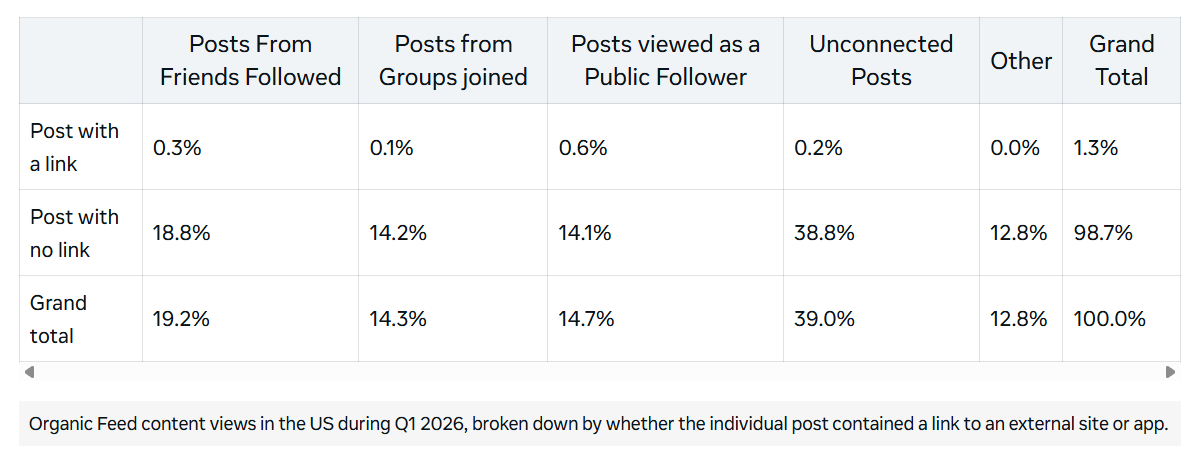
But every now and then the picture solidifies, just like it does in this FT graphic.
This captures data presented by Meta when they were trying to convince a court they weren’t a social media platform at all.
Oh, the audacity.
The data shows we are less likely to keep up with friends, share an opinion or meet new people. We are more likely to follow celebrities and fill spare time.
We may feel this but its rare for a company to quantify it.
It’s not just Meta lawyers saying it.
Danah Boyd is a rare thing. An academic whose work is useable. Her book ‘It’s Complicated’ has been on my bookshelf for years. Her research-based observations explains how young people use the social web.
Young people, she concluded, use the social web in the same way as my generation – Gen X – used the landline. If I wanted to speak to my mate David after school in 1985 I’d have to call him on the landline because there were no mobile phones. If my parents came into the hall while we were chatting, I’d change the conversation or take the phone into another room if the extension cable allowed.
In 2026, Danah Boyd in her academic paper ‘Social Media Is Now Parasocial Media’ has observed today’s changes and describes the new era as ‘para-social media’.
What does that mean?
The para-social relationship is a one-sided relationship where person ‘A’ thinks they know person ‘B’ intimately but person ‘B’ isn’t even aware they exist. A bit like my Aunt and George Harrison. She loved him and had his poster on the wall. But the quiet Beatle didn’t know she existed.
She said:
“Today’s social media platforms are no longer centered around sociable activities. Instead, most platforms offer us a broadcast medium and invite us to learn how to game the algorithm. Scrolling is easier. Sending funny videos to friends via text message feels safer than reposting.
“Because of these shifts, we now live in a world of parasocial media. Parasocial relationships are one-sided connections, where individuals keep tabs on the lives and movements of people – like celebrities – who do not know us and feel no pressure to reciprocate.”
What para-social media means for the public sector
I think Danah Boyd is right.
People want less conversation and connection and they do want to follow celebrities and entertainment.
But for the public sector, the twisted entertainment can be a pile-on to an organisation like the RNLI or a Councillor who has made a comment that others disagree with.
There is very little space for discussion in the comments section of a police Facebook page following an arrest.
The public sector has pulled back from this. Restricting comments is now the norm for high profile cases. Ten years ago this would be unthinkable. Today, it’s a way to stop a bonfire.
The shift to more video on social channels is also inherently para-social. We see the clip and we can react. But we are not expected to take part in a discussion.
But does this mean the public sector needs to pull away from digital channels?
No. It’s where people are. But the public sector does need to adjust how it delivers its communications. I could go through a pile of tactics. But strategically, if social media – or para-social media – is now about filling spare time, entertainment and celebrities what does that look like?
More entertaining content for one.
Content that will actually work on the platform not what a middle manager would like to happen.
Yet again, the communicator as educator for the organisation is uppermost.
And yet again, the data on what works and what doesn’t will be critical in winning this critical argument.
For more, I deliver training to help you make sense of the changing landscape.
‘Why don’t you blog about your training that often, Dan?’ I was asked by an imaginary person.
Alright then imaginary person, I will.
If you’ve seen what I share here about comms and PR in and around the public sector then you’ll love the training. I read the research and scour the web for insight so you don’t have to. Think of my LinkedIn posts as a 7″ flexi disc and this training an always updated Spotify playlist.
They’ll give you the resources and insight to operate in a changing landscape.
So, this is training coming up in 2026 and early 2027.
Aside from these dates, I can also come into your place of work and deliver for you and your team.
If you want to get polished at how to plan, shoot, edit and post effective video then ESSENTIAL VIDEO SKILLS REBOOTED is for you. Featuring insight on optimum lengths, channel-by-channel editing styles and algorithm-friendly posting advice.
#46 Online delivery 16.10.26 – SOLD OUT #47 EDINBURGH 15.10.26 – Final spaces #48 LONDON 22.10.26 – Limited spaces #49 BIRMINGHAM 6.11.26 – Limited spaces #50 Online delivery 20.11.26 – Limited spaces #51 Online delivery 28.1.27 – New date.
If you are after an all-rounder ESSENTIAL COMMS SKILLS BOOSTER is for you. This covers media landscape, comms planning and evaluation, creating content and algorithms. We’ll also look at the seismic issues around the Meta One subscriptions which will stop you adding links to all your content for free. I’ll also show you new channels, how to connect with Facebook groups, how to deal with comment, criticism and abuse as well as AI basics.
#73 Online delivery six sessions from 16.11.26 – Limited spaces #74 Online delivery six sessions from 2.2.27 – NEW
If you are after an understanding of how to use AI safely and effectively in the public sector ESSENTIAL AI FOR PUBLIC SECTOR COMMS is for you. Drawing up governance, using it safely, better prompts, ideas for using it as well as detecting AI content and dealing with misinformation and disinformation.
#15 Online delivery five sessions from 13.10.26 – Limited spaces #16 Online delivery five sessions from 2.2.27 – NEW
In part two here, I’ll go through potential workarounds. In part three I’ll go through how this will impact Instagram and WhatsApp.
So, are there workarounds?
Firstly, no you can’t add multiple pages to a Meta One subscription. You can add one Facebook page, one Instagram account and one WhatsApp.
Albert Einstein once said that behind every difficulty lies opportunity for he was an innovator and his meme game is legendary.
Facebook really hates links
The thing to remember in all this is that Facebook as a platform really dislikes links and always has done.
Why? Because it wants to keep you on the platform as long as possible. That way, you are more attractive to advertisers. This is the online equivalent of BBC1 only showing trailers to BBC shows. They won’t ever send you to Channel 4. Why would they?
Here’s the half-full bit.
Links are a bit of a red herring
Good news? Alright, good-ish.
You getting angry at Facebook for them taking multiple links away from you is a bit of a red herring.
Why?
Because they’ve been strangling the reach of your links for years.
At one stage, around 10 per cent of people’s timelines were links.
Side-note: if someone from the comms team has sent you this blog so you can see the data around the futility of links please listen to them. They know what they are talking about. It is 2026 not 2016.
So, actually, because so few people are seeing links publicly taking them away isn’t quite the cliff edge you may think it is. It’s just an overdue jolt to remind you to revisit your content strategy.
Rather than shovel links onto everything it’s far more effective to be selective.
If you have a social media management tool please pay attention at this point. I turned down a partnership with a provider so I could give you this advice.
What your primary Facebook strategy post-Meta One should be
Tell the story on the platform.
Turn that into a Soviet-era poster and pin it up by your workstation.
Like this one:
The things you want people to know? Tell them. Don’t expect them to click to a webpage, wait for the page to load and then read the 400 words and accompanying pdf. Life is too short and Meta’s link throttling ensures that really won’t happen. It’s no longer 2010.
The link in comments dilemma
In recent months, Facebook have been experimenting by limiting links posted into comments on pages. This has long been a popular workaround, but I suspect its days are numbered. Common sense would dictate that if a page is being charged to post links the page will also be limited posting links in comments. So, this may no longer be the blind-side workaround it once was.
Pointing people at a website with a link is no longer an everyday. It’s now a nice to have.
Video, a carousel or plain text are all options for you.
But if you really, really want links beyond your two free a month with Facebook’s free version here’s some ideas.
Telling the story on the platform: Video
This South Wales Police bodyworn camera footage and brief outline on Facebook would have been a link a few years ago. It works fine without. It tells the story on the platform. It doesn’t need a link.
Telling the story on the platform: Carousel
The carousel continues to be the top performing type of content on Facebook. I’ve read atheory that this is because giving a spread of pics is visually more interesting and also gives a degree of agency. Like the 4th pic? No problem. Comment on that.
This Staffordshire Fire & Rescue post is a great example.
Get your Facebook group game up to scratch
Two thirds of the UK population use Facebook and two thirds of them use Facebook groups. They are the most important channel for local government information for everyone aged 18 to 64 bar none.
Some groups are good and some are really poor. Engaging with the good ones will allow you to reach those communities directly. The best results are from navigating to pages directly and posting the relevant information rather than using tools that can speed-up the process.
Yes, I know you are busy. The question to ask is, is the time spent worth it? If the answer is yes, then share that important information directly. Yes, you can share a link into groups. Yes, it will hurt your reach but it can be done.
You can still post a link in Facebook group comments.
Chat to message tools
Here, you invite people to put in a keyword and they get messaged in Messenger.
Meta Business Suite has this functionality for free. It’s pretty straight forward to set up. Downsides are it won’t let you send a pdf or a link. However, there are some paid-for tools such as ReplyZen which costs around £30 a month and allows you to add links.
If you badly need links can you afford £30 a month?
Alternatively, if its an issue that people may not want to broadcast publicly such tools can be used on Messenger. So if they are interested in fostering sending a message on Messenger with the words FOSTER sends you more information.
This is potentially really useful.
Creating a Facebook page event and adding a link
Facebook page’s events functionality is a greatly overlooked feature.
You may have a ticketed event like a Pantomime in your theatre where you need to shift tickets. You may have a free event that you want people to know about like an Italian-themed Market in the High Street.
The route for this would be to create an event on your Facebook page.
If you are on a 14-day run for that Pantomime then you’d need to create an event for each day. The joy of this is that it allows you to add a ticket link every time you do. The events functionality is also quite sticky. So if someone says they are either ‘going’ or ‘interested’ they’ll be reminded and their friends can be informed.
The question here is whether the success of that play or market worth the time to spend three minutes on creating an event page for each day of the run. Knowing the importance of a money-spinning pantomime I’d say ‘yes’.
This running event is listed on Manchester City Council’s Facebook as an event with a link.
A call to action in text
You may have seen the British Army recruitment content on the side of buses or online. The call to action there is ‘Search Army Jobs.’
Searching that on Google in the UK brings you to a sponsored link about careers in the UK armed forces.
Of course, you need to get your keyword Google Ad game up to scratch. You’ll need to make sure either you appear as a top search term or you’ll need to pay Google some money.
The question to ask is is the link worth the Google Ads investment?
Lastly, maybe Facebook isn’t for you?
If you’ve looked through the list of options and you don’t really fancy them it could be that looking for a Facebook alternative is the best option.
Who that is depends entirely on who you want to reach.
For more, I deliver training to help you make sense of the changing landscape.
Each Meta One subscription allows you to add one Facebook page and I’ll go through the options further down the post.
The first important point is that Meta One is in limited testing and is slowly being rolled out. But page admins are starting to see this appear on their pages.
But first…
How did we get here?
Facebook for some years has dialed back on posts from pages with links. At first, they said this was in response to user feedback. What people wanted to see was updates from friends and family, they told us. Now they can see a profit in restricting links they’ve stopped saying that so much.
But behind this, Facebook have a point.
People don’t want to click to a poorly-written webpage. They want the information on the platform. So, tell the story on the platform has been a good maxim to follow.
Each level buys you something extra. Prices are UK in September 2026.
Meta One Essential £12.49 a month (£149.88 a year)
This gets you the following
“A verified badge.”
“Protection from impersonators.”
“Add links to your profile.”
What this means for public sector people. There’s maybe some merit in having a verified badge and the automated protection from impersonators. It’s a shame something that used to be a civic obligation now has a cost attached. Being able to add a link to your profile in this tier is interesting. The implication is that without paying you can’t link to your website which has been the default setting on every page since pages were introduced.
There is some suggestion that this price bracket buys you two extra links a month but this is unclear.
Meta One Advanced £41.99 a month (£503.88 a year)
This gets you the following:
“A verified badge.”
“Impersonation protection.”
“Your posts can get shown to people beyond your followers.”
“Add eight links to posts and eight extra links for Reels.”
“Appear higher in search results.”
“Enhanced profile. Add three locations and three other profiles on Facebook.”
“Bold Follow button on your Reels.”
“One support case per month with a real person.”
“Advanced content scheduling and reach your audience when they’re most active.”
“Follow invitations. Turn interactions into lasting connections by automatically sending follow invitations to people who engage with your content.”
What this means for public sector people. You get the Meta One Essential perks but you also get eight links in posts and another eight in Reels. So, this has a knock-on effect on your video creation game. If you do pay for this tier you’ll need to use your links wisely.
The ability to invite people to like your page is handy. So, if someone has liked or commented they’ll get an automatic invite. This can be handy if they are residents in a council area, for example.
What’s interesting in this tier is the ability to show content beyond your followers. The implication is that you won’t be able to unless you pay. This is a huge change. Until now the architecture of social media is to blow-up and make viral a popular post travel far and wide. This appears to end that for low or no Meta One accounts.
In addition, unless you pay you won’t figure as high in Facebook’s notoriously rubbish search engine? Interesting. For most public sector organisations this is less of a concern. They may well have established pages and brands.
The advanced content scheduling option is interesting. If you blow £6k a year on a social media monitoring tool then this starts to become a debate that this route is a saving. Also interesting is that you can actually talk to a real human being once a month.
Meta One Expert £129 a month (£1,548 a year)
This gets you the following
“A verified badge.”
“Add 20 links to posts and 20 links to Reels.”
“Dedicated support five times a month.”
“Impersonation protection.”
“Featured in feed. Have the opportunity to be featured in feed and introduce your brand to new audiences.”
“Appear higher in search results.”
“Bold Follow button on your Reels.”
“Follow invitations. Turn interactions into lasting connections by automatically sending follow invitations to people who engage with your content.”
“Enhanced linksheet. Make it easier for people to find your website, social channels and other key destinations right from your your profile.”
“Advanced content scheduling and reach your audience when they’re most active.”
“Five support cases per month with a real person.”
“Custom chat themes.”
What this means for the public sector. All the previous benefits plus 20 links in posts plus 20 links in Reels. Plus five calls for support. I’m not sure if the step from the lower ‘Advanced’ option is worth all that.
Meta One Expert £419 a month (£5,028 a year)
“A verified badge.”
“Add links to posts and links to Reels.”
“Unlimited dedicated support.”
“Impersonation protection.”
“Featured in feed. Have the opportunity to be featured in feed and introduce your brand to new audiences.”
“Appear higher in search results.”
“Enhanced linksheet. Make it easier for people to find your website, social channels and other key destinations right from your your profile.”
“Enhanced profile. Eight addresses and eight other profiles on Facebook.”
“Bold Follow button on your Reels.”
“Follow invitations. Turn interactions into lasting connections by automatically sending follow invitations to people who engage with your content.”
“Unlimited links in Reels.”
“Unlimited links in posts.”
“Unlimited cases with support specialists.”
“Advanced content scheduling.”
“Custom chat themes.”
What this means for the public sector. All the benefits from lower price points but the ability to post as many links as you like in posts and Reels. It feels as though five grand a year is pretty expensive unless you are Coca Cola.
Links in comment may not be the answer
By the way, if you are thinking the links in comments workaround is the way round this, you may need to think again.
I’ll blog a follow-up of potential workarounds in part two.
Conclusion
If something is free then has a charge people are going to be angry.
Regardless of whether you take out a Meta One subscription or not this is going to have to lead to a fundamental re-appraisal of how content is created. This is not a bad thing. For far too long some comms people have just synched with a social media management tool and pumped out links. The amount of Facebook timeline taken up by posts from a page with a link is now a witheringly small 0.6 per cent.
Is it worth it?
That’s the $64,000 dollar question.
It all depends on how important Facebook is for your communications strategy.
Many comms teams have a social media management subscription and it looks like Meta have their eyes on that particular lawn. If you want unlimited links that’s £5k a year. But I really don’t think that links are the way forward.
But I can see an argument for Meta One Essential or even Advanced.
I’ll follow-up with a part two on work-arounds if you don’t have the funds to pay and I’ll write a third part on Meta One on Instagram and WhatsApp.
For more, I deliver training to help you make sense of the changing landscape.
A significant judgement on how AI is used in and around local government has been quietly published.
The case centres around a deepfake of a Scottish Labour Councillor falsely quoted making hate speech against refugees.
Meta’s oversight board, which is independent of the company, have examined the case and ruled:
“The Board found Meta needs to do much more to effectively address such content, including by increasing penalties for sharing harmful deepfakes, to protect users from potential deception.”
If Meta do up their game this could have a bearing on what AI-generated content is posted onto Facebook about politicians be they a senior politician or a lowly Councillor.
Included in the list of recommendations are to demonetise such content, limit reach and to add a ‘high risk AI tag’ to the content.
However, the 10-months it took the case to reach judgement shows the flaw in Meta’s existing processes. Action will need to be made far faster for future action to have a practical impact.
According to the judgement, the elected member took part in an anti-far right rally and their likeness was photographed or recorded. From this, a deepfake was created with her saying: “Refugees are welcome here, even if they rape our women, because white people do that too.”
The oversight board report adds:
“The portrayal is realistic, though on closer inspection appears synthetic: the audio is not fully synchronized to her facial movements, indicating that it is a fabrication. The video was part of an album containing a photograph of several named women at an anti-far-right protest, including the councillor. The album and video together received more than 5,000 views, over 50 comments, over 20 reactions and more than 10 shares.”
However, when the elected member and one other complained to Facebook through online tools the offending video was retained. The complaint was then escalated to the Oversight board but Meta still refused to act claiming the video did not violate community standards or even need an AI tag.
The Oversight board did not think it should be removed for misinformation, perhaps surprisingly, but it did need labelling ‘High risk AI.’
What this means for public sector comms
Firstly, that Meta’s Oversight Board have ruled against deepfake video could strengthen a council’s own internal policies for regulating members’ standards.
Thirdly, extra steps in this field may start to bring a small measure of extra protection against misinformation.
Fourthly, this should also drive deepfakes away from the pages of elected members, candidates and political parties. There have been isolated cases of elected members and MPs posting deepfakes of political rivals on social media.
For more, I deliver training to help you make sense of the changing landscape.
As a study for how to deal with a reputational crisis the RNLI’s handling of several days of far-right protest is fascinating.
More than 100 masked protestors surrounded the organisation’s Poole HQ after a RNLI boat rescued 120 refugees from the English Channel.
Staff were abused online and in person with calls to cut the lifeline of donations made online.
But first some background.
What the RNLI is
The Royal National Lifeboat Institute – RNLI – is a charity founded in 1824 with a core mission of saving lives at sea regardless of nationality or belief.
In 2025, they launched more than 9,000 times helping 44,000 people and saving almost 400 lives. They operate a network of more than 400 ships around Britain and Ireland. They are a charity independent of Government tasked to respond to incidents by Her Majesty’s Coastguard.
Timeline
Since 2016, there have been more call-outs in the English Channel to small boats connected to asylum seekers travelling to the UK.
Online, RNLI volunteers are identified and abused, a campaign to encourage people to stop donating to the RNLI is launched. Individuals are ‘doxxed’. This is an aggressive campaign technique where names and addresses can be posted online for people to bombard them with hostile messages. The approach has been used in the past by a range of different extremists.
Elsewhere, on X there is a slew of hostile content including this AI image show a fighter jet sink an RNLI boat with the text ‘Make Britain Safe Again.’
No doubt, there is detailed approach the RNLI put together and it will be fascinating understanding the big picture when this emerges.
There are some things that are clear from their digital footprint.
STRATEGY
Have a mission and stick to it
Looking at the communications, there is always strategy and tactics. The RNLI has a clear mission. It looks to save lives at sea. In this episode of criticism, the organisation has kept this lighthouse beam of clarity uppermost in their decsion making and communications.
This strategy wasn’t made up on the fly. It’s been the same one since the 1820s. It’s possible that an organisation with less grasp of their mission and weaker leadership would have taken a different course. Could they as an organisation maybe refuse to rescue certain people and not others? It’s difficult to see how this could possibly fly legally or ethically.
They didn’t attemp to fight every grass fire
What is striking is that the RNLI comms team didn’t go to every online post they could find to challenge every debate, conversation and piece of misinformation. This makes sense. Conventional wisdom is that if you respond to a post online you amplify that post. People will not scroll through the back and forth for a considered view. They will just read the amplified first post.
Incidentally, here’s an example of the kind of content:
TACTICS
They kept message discipline and waited
Strikingly, they did not appear to be pushed into commenting online straight away as the protests were playing out. None of the channels I could see responded with a formal or informal statement although I’m sure the RNLI press office would have been talking to journalists.
None of the corporate channels did so and also most importantly none of the 238 stations around the UK and Ireland. This is likely to be due to a mix of good governance and good training.
They wrote a post a considered and weighted statement on their own channels
The RNLI’s own assets are considerable. They have 295,000 followers in Instagram, 703,000 on their corporate Facebook, 71,000 on LinkedIn and 269,000 on LinkedIn. Overall,. That’s more than 1.3 million. Impressive, but dwarfed by some politicians and news influencers.
They also have 195,000 followers on X. Interestingly, they have not posted since summer 2025 and didn’t do so in this episode. They have quietly withdrawn from the platform as have other organisations.
The RNLI statement’s headlines is underlying the core message: ‘The RNLI is a charity that exists to save lives at sea.’
On an occasion where you need to weigh-up every word and nuance, a piece of text works well. You can polish and get things right. You would be less able to get across the points you want through video or a round of media interviews.
The statement sidesteps the politics of the situation. It returns to the core reason the RNLI exists. That’s to save lives.
Note that the statement doesn’t enter into the arena of politics. There is no commentary of Government policy or direct criticism by name of a politician or campaigner. This keeps distance between the charity and politics.
Human stories further underline the RNLI core message
Once the dust settled, lifeboat station posts underlined the RNLI’s core message with lived experience.
For example:
And:
At RNLI Hoylake, they addressed more directly an outpouring of support with people wanting to contribute to the upkeep of the boats. Again, they avoided politics.
What these posts show is the day-to-day activity in saving lives.
GOVERNANCE AND PLANNING
The strength of having a network of station accounts
Around the coast of the UK and Ireland there are almost 250 lifeboat stations. From what I can gather, it is not mandatory to have a social media presence. Some are maintained centrally but the larger and more active stations do have locally-run social media accounts.
This local approach can build a strong connection with the local area they operate from.
For example, RNLI Eastbourne:
In the past, I’ve often used RNLI station accounts as part of an argument for fire and rescue services to run well-trained and maintained station accounts.
Measures against hate comments
Interestingly, several of the RNLI station accounts limited commenting to those who have followed the page to 24-hours or more.
This is a really useful technique that allows regular followers of the page to comment but limits those trying to spread hate.
Having a set of house rules means the RNLI are prepared
Like other large organisations, the RNLI has a set out house rules which they call ‘contribution rules.’ This governs behaviour. If it can be summarised in two words it is this: ‘Be civil.’
I’m quite sure the corporate page admins took extensive action against some of the more hateful comments.
Nobody has been directly attacked and key to the RNLI’s mission nobody has been lost at sea.
The RNLI have navigated through a treacherous spell of weather intact through good leadership and good communications. But all this gives the impression of being built on good training and good governance. As ever, build it in peacetime calmly not when cars are on fire.
For more, I deliver training to help you make sense of the changing landscape.
The good thing about summer is that it gives me a chance to catch-up.
I’ve spent a lot of time updating data, reports and upgrading the training decks.
One of these areas I thought I’d share with you is optimum lengths for short-form video.
On the face of it, here’s not really been much change over the last.
But digging into it, yes there has.
For optimum video lengths, keep it short and simple.
So much is in and around the 30-second mark. That’s the case with Reels on Instagram and Facebook as well as X and LinkedIn.
LinkedIn sometimes surprises people. Only 30-seconds? But remember, you are chasing busy professional people who are time poor.
How these figures can be helpful
The job of a comms person is to educate the client in a rapidly changing landscape. Having these stats should help you bat away a request for an eight-minute clip of a middle manager talking about an arcane project only he or she cares about.
Like the Schleswig Holstein question, only three people ever understood it and one of those became insane.
Why optimum lengths don’t matter so much
When digging into the research it’s clear that the algorithm isn’t chasing a pre-appointed length and pushing those.
There is no magic length number.
What matters most of all is retention. How many people stick around?
So, make a longer film if you need to but you need to deliver something of value.
A three-minute TikTok that retains 50 percent of people is classed as ‘good’.
Retention rates for short-form video
The idea of retention being important means there’s no a post-posting phase for the video. You posted it. But how is the clip performing?
Go back into the data and see where people switched off. What was it? A person? A lack of cutaway? The subject?
Bring that forward for the next film you make.
There’s upcoming dates in Birmingham, London and Edinburgh as well as online. I can also come to you to deliver training to you and your team.
It’s clear that Andy Burnham’s use of TikTok has blown open the door for many public sector organisations.
Engaging, topical sometimes talked about policy and sometimes didn’t the approach was a key part of the Prime Minister’s honeymoon period.
Other politicians are available, but if 10 Downing Street is using it, what excuse do the rest of the public sector have?
Quick note: TikTok has never been banned in the UK. UK Government advice which devolved governments also share is not to have TokTok on a device which has your work email. The workaround to this? Edit and post your TikToks from a burner phone.
If you’re worried you’ve missed the boat, are too old or don’t have the aura (ask your children) then I’ve gone through the TikTok advice and read the data so you don’t have to.
Before you get started with TikTok
Spend a month with the app. Seriously, spend some time getting to know and understand it. The algorithm is based on your what you are interested in not your friends. So, if you like midweek recipes then by doing things like watching all the way through, liking and forwarding to a mate you’re telling the algorithm that you’ve enjoyed that. So, the algorithm will send you more.
Realise that TikTok is not marketing, public relations or even traditional social media. It needs a different approach. As TikTok say themselves:
“TikTok is not a social media platform. It’s an entertainment platform. People aren’t scrolling to be sold to. People come to laugh, learn and then switch off.”
Now, we can argue the legal definitions. But the broad point is not to think sell, sell, sell. There’s time for that. So, an account that is all wall-to-wall call to action will hit a low ceiling.
The account that has some non-selling content works better.
Your first second is critical. You need to get people’s attention and watching. You’ll notice this the more time you spend. This is critically important.
Get started as a public sector TikTok account
Make sure you have a business account. Here’s a short TikTok on how to do that with your existing account. You’ll be limited to what TikTok’s assets you can use when you edit within the app using this route. That’s things like music. You’ll have less choice but this means you won’t have a tap on the shoulder from a music publisher demanding money after that viral campaign used their track.
Make your bio relevant. If you are a museum in the Black Country then tell people and give an address and a postcode. Make it relevant.
You and your chief executive aren’t the audience. If you are going down a TikTok path you may be doing so to reach a younger audience. Your chief executive may neither like or understand the content. They are not the audience. If you only communicated on the channels he or she liked it may be the BBC, Local Government Chronicle and The Angling Times. That is not a media landscape. That’s a chief exec’s niche.
Be ready to experiment. TikTok is a platform that’s evolving and changing. Having business account opens up some extra analytics.
TikTok hates polish. Rough edges are fine.
Planning your TikTok
Shoot vertical. TikTok is a vertical app.
Ask yourself the question: ‘What does the viewer get out of this?’ What’s in it for them? Are you telling people where to go in your area at half-term for low or no cost? Are you telling families how to prepare for flu-season? Or what fire safety advice a fresher needs to know going away to University for the first time?
Think about what they NOT the organisation wants.
The audience wants to see themselves reflected. The keen walker wants to see a keen walker talking about why the Yorkshire Dales are great in the Yorkshire Dales themselves. They want that connection with the person.
Come up with a shot list. You need the fresher outside their student house, the smoke alarm and the points you want to cover.
Script or not script. TikTok says people like authentic videos, authentic people and realism. That doesn’t always lend itself to scripts. But for the public sector, there’s some great scripted local government examples. Why does this work? It keeps the cabinet member on track. You don’t get 30 seconds of what happened at scrutiny committee which is of interest to literally six people.
While we’re at it, don’t waste your time on names at the start of your TikTok.
“Hello, I’m Cllr Dan Slee, cabinet member for regeneration services….” is death. Put their title on the screen not in their mouths. The first second is critical, remember?
Hooks, hooks, hooks, hooks. Hooks are the text at the start that clip that you hope reel in people’s attention. As an ex-journo, I think of them as the placard outside the newsagent shop to lure people in to buy the paper. TikTok’s advice is:
Problem + curiosity = a good hook.
So,
Need half-term activities in Dudley? Here’s some you may not know.
The problem is half term is coming and parents are wondering how to keep their children entertained. The curiosity is places you may not know.
Evergreen adds life. Some content needs to be topical. Others can be evergreen and can be resurfaced by the algorithm at a future date.
If you have a campaign make multiple videos. One TikTok won’t rule them all. But several will drop in front of people and remind them.
Don’t overload. If there are five brilliant things about the national park, maybe make five short TikToks rather than overloaded one.
If there is a call to action, make it clear. Tell them to click the link for the download of family-friendly walks.
TikTok Creator Insights. This is a webpage that shows you whats popular on TikTok that you can use for inspiration or ideas. That trend could sometimes be adapted for the museum.
Editing your TikTok outside the TikTok app
Edit outside and finish off on TikTok. Personally, I’m a fan of editing outside the app and then finishing off using the app itself. Why? TikTok’s editing app Capcut is really good in many ways but it won’t let you add cutaways. For me, that’s a stumbling block. Cutaways are the supporting clips that add colour. So, if the interviewee is talking about how beautiful the daffodils are in the park in Springtime you can add some footage or an image of those blooms.
Besides, you may want a short form video on Reels or LinkedIn, too. If you edit outside the app you can use that edit across several platforms.
Keep the top 20 per cent and bottom third of the screen free. The platform will add a caption in those areas. So, be careful.
Then finish off on the TikTok app
If you first edit outside the app, upload it and finish off in TikTok. If you’ve a business account you’ll be limited to audio cleared for business use that you can add a this stage. This is good for the reasons already covered.
Job title as a title on screen. I’ve mentioned this before but it needs repeating. People don’t want to waste time on their title.
Date stamp on the app. The BBC do this and I’m quite a fan. Put the date in a corner of the video. This is particularly useful on a fast-moving crisis. So, the fire that has closed off the motorway? Put the date on. It may not drop into people’s timelines for a week. Build in obsolescence in those circumstances.
Work out your key words. If you are launching a first aid course for new parents in Aberdeen include this in the words the speaker says and subtitle using TikTok’s app. This way the script becomes metadata. Metadata is the clues search engine look for. On a webpage, this is the page title, sub-headers, the text itself as well as pictures or video. TikTok’s metadata is the speech it can subtitle, the title, hashtags and the caption.
Add a geotag in the editor on the app. If you are in Powys, add a Powys location. This means you’ll reach more people interested in Powys.
Don’t go overboard on the hashtags. Too many confuses people and it’s the reason why people don’t break past 200 views. Oh, and the #fyp – for you page – hashtag is buried below eight billion clips. TikTok’s advice is go niche.
Don’t use the word ’viral’ TikTok say. Everything is viral.
Posting your public sector TikTok
There isnt a single best time to post. This isn’t me saying this, this is TikTok.
Your TikTok will be shown to 200 people. If it works with them it’ll go to more people. This is why the key words are so important. The more clear you are the more chance of reaching the right people.
How do you know if your TikTok has worked?
As a metric, retention, retention, retention. TikTok really stress the importance of retention over all other metrics as the thing to strive for. Retention for them beats everything. So, a 45-second clip watched by 50 per cent all the way through is more valuable to the algorithm than a 180-second clip watched all the way through by one per cent. This is the metric to look at.
Your engagement graph. Each clip will show how many people watched and when they drifted away. A 30-second clip watched by 50 per cent is good. Don’t skip this. Go back and see what worked.
Did they do what you wanted? Did people go to the park at half term? Or sign-up for the special event at the gallery?
Don’t be frightened to experiment. Every time you post you’ll learn something.
Post-posting
Once you’ve posted, go and engage. Keep an eye on comments and reply to them where you can. TikTok likes the idea of a community and you talking to them. Comments can also be a jumping off point for your next content and TikTok really likes that. If you are just talking about yourself that’s not so good. Talk about your community, too.
That’s a snapshot.
There’s more at the training I offer.
There’s upcoming dates in Birmingham, London and Edinburgh as well as online. I can also come to you to deliver training to you and your team.