LONG READ: What you can learn from Andy Burnham’s early social media content strategy

There’s been a slew of posts about new Prime Minister Andy Burnham’s use of social media as a communications channel.

There’s been some interesting reads. He’s recruiting a dozen more social media posts for the 10 Downing Street operation. He may or may not be the UK’s first social media Prime Minister.

Let’s been honest, two weeks in and he’s on his honeymoon period.  

But there’s enough there to intrigue me into making me spend some time evaluating his content. 

I’m anticipating the training request ‘we’ve been asked to make our senior people look as good as Andy Burnham.’

How politicians used to communicate

Growing up, the set-piece TV interview was the way politicians would communicate their thoughts and policy detail. Journalist Rob Burley’s excellent ‘Why Is This Lying Bastard Lying To Me’ traces the rise and fall of the 40-minute Sunday morning political interview.

The trouble is nobody outside Westminster wants to watch.

So, with more than 80 per cent of the UK population having a social media account it makes sense to be good these channels as well as media relations, strategy, policy, public speaking and all the other things a successful Prime Minister needs. For a Labour politician facing a hostile media it also makes sense. 

Were I still in regional media, I’d be asking why local news journalists don’t get to interview the Prime Minister so much when he visits town. And yes, other politicians are available.

So a post of three parts. First some data then some learning points and then some content.
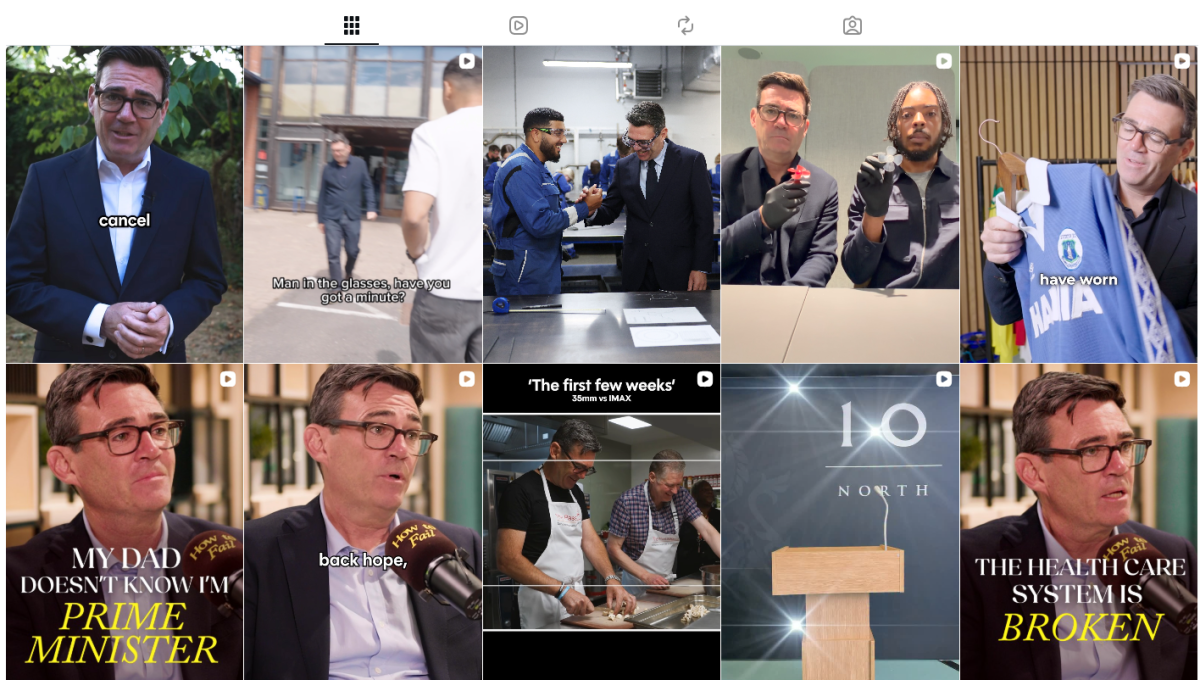
PART 1: Some data on Andy Burnham’s social media content

So, how are the numbers? I’ve taken a look at Andy Burnham’s own Instagram, TikTok and Facebook. I’ve not looked at the 10 Downing Street accounts.

At first, I looked at Instagram mapped content there. But exploring TikTok and Facebook it was clear there was content unique to those platforms. How come I haven’t looked at X? Hours in the day, mainly. X is still important to politicians and journalists but less so for the wider public. A quick glance over there shows much less engagement but strong reach. So, around 13,000 engagements on X for the two week and here’s what we’ve achieved listicle. That’s about half of the performance of the same content on Instagram.

I looked at engagements per post as a metric. Why? Because likes, comments and shares are a marker of people literally engaging of what is being said. They haven’t simply scrolled past. When people engage it also sends a signal to the algorithm to show it to more people. Not only that but they are more likely to be shown future content.

Instagram is his largest channel with 660,000 followers outranking Facebook (610,000) and TikTok (465,000). But follower numbers are less important. All of the platforms are showing you content from people you don’t follow if it performs well or you’ve shown an interest in related content.

I’ve also calculated the percentage reach for each of the channels. So, in other words, if you have an account with 100,000 followers reaching 5,000 would be five per cent. It’s a marker of how effective the content is. 

For Instagram this is 3.2 per cent. This is narrowly behind Hootsuite’s benchmark for Government of 3.5 per cent. For Facebook, Andy Burnham’s numbers are 4.1 per cent which is higher than the 1.5 per cent Hootsuite metric.

But its TikTok with a 16.6 per cent engagement rate that’s the real winner. That’s more than ten times the social platform’s suggested 1.5 per cent benchmark. That would be of interest no doubt to political pollsters.

The overall raw numbers pan out in a very similar shape for overall engagement numbers. On average, the 77,000 engagements for TikTok outrank the 25,000 engagements on Facebook and 21,000 on Instagram.

Part 2: What you can learn from Andy Burnham’s social media strategy

Collaborations, collaborations, collaborations. His team love to set him up with a collab. That’s working with an interviewee for a chat with content often being shared. Of the 25 posts, seven are collaborations. This works here to show a very human side. 4

He sits down with Elizabeth Day from the ‘How to Fail’ podcast which elicits an emotional moment where Andy Burnham reveals how his Dad’s Alzheimer’s disease is so advanced he doesn’t realise his son has been made Prime Minister. Imagine your crowning glory being taken away from you, you are invited to wonder. It’s a touching moment that probably wouldn’t work with a political interviewer. It reaches 100,000 engagements on Burnham’s Instagram but isn’t posted to TikTok or Facebook by his team. 

Instead, the ‘How to Fail’ channel is where you can find it on TikTok and Instagram along with eight other clips and a 54-minute podcast on Spotify and other providers. That’s the nature of collaborations.

He also meets @classicfootyshirts to talk about his love of Everton FC as well as the more heavyweight former diplomat Alexander Dragonetti. There’s also street voxpopper @robcolfer which allows him to talk about Sheffield music and science influencer Big Manny which has more than 100,000 engagements across Instagram and TikTok.

The basic sums of this is that he can break out of his own channel and reach other audiences who probably aren’t following much hardcore politics. It’s a smart move as part of a wider strategy. Critics may say this is not rigorous feet to the fire scrutiny.

Working with influencers will probably work in a honeymoon period. In times of crisis I’d expect this will probably be left in the toolbox.

Influencers. Yes, the public sector can work with influencers. But a bit of prep is needed to make sure you are not sitting down with a dark past or shady opinions.

It’s not posted across all channels. This is such an important lesson from this exercise. Content is posted to the platform where it’ll work best. So, stop the boats is reserved for Facebook. Posts about training for young people go to TikTok. That makes sense. Be aware of the channel.

Bespoke content. Sometimes there was Instagram-only, TikTok-only and Facebook-only content. I was surprised to see Andy Burnham’s admins experiment with text-only posts on Facebook which are also quite long form. Several hundred words on a topic is perhaps surprising. 

Softer content gets the audience for the drier policy stuff.. This is not the best performing content but posts which set out what the PM  has done that week. They feel like the meat and potatoes. They want you to know this. My guess is that softer content reels people in to create a bigger crowd for the more serious messages.

Video, video, video. There’s so much video. To someone who has been banging on about the importance of video this gladdens my heart. But it is not a cure all. There are times when it’ll work and times when it won’t. 

Not so much traditional politician content. The collabs by definition break outside of the politician at the Despatch Box or lectern. In fact, it’s notable how little traditional PMQs sound bite or lectern content there is. Why would he? He’s about doing things differently.

To camera and in conversation. Burnham sometimes delivers a piece to camera and sometimes is captured chatting to an interviewee. That feels deliberate. Mixing it up freshens it up and will deliver different results. The piece to camera can be the points he wants you to know. Counter intuitively, the conversations with interviewers reveal the most personal and intimate content. Revealing the point about his Dad’s dementia may feel a little too manipulative if it was in a speech. 

Hope. One of his early positions is the aim to restore a sense of hope. Indeed, there’s a video which captures this. So much of the internet can be powered by rage and there’s an absence of angry finger pointing here. In this snapshot of content he doesn’t mention his political enemies by name. They’re not even in the screen. His team would probably argue that the content reflects the hope message.

Speaking off the cuff. As an experienced politician he makes a lot of what he says look effortless. He has an ability to communicate without notes. This is rare. Warning: most politicians trying to emulate this will struggle. He has a well thought-out message and he delivers it in conversation rather than set piece soundbite from an autocue. There is no Tony Blair-style jarring of ‘This is no time for soundbites… but I feel the hand of history on my shoulder.’

All this will make it difficult for other politicians to replicate. The bright comms team will anticipate this. The more tightly scripted and tightly edited Oxford City Council approach feels a better route for the less experienced performer. 

Part three: the content itself

Dive in, have a look. It’ll change with time and events no doubt

VIDEO: A collaboration with @robcollfer (227k Instagram followers) who carries out voxpop interviews in the street. He stops ‘Man in glasses’ and asks Q: what is your favourite thing about Sheffield?  Answer: The Crucible for the snooker, Human League and Arctic Monkeys. Q: And least favourite? The transport links. A cunning way to talk about the poor transport links across the Pennines.

Likely to appeal to: Sheffield people, music and snooker fans and northerners fed-up with poor transport links.

Hook: “Man in the glasses, have you got a minute?”

Instagram engagements 10,200. 

TikTok engagements: not posted

Facebook engagements: not posted

Video length 1’25”.

PIC: A listicle of the week’s achievements with a shot of the PM meeting a factory worker. ‘My Government is getting things done’.

Likely to appeal to: Core audience of the page.

Hook: “My government is getting things done – here’s just some of the changes we’ve made this week.”

Instagram engagements 6,600.

TikTok engagements: not posted

Facebook engagements: not posted

VIDEO: A collaboration with @big.manny1 (1.5 million followers) an Afro-Caribbean man who makes science relatable to young people. In the clip, Manny narrates making a circuit breaker in the same way that the PM is making a circuit breaker by creating the Number 10 of the North in Manchester to make decisions outside London.

Likely to appeal to: Young people.

Hook: @andy.burnham is introducing a circuit breaker into UK politics with the new No. 10 North.

Instagram engagements: 51,500.

TikTok engagements: 68,800

Facebook engagements: not posted

Video length: 45 seconds.

TEXT: We’re changing the rules… are you creating British jobs?. This is text and Facebook-only. It’s also long form text. 

Likely to appeal to: Older Facebook natives.

Instagram engagements: not posted

TikTok engagements: not posted

Facebook engagements: 31,500

TEXT: We’ve all had some experience of struggles with mental health. Like the previous post, this is text and long form text.

Instagram engagements: not posted

TikTok engagements: not posted

Facebook engagements: 35,200

VIDEO: I’m back down at Ashton Bears. A selfie video shot in landscape in downtime revisioting the Rugby League club he visited during the recent by-election. 

Instagram engagements: not posted

TikTok engagements: not posted

Facebook engagements: 9,200

Video length: 1 minute 42 seconds.

VIDEO: AI is important so is engineering. A video direct to camera in hi-vis celebrating engineering and other jobs. This is related to the policy announcement also in this run about practical jobs being important.

Instagram engagements: not posted

TikTok engagements: 94,200

Facebook engagements: not posted

Video length: 1 minute 42 seconds.

VIDEO: Collaboration with @classicfootyshirts (1.5 million followers). The PM is shown a late 1970s Everton shirt, talks of his love of Everton and correctly names the player who would have worn the shirt.

Likely to appeal to: Football supporters especially Evertonians.

Hook: “What does Everton Football Club mean to you?”

Instagram engagements: 8,600

TikTok engagements: not posted

Facebook engagements: not posted

Video length: 33 seconds.

VIDEO: Collaboration #1 with ‘How to Fail podcast with Elizabeth Day’ (210,000 followers). In an emotional clip the PM describes how father’s alzheimers is sufficiently advanced that he doesn’t know he is PM.  

Likely to appeal to: Broad appeal but especially amongst those whose family have experienced Alzheimers.

Hook: “My Dad doesn’t know I’m Prime Minister.”

Instagram engagements: 100,000

TikTok engagements: not posted

Facebook engagements: not posted

Video length 1 minute 30 seconds.

VIDEO: Collaboration #2 with ‘How to Fail podcast with Elizabeth Day’ (210,000 followers). In this clip, its more a platform for the PM to explain what he is standing for and talks about the need to ‘bring back hope’.

Likely to appeal to: Core audience.

Hook: Bring back hope.

Instagram engagements: 5,000.

TikTok engagements: 11,200

Facebook engagements: 8,500

Video length 1 minute. 

VIDEO: A show reel of places the PM has gone in the first few weeks. Using ‘Can You Hear the Music’ from the film Oppenheimer plugging into the cinema meme of showing something in 35mm as opposed to the more expansive IMX shot.  

Likely to appeal to: Scrolling audience.

Hook: ‘The first few weeks.’

Instagram engagements: 12,800

TikTok engagement 25,200

Facebook engagements: 49,200

Video length: 29 seconds.

VIDEO: Ask me anything. Taking questions posted on a range of subjects some tricky and some not. While one shot with captions, it is made visually more interesting by jump cuts that crop in on each closer creating pace and intimacy. This plugs into the internet convention ‘ask me anything’ when famous people take questions from the public. 

Likely to appeal to: A scrolling audience.

Hook: ‘Ask me anything’.

Instagram engagements: 5,900.

TikTok engagement: 21,300

Facebook engagements: 10,900

Video length: 1 minute 30 seconds.

VIDEO: Collaboration with @ellisplatten (138,000 followers) the man who owns classicfiootballshirts. Ellis uses the Number 10 podium to joke how his first policy would be to make everyone wear a football shirt.

Likely to appeal to: Football fans.

Hook: ‘Good evening, Britain.’

Instagram engagements: 11,500.

TikTok engagements: not posted

Facebook engagements: not posted

Video length: 15 seconds.

VIDEO: Collaboration #3 with ‘How to Fail podcast with Elizabeth Day’ (210,000 followers). A major policy shift acknowledgiong the need to tackle social care.

Hook: The healthcare system is broken.

Instagram engagements: 16,000.

TikTok engagements: not posted

Facebook engagements: not posted

Video length: 1 minute 30 seconds.

VIDEO: It shouldn’t just be about University education. This is shot with an off-screen interviewer the PM is engaged with. It covers a significant policy change. Young people should be encouraged that vocational education is a good route foir their career.

Likely to appeal to: Parents and young people.

Hook: “For too long, young people have been told there’s only one route to success.”

Instagram engagements: 7,600. 

TikTok engagement: 22,000

Facebook engagements: 7,400

Video length: 52 seconds.

PICTURE: Andy Burnham in Downing Street. A recap on the first two weeks as a listicle.

Likely to appeal to: A scrolling audience. 

Hook: “Two weeks ago today, I admitted that politics has not been working for you and that we all need to raise our game.

Instagram engagements: 21,200

TikTok engagements: not posted

Facebook engagements: not posted

VIDEO: A press conference-style set-up. To tackle the issue of small boat crossings. 

Likely to appeal to: People for who the small boats issue is important. 

Hook: The number of crossings is down by 50 per cent. 

Instagram engagements: 9,700

TikTok engagement: 6,200

Facebook engagements: 21,500

Video length: 1 minute 30 seconds.

VIDEO: A super carousel of images shot in the opening weeks. Dozens of shots of the PM meeting a range of people from the King to members of the public. 

Likely to appeal to: Scrolling audience.

Hook: Behind the scenes – the first two weeks… 

Instagram engagements: 3,900

TikTok engagements: not posted

Facebook engagements: not posted

Video length: 20 seconds. 

VIDEO: A piece to camera summary of the first two weeks. A verbal listicle. 

Likely to appeal to: A scrolling audience.

Hook: Second week as Prime Minister .

Instagram engagements: 33,800

TikTok engagement: 187,000

Facebook engagements: 48,900

Video length: 1 minute 9 seconds.

VIDEO: The need to devolve power. A piece to camera celebrating the regional differences of a roll / barm / tea cake / cob to make the point that local people know what’s to be done locally.

Likely to appeal to: People from the Midlands and North.

Hook: Now this is a barm and no-one can tell me any different.

Instagram engagements: 36,100

TikTok engagement: 72,900

Facebook engagements: 27,900

Video length: 50 seconds.

VIDEO: Criticising online job interviews. A sit-down interview-style interview approach about online job interviews. 

Likely to appeal to: frustrated jobseekers and older people who don’t like technology.

Hook: I’m not a fan of this online job interview culture. 

Instagram engagements: 11,400

TikTok engagement: 35,100

Facebook engagements: 36,700

Video length: 30 seconds. 

VIDEO: Collaboration with former diplomat, columnist and influencer Alexander Dragonetti (240,000 followers) on tackling social care. A chat on benches with a two shot of the two of them.

Likely to appeal to: People who have experience of care for a family member.

Hook: “I would never forgive myself.”

Instagram engagements: 10,300

TikTok engagements: not posted

Facebook engagements: not posted

Video length: 1 minute 35 seconds.

VIDEO: The need for Number 10 North. An informal fireside-style interview to allow the main points to be delivered.

Likely to appeal to: People in Northern England.

Hook: “I think we need to be more ambitious.”

Instagram engagements: 4,800

TikTok engagement: 7,100

Facebook engagements: 8,000

Video length: 38 seconds.

VIDEO: Practical jobs are important. A TikTok-only piece to camera with mortar board and hard hat props to underline the importance of practical jobs.

Likely to appeal to: Young people.

Hook: “For decades, young people have been told a mortar board leads to success but this doesn’t. I’m not having that.”

Instagram engagements: not posted

TikTok engagement: 420,000

Facebook engagements: not posted

Video length: 38 seconds.

VIDEO: A speech given to real people without notes standing amongst a seated audience

Hook: “I speak from the heart…”

Instagram engagements: 22,500

TikTok engagement: 33,100

Facebook engagements: 29,200

Video length: 1 minute 25 seconds. 

That’s it. Thanks for reading. It would be interesting to compare to a figure on the right of British politics. If I can find the time, I may.

For more, I deliver training to help you make sense of the changing landscape. 

ESSENTIAL AI FOR PUBLIC SECTOR COMMS

ESSENTIAL COMMS SKILLS BOOSTER

ESSENTIAL MEDIA RELATIONS

ESSENTIAL VIDEO SKILLS REBOOTED.

ALL CHANGE: How a local government comms team can navigate a change of administration

There’s many unique things about local government communications and none more so than the change of administration.

The old administration have met their Waterloo at 3.56am in a leisure centre sports hall and there’s now a new Sheriff in town.

What challenges now face?

Here are some notes for the local government comms team wondering what is around the corner.

Much of this falls on the head of comms but there’s reading to be done for everyone in the team.

Remember, there have been changes in administration before and there will be again.

Truly, there is nothing new under the sun.

The mental image I have for this period of people’s careers is the cricket shot of the forward defensive. Play safely, with caution and without risk.

Understand the new strategic priorities

First, the head of comms needs tto understand the strategic priorities of the incoming administration. What’s important? What’s not? It’s their job to help communicate them.

Was there a manifesto? What did it say? 

It’s quite possible that the big comms plan you’ve been working on is not wanted anymore. That’s life. There will be another one.

Can the head of comms arrange a meeting with the Leader?

It’s also important to understand from that meeting who may be doing the communicating. Is the Leader media savvy? Are they a former Councillor? How much support do they need for interviews? 

It’s maybe worth starting with a clean slate on how you offer that help. What works for them? A phone call? A WhatsApp message? Avoid ‘Cllr X wanted this, is this okay with you?’

Understand they may be suspicious

Typically, the new Leader may have been the opposition Leader and may think the comms team are the dark agents of spin who are the megaphone for the administration they so deeply despise. Their greeting to you may be lukewarm.

They may be wanting to pick-up on gossip they can use politically. Don’t. Be professional. Similarly, they may expect you to have the same political views as them. Again, your job is to be professional and to give that support to the best of your ability.

It’s the head of comms’ job to set out what they can do to help. Some strategic quick wins here may be helpful. Hello that hackneyed phrase ‘low hanging fruit.’

But sooner than later you’ll rub up against what they may want versus what you can legally do. You answer to the Chief Executive not the Leader.

Local government comms is a tightly regulated area and if its been a while since you brushed up on this now is the time.

Draw up a briefing note for the team

The clever head of comms or manager will draw-up a briefing note that sets out what the team can and can’t do.

The benefit of that briefing note is everyone is on the same page, literally. It should set out the chapter and verse for the relationship between the comms team and the administration as well as the other elected members. 

i) The elected member – council officer relationship. 

Check your council’s constitution for this. It sets out what is reasonable and unreasonable. There’ll be more than likely be something about undue pressure, should you need it.

ii) The legal principles of what you can and can’t do

In a nutshell, you can’t be political. Comms teams are politically restricted which means that you can be ba member of a political party but you can’t campaign for them or express open political views. Is everyone in the team clear on that? The press officer more than likely will be? How about the new graduate who works in marketing? 

In England, the Code of Recommended Practice on Local Authority Publicity is the yardstick to work to. 

The principles are clear:

Publicity by local authorities should:

• be lawful 

• be cost effective 

• be objective 

• be even-handed 

• be appropriate 

• have regard to equality and diversity 

• be issued with care during periods of heightened sensitivity 

The passages on even-handedness and objectivity need to be studied closely and it would be useful to keep the exact wording handy. It needs to be accessible. It needs to support the law on equality and diversity. You may need this.

For Scotland, there is a very similar document and there are also a version for Wales. There is no specific version which mirrors this in Northern Ireland but there is more disparate advice across different acts

Your behaviours

I often thought when working in local government that you need the skills of a diplomat and to be able to understand the complex and explain it in plain English. The skills of a diplomat in this post-election period are particularly important. 

Understand what you can and can’t do in your job and treat all elected members with respect. 

It is not such a bad idea to communicate what you can and can’t do at the appropriate time when pressed. Out in the wild, the junior member of the team may feel less confident of this. This is fine. They should be able to flag things up with the manager or the head of comms.

The head of comms may want to have a conversation with the chief executive as a reminder about what the comms team can and can’t do. If they too had a copy of the briefing note this wouldn’t be all bad. 

On occasion, I was put under pressure from an elected member who were testing boundaries. Could I send through a picture for a political leaflet? No. It was created with public money. Can I criticise a political party? No, the release needs to be objective. But the cabinet member can talk to the reporter directly and say whatever they like. People are watching and will complain. When that complaint lands you’ll be on your own. 

After a conversation where advice was offered, you may want to confirm all that in writing to ensure there’s no confusion. 

After years spent court reporting the words ‘In my respectful submission, this is my professional advice…’ have been used often in my career.

Also, you may be tempted to remain on terms with politicians from the departing administration. They may be after snippets of gossip. Avoid this. The relationship has now been reset. Be professional.

Remember, your ethics and your reputation have been hard won. Protect them.

Your own individual insurance policy 

I’ve been very consistent in saying that everyone should join a union. It is an insurance policy against bad employers. If you haven’t done so join one today. It takes five minutes. There is usually a cooling of process where the union won’t handle an issue that’s just emerged. So, join ahead of time.

It’s worth repeating that HR are employed by the organisation for the organisation. There’s a limit to what they can do. 

In addition, the CIPR have an ethics hotline where members can talk to people to get advice.

Failing everything there is always the wise words of the Buddha: “All things must pass.”

Good luck. This will be a few pages in your autobiography whatever happens.

Creative commons credit: Forward defensive by Anthony O’Neil, CC BY-SA 2.0.

PAGE REVIEW: What do you do with your social media if your organisation merges with another? 

When there’s a change of borders for an organisation there needs to be a change of borders for the socials too. So here’s some questions to ask.

Changes in the NHS and changes in parts of local government. We’re seeing some of the biggest changes for 50 years.

But what should a comms team do?

Well, there’s a long list of tasks to do. Not least explain the changes to residents who generally don’t care so long as there’s a GP appointment or have their bins collected.

To merge pages or not to merge?

Here’s a scenario for you.

The county of Oxdown had five councils. There was a county council and four towns each with their own District Council.

Under changes, there’s going to be just two councils. From now on, East Oxdownshire and West Oxdownshire will take shape. 

First things first, do you even want to have a single page for this new organisation?

The attraction is a single digital footprint which can be your new font of all knowledge. But the downside is that your Facebook page may now be unbalanced. They will have more people from one area than the other. 

So, do you keep the existing pages? That could get messy. 

Here’s some practical tips for each of the main platforms.

Realistically, the key to making this work is to keep the page admins on board. If someone leaves with the keys to the account then this can throw a spanner into the works. There’s a risk that a disgruntled member of staff can not just fail to pass on the admin rights but to leave with a send off.

On LinkedIn

I’m starting with the business-focused platform as that seems the easiest to tackle.

Good news. If two organisations merge there’s a way to merge pages.

Both pages need to be of the same name and have the same super admin. That’s an admin with the maximum levels of admin rights.

You can merge a secondary page into the main page. The second page’s followers will be added to the first but the content won’t go with it. 

There’s some useful notes on what to do on merging LinkedIn pages here.

On Facebook

Good news. This can be done but there are hoops for you to jump through.

On X (formerly Twitter)

Bad news. You can’t merge accounts

Overcoming the Facebook imbalance

One NHS Trust I worked with hafd merged with another. They kept their Facebook page and renamed it. The only problem they were now lopsided. They had 95 per cent of their page followers coming from one half of the new area.

The way to tackle that was simple. Firstly, it’s the Facebook group approach I keep banging on about. Post to the page and then share to the Facebook groups in the area where they have no followers. 

Secondly, its Facebook ads. Yes, I know you’d rather not but if you need to get a message out and the benefit to the organisation is more than the ad budget you are in the black.

Creativity is the key. 

On Instagram

Bad news. You can’t merge accounts. This is to stop follower manipulation. So, you’ll have to pick one and mothball the other.

Pick an account, any account 

If two councils merge and there’s two library services you need to be thinking about what route to take. There’s the route of merging pages. But the practicalities may make this impossible. So which one will you pick as the flag bearer?

Mothballing and redirecting accounts

The internet is littered with ghost social media profiles that have run out of steam. There is a list of reasons for this. Sometimes it’s because the admin has moved on. Maybe they’ve  metaphorically threw the keys to the page into the canal on the way out. Or maybe the organisation has become defunct and nobody bothered.

When an organisation stops operating there’s absolutely a need to review what pages there are and bring to a close their usefulness.

Mothball 

For me, mothballing is better than deletion. There may be a need to refer back to previous comments and coverage. Besides, deleting an account may allow someone else to take that handle for themselves.

This example of London Midland Railway shows how to do it. Sign off then signpost to the next account. 

Perfect.

For more, I deliver training to help you make sense of the changing landscape. 

ESSENTIAL AI FOR PUBLIC SECTOR COMMS

ESSENTIAL COMMS SKILLS BOOSTER

ESSENTIAL MEDIA RELATIONSESSENTIAL VIDEO SKILLS REBOOTED.

THE PATH AHEAD: 25 predictions for public sector comms in 2026

It’s the time of year when I like to think about where we are headed and this I’m going to cite former football manager Tony Pulis, Albert Einstein and Taylor Swift.

The former Stoke manager has spoken about the need for today’s manager to be better at ‘managing up.’ That’s the art of bringing the club’s board with you. 

That skill in public sector comms will become absolutely critical in a year of crisis and change for reasons I’ll set out.

Einstein struggled at school but made time to learn in his own time. The leaders of 2035 will be learning in their own time too. The very bright team will encourage regular learning.

Taylor Swift? 

“Long story short, I survived.”

There will be change, redundancy and re-applying for jobs. There will be short term pain I don’t minimise. I can only offer my own experience with time and perspective.

How did last year’s predictions work out? 

68 per cent I got wholly right 

16 per cent partly right 

16 per cent wrong

Predictions I got right

The media landscape did continue to splinter. 

Algorithms did continue to edge out friends and family as the driver of traffic on social channels. 

Good content did beat churning out noise. 

Teams did start to have input into the corporate AI policy as well as have one for their comms team.

BlueSky did continue to be niche.

Staff face were facing perma-crisis fatigue so brighter heads of comms invested in them.

Vertical video did break out into the mainstream.

Mass readership local news will look even less like what local newspapers used to be.

Teams did struggle to reach people without ad spend.

Teams have been siloed in a Microsoft AI landscape ignoring the better tools out there.

Legacy tech in an AI world has been a problem.

Teams have been trapped in a Gen X landscape and have not taken on Gen Z people fast enough.

The risk of not bringing the organisation along with you was a problem and remains one.

The risk of not learning new skills was a problem and remains one.

Hmmm… partly right

Hiring a chief story teller did gain wide traction in PR but not in the public sector.

Recruiting an army of advocates to share your content in their communities was be one of the best tactical things you could have done. Few did.

There wasn’t a major be AI fluff up. But there were minors ones.

No

I’m not sure that regional news shifted meaningfully to email first newsletters. 

I don’t think the public sector embraced AI cartoons.

I don’t think teams have really embraced AI agents let alone AI swarms.

This year predictions have grouped themselves into strategic, tactics, media landscape and continuous professional development. 

Predictions

Strategic

This year will cover an epoch that will be the biggest change in the public sector for 50 years. Some shifts will be self-inflicted like huge reorganisations of the NHS and local government in England. Some will be big picture like AI. In the words of the late Robert Phillips, the PR futurist, ‘embrace chaos.’ Because that’s what the future holds.

Evaluation needs to change but the public sector will be slow to make that change. It needs to move away from the number of web hits, media queries, Facebook followers and likes. It needs to take into account the fracturisation of the media landscape. Those Facebook group posts, those email alerts, that disinformation challenged. How to count that?

As people turn more to Large Language Models (LLMs) like ChatGPT and Copilot for search the corporate website will decline in importance. The challenge is that information gleaned from these sources may be inaccurate. Correcting misinformation is needed. But simply putting it on the web is a not a magic cure-all.

The Daily Mail will run a story saying AI is a fad that’s now over. Just as it did with the internet in 2000. On a macro level, there will be an AI hype correction. Gartner’s hype cycle shows generative AI moving from the peak of inflated expectations into the trough of disillusionment. It could move from there to the plateau of productivity. That’s when it gets truly useful. Before we discovered Google and Amazon there was the dot com bubble.

Local government communicators will have to deal more with more Councillors, Council Leaders and candidates who don’t observe conventions, advice or the law. Comms teams need to remain calm. They need to refresh their knowledge of what local government comms can legally do and say. They need to communicate this 365 days a year locally to all parties. Not the morning after an election win. Demonstrate you are politically restricted. Building basic relationships with party leaders to re-iterate this point would be sensible. So would joining a union. These influences will be felt less strongly in NHS, police and fire & rescue.

If they haven’t done already, good communicators at all levels should understand how algorithms have changed and educate the organisation accordingly. That’s things like links should not be used as a primary tactic, for example. That’s so 2011. Without doing this your output may be pointing in the wrong direction.

As pressure grows on services, there will be greater pressure for a slew of vanity comms. That’s comms to look good in front of an incoming administration, a new organisation or to help look for a new job. This will play havoc with the team’s priorities left unchecked. Does your organisation have a list of actual priorities? You’ll need this to bat away the flim-flam.

With all this change, some people will forget internal comms. If you forget internal comms you are stuffed. It’s really hard to evaluate this but in a time of change talk to your staff. This is less prediction and more advice. But this is internal comms to staff but also managing upwards. 

An AI plan for a comms team will become essential. This will work out what AI is, some basic training and working out how the organisation can use it constructively and safely.

The smart team will further streamline approval processes. Sign-offs built for the print age do not work when the demand is often real time.

The gig economy will be more of a thing in the public sector. The sector is in the middle of a shake-up but still needs hands to do certain tasks. Drawing on some experience when and where it is needed will become routine. 

There will be more people demanding more failing tactics. The poster used to work. So the answer is more posters. This needs to be resisted. Some of this will be service areas and some will be the team itself. 

Tactics

Human storytelling will stand out even more strongly. Enshittification is the precise term that describes the process where something online starts off good then gets filled with rubbish. In social spaces, the amount of AI slop and abuse is noticeable. But so is the nurse talking about what motivated her to become a nurse in the first place.

Tactical print will be more effective. Cutting through some noise is a strength of tactical print. It’s novelty value will cut through. It can also land through a letterbox without a crowd of hostile people commenting on it.

More comms workflows will be automated by AI. Rather than being a threat the process that trims minutes from tasks will be a benefit. 

There will be things of benefit that AI does at the end of 2026 that we could only dream about at the start of the year. There’s no point predicting a widget that does ‘X’. But when that widget comes along we’ll all be impressed.

The media landscape

In regional journalism, there will be even fewer reporters and BBC Local Democracy Reporters will become even more important. People who work in journalism talk about AI creating a ‘bloodbath’ amongst an industry whose senior people are failing to grasp how AI will affect them. This will play out as fewer reporters paying even less attention to what you have to say. BBC-funded reporters will be the exception to this. They are the final bastion to what old journalism looked like. Elsewhere that kind of reporting will get even harder.

A crisis scenario made worse by AI is around the corner. We learned hard lessons about social media in 2011’s riots. We will learn more about AI and emergency planning in 2026.

More disinformation. With the rise of the far-right and Russian influence the public sector strategically needs to understand what disinformation is and how to challenge it.

One of the most significant barriers to good communication will continue to be the radicalised over 50s. Some public sector Facebook pages are magnets for bile and misunderstanding. Shaping a way to triage debate and misinformation will be the most important day-to-day challenge.

There will be more very good and more very bad video. Some of it will tick a box and will fail. The best will have a hook, be made for the specific channel and will work. The Chief Executive may hate some of it. They are not the audience.

Continuous professional development

The public sector may finally wake up to the idea that niche content will perform better than a single loud broadcast across multiple channels. We’re not in Kansas anymore and it’s not 1990. The entire population of Stafford does not watch the 9 O’Clock News and read The Stafford Newsletter. The bright comms team will create content for the Polish WhatsApp, the email list aimed at parents and the Reel aimed at under 24s. They will be entirely different pieces of content. An army of advocates will make this easier. The Polish employee who can share content to the Polish WhatsApp will add value.

There is an immense need for teams to come together to schedule regular time to train more, listen more and to reflect more. All this change would have been hard pre-pandemic. Even if WFH was ended tomorrow, it will remain hard. Time booked in for training or to compare notes is not a luxury. It is survival. This is where you can plot a path for the future pf the team and your own future. This will involve listening, learning and adapting. This may be thorny. It will always be useful. This is best done at scheduled times face-to-face. If the team won’t do it, do it yourself. 

Some people will ‘Brooks’ it. Brooks was the character in the film ‘Shawshank Redeption’ who becomes institutionalised. He cannot learn new things. Some comms people buffeted by years of change will make a conscious decision to stop learning. This is understandable but is going to be tricky for leaders.

The comms person who is still in the sector in 2032 will have set aside time to learn new skills now. A comms person who doesn’t invest an hour a week minimum now in their own R&D won’t have the skills. The bright head of comms will encourage this. Reassurance is going to be a big part of this. The sharp officer will just do it anyway. 

That’s it.

Thanks for reading.

For more, I deliver training to help you make sense of the changing landscape. 

ESSENTIAL AI FOR PUBLIC SECTOR COMMS

ESSENTIAL COMMS SKILLS BOOSTER

ESSENTIAL MEDIA RELATIONS and 

ESSENTIAL VIDEO SKILLS REBOOTED.

Picture credit: By Footpath Sign by Keith Evans, CC BY-SA 2.0.

LONG READ: Southport and the two new pressing questions of emergency planning 3.0

As the dust starts to settle on the horrific murders of three children and rioting in Southport two important questions start to emerge for public sector communicators.

Firstly, how to communicate on a hyperlocal level in an emergency?

Secondly, how to challenge the world of disinformation that can come with it?

Communicating on a hyperlocal level

Ofcom’s Review of Local Media correctly shows the dartboard-shaped new landscape of communicating locally.

It starts with your street as the bullseye and radiates out to your neighbourhood, town or city then your county nation or region. It looks like this:

The channels radiate from WhatsApp and Facebook groups locally right up to TV and radio nationally.

In an emergency, Twitter has been the default first platform for the public sector to communicate on since 2011.

The Manchester Arena terror attack and the London Bridge terror attack, for example, were all communicated by emergency services through Twitter first and in almost real time.

Indeed, London Ambulance Service stopped answering the phones to the media and relayed their statements on Twitter as the incident played out.

But Twitter, now X, is not what it was. The limit on tweets you can see has blunted its effectiveness at reaching people. Its timeline is no longer in chronological order.

What is now happening is the local emergency and the disinformation that surrounds it is playing out first on WhatsApp and Facebook groups.

The big problem is this escapes the gaze of police, fire & rescue, NHS and council people who operate on a town, county or regional level.

It’s important to say there is no criticism in this post of those organisations responding to what was a triple murder in Southport followed by a riot then recovery. Quite the opposite, teams from Merseyside Police, Merseyside Fire & Rescue, North West Ambulance Service, Mersey and West Lancs NHS Trust and Sefton Council stood up to be counted.

Like this post.

In an emergency, information rather than click-attracting content is key.

I’m sure there will be a more detailed study into the events and lessons learned but as a blogger some things struck me.

The timeline for Southport

Firstly, let’s look at the timeline to see how it measures up against the Ofcom dartboard.

At 11.50am on Monday July 29, a man armed with a knife attacked children at a venue in Southport. 

Jamie Lopez, a reporter for the subscription news service The Lancashire Lead, recalls how the information vaccum was filled with rumour:

“I was born and raised in the town and on Monday spent hours waiting in fear for official news to come through. The WhatsApp groups and Facebook comments were filled with terrifying stories of what may have happened and just how many people were affected.

“Most of those suggestions had lots of details wrong but ultimately the key point remained true – children and adults had been stabbed by a lone attacker who’d embarked on a spree of unimaginable terror.”

The subscription news email The Post also pointed to WhatsApp as being the key channel. It reports the anxiety of a Southport parent as the news spread.

“All of a sudden I was getting all these messages flashing through on my phone, on WhatsApp and things,. No one really knew what was happening or where it was — at first we were worried it might be some of their friends.”

So, misinformation and confusion on WhatsApp and Facebook groups first as the incident played out. It started off as being hyperlocal.

Just over an hour later came the first statement on the Merseyside Police website.

At 1.07pm police confirmed a major incident, casualties and a man arrested with a knife seized. An order to ban drones from the area was made and published at 4.18pm the same day.

By 5.25pm police confirm a 17-year-old from the Banks area of Southport has been arrested that the incident was not being treated as terror-related and urge people not to speculate.

Stop speculating?

Far right social media had gone into overdrive. They immediately blamed Islamic terrorism with unfounded allegations the attacker was from Syria and had come to the UK illegally. See here, here and here.

Far right agitator Tommy Robinson was telling his 800,000 X followers this was the fault of illegal immigrants. Andrew Tate falsely claimed the culprit was an undocumented Muslim who had arrived on a boat.

At 7.18pm a more detailed statement was given on the incident by Merseyside Police. Tragically, this was a Taylor Swift-themed event the children had been attending, they say.

By Tuesday, the death toll had risen to three by 12.12pm with an update from Merseyside Police and Sefton Council were forced to combat online rumours it was going to kick off again.

And then the riot

A vigil for the children was held that evening but a crowd then started attacking a mosque in the town. Camera phone footage posted by people in the mob then started to be widely circulated. By 8.35pm a statement outlining arrests was made. Fifty police officers were injured.

On Thursday August 1 the court appearance of the teenager accused of the murders reported by the Liverpool Echo.

The Guardian report that an incorrect name had been circulated by far right influencers with videos topping 800,000 views in less than a day

By the morning of Wednesday July 31 Nigel Farage MP had got involved. He posted a video questioning what information was being withheld rather than asking the question in Parliament and getting an answer.

Legitimate questions, commentators said, but he could have got answers had he asked his questions in Parliament.

What was being hidden?

In the UK, the law forbids police immediately identifying a 17-year-old but in the world of conspiracy ‘they’ don’t want you to know who it is because ‘they’ are hiding something.

A court order was later made to identify the accused as Axel Rudakubana who was born to Rwandan parents in Cardiff.

So, it wasn’t a Muslim immigrant who came illegally on a boat at all.

Organised disinformation

The News Agent news podcast produced an excellent investigation into the background of misinformation (accidental) and disinformation (deliberate) around the Southport incident.

I strongly urge you to take a few minutes to catch-up on this if you work in the public sector. It sets out the far right conspiracy playbook that if you spend any time online you’ll see.

One of the means of conspiracy, the podcast reports, is ‘they’re not telling you stuff’. They’re hiding it from you.

Who?

‘A shadowy cabal, the Deep State, the woke.’

It sounds crackers but it clearly has traction.

This isn’t unique to Southport. This practice, the programme reports, is well established to encourage division and hate.

Marc Owen Jones, an academic who specialises in disinformation, was interviewed on the programme after posting a thread on X, formerly Twitter, which showed 27 million impressions speculating that the attacker was a Muslim, migrant, refugee or foreigner.

The academic calls the key people who spread disinformation ‘disinfluencers’.

What makes you laugh or makes you angry gets the most clicks, he says. Clicks attract influence, attention and money, he says.

Authoritarian regimes who don’t like the West are often ultimately behind many of these attempts to encourage polarisation, he says. The Daily Mail linked a site with links to Russia as being a key driver of disinformation in the days after the incident.

This may or may not be be the case but this probably won’t help the police, NHS or council communicator faced with an unfolding incident on the ground.

In addition, BBC Verify published an investigation into the online activity that shows an organised at attempts to encourage organised protests. In several places this led to violence.

The ugly side of Facebook groups

I’m a member of hundreds of Facebook groups across the UK. In part, this is a legacy of work I did during COVID to support councils across the West Midlands and from work I’ve done with the public sector across the UK. Occasionally, content from them drifts to the surface.

Fired by revulsion and anger at the Southport murders the misinformation about the identity was being circulated in groups such as the Cannock Chase Discussion Group which has 9,500 members.

The Sunderland Have Your Say Facebook group’s 35,000 members were also alive with misinformation days before violence was to flare there.

Elsewhere, a TikToker from Hartlepool spoke about a Facebook group message organising a ‘protest’ at the town Cenotaph warning her Muslim friends to stay away.

It is striking that misinformation such can gain traction hundreds of miles away from the actual incident.

This is some community groups and not all.

The positive side of Facebook groups

For the more positive side, the Southport community Facebook group with 35,000 members reflected the mood of the town.

Horror then shock then a determination to come together by clearing up the damage.

Heartening.

And also…

But also…

So, the Facebook group can be a compelling part of the recovery just as much as they can be a source of speculation.

Indeed, content created by the public sector was shared into Facebook groups such as this Mersey Care NHS Trust post which captured the mood of remembrance and reflection.

The role of WhatsApp, Nextdoor and Facebook groups

The incident in Southport falls squarely into the findings of the Ofcom Review of Local Media. 

It played out on WhatsApp and Facebook first. This is a danger point. Rumour fills the vacuum. Once the official statement has been released the message used to be immediately amplified by traditional media. The only vacuum was word of mouth. Now, that’s not the case.

I’d add the community-based network of Nextdoor into this street-by-street mix.

Emergency planning v3.0 and spreading the message on Facebook and WhatsApp

Emergency planning is the duty on the public to warn and inform in an emergency.

This is something that police, fire and rescue, council, NHS and others have a legal duty to plan for.

If traditional media releases are emergency planning v1.0 and social media then using Twitter has been v2.0 then the evolution of WhatsApp, Facebook groups and Nextdoor would be a v3.0 iteration.

This is the phase the puublic sector must now adapt to.

How to plug into WhatsApp and Facebook groups?

I was working in local government around 2010 when the English Defence League came to Birmingham. The first time they came they spread rumours of a white youth being stabbed by an Asian gang. It was pandemonium. The second time they came the police were ready for them.

The second time, a senior officer active on Twitter was scanning for misinformation and then shooting it down in real time.

If there’s a rumour of a stabbing who are you going to believe? An account you don’t know or a police officer you follow?

This incident was a breakthrough moment for me.

A similar Eureka moment is needed with the latest evolution of Emergency Planning, the v30 which has WhatsApp, Nextdoor and Facebook groups.

Ideas for WhatsApp

In peacetime, the lesson from the first WhatsApp Channels are that images with text are sharable and do best on the platform.

So, would a pre-existing WhatsApp Channel that can share an image with text with a request to share into subscribers groups be an idea?

Absolutely.

Indeed, Liverpool City Council used their WhatsApp Channel to spread a video appealing for calm.

The value of using WhatsApp to send a message to particular community leaders in a specific language also presents itself. The good part of a fractured media landscape is that it’s fractured and you can reach your audience with some research.

Could this work in the first minutes of the incident? Potentially and the recovery phase, too.

Ideas for Facebook groups

The lesson from the General Election in Facebook groups is similar to WhatsApp. That’s sharable images. So what would that look like? Key points from the statement as Sefton Council did when encountering online rumour? Images of community clean-up with text, maybe?

Within 15 hours this post from Sefton Council showing a landmark lit up in pink in memory of the attack wqas shared more than 130 times and 300 engagements. That’s a positive number however you look at it.

A strategy of posting and forgetting probably isn’t the most effective way to use Facebook. Being proactive and sharing to groups is definitely the way to go. I’ve heard of some police forces having an email list of Facebook group admins. I’m not sure that’s the most effectiove way to talk to them but the idea of taking them seriously I absolutely love.

Ideas for Nextdoor

This is harder to review since what a council posts to Nextdoor is invisible if you are not in that particular community.

But the partnership agreement with Nextdoor by a public body allows a message to be sent to EVERY subscriber. This is a hugely helpful step in an emergency. One downside if you go down this path is that you can only see messages which land on your page. You can’t see the discussion that falls outside it. In a situation like Southport that’s probably not helpful.

Report, report, report

If you see misinformation and disinformation hit the report button on social media. I don’t see much hope with doing this on CX, formerly Twitter but I’ve anedcdotally heard of Facebook taking complaints more seriously.

Conclusion

‘All politics is local,’ is a commonly heard phrase that was first heard in the 1930s.

All emergencies are local, too. But as my first news editor once said local can be a very elastic term.

There’s no question that the new landscape that gives a local voice to local issues needs to be one that the public sector needs to understand.

It needs to grasp the hyperlocal landscape of WhatsApp groups, Facebook groups and Nextdoor.

But running alongside is the second challenge that is more insidious and that’s how to challenge misinformation.

Should resource be allocated to monitor and tackle this? I’d say so. But that’s easy for me to say because I don’t work for one of the public bodies that dealt with it. Being several steps removed to see the absolute need to tackle that rumour.

I’d be interested in seeing the debate around these questions.

I remember hearing Carolyne Mitchell, the Scottish communicator, say that it is better to sort things out in peacetime rather than when cars in the street are on fire.

In a week when cars in the street have been set on fire I’m reminded how very true this statement is.

SOCIAL RULES: 28 examples of social media policies and advice to beef yours up

A good social media policy like reinforced does the heavy lifting out of sight and can be juist as useful.

I’ve been involved with several and know they can be a bit of a devil to draw-up, agree, get signed off and then stick to.

So, I thought it useful to blog some examples which date from the last few years.

A good social media policy sets out how staff can use it and also how the organisation will use it.

You want iyt to be simple, clear and easy to follow. You also want it publsihed so people can see it. I’m puzzled at how so often people will bury theirs like an unwanted Christmas jumper.

Reading through the examples – and there are some fine examples for 2023 it struck me that there are a couple of things a robust policy needs to include.

Set out how the organisation will broadly use social media

You want this to be some clear basic principles.

So, we’ll use the best platform to reach the right audience is good.

We’ll use MySpace for the kids and Twitter for BeBo for customer services will really hem you in.

Set out how staff can use it and not use it

Again , broad principles are good. For the most part linking your code of conduct to also include social media does most of what’s needed.

The General Medical Council’s policy is aimed at how doctors can use it, for example, and they pull in existing good medical practice guidance before adding some other things around confidentiality and boundaries.

I also like University Hospitals Dorset’s policy as it covers how the organisation will use it but also staff out-of-hours too. They quote human rights legislation to defend their right to a voice but also spell out what will get them into trouble with codes of practice.

Beefing up the support

One thing I did see missing from some of the polocies was robust support for those using social media for the organisation.

It was good to see ‘trolling’ raised as an issue but I’d beef that up with reference to the Health and Safety Executive’s guidance on abuse in the workplace which covers abuse online, too.

Social media policy examples

Government

Scottish Government.

Government Digital Service – UK Government

Student Loans Company (for staff)

Quango

Information Commissioners Office (for staff)

Local government

Bristol City Council

Middlesborough Council

Lincoln City Council [We transfer]

Fire and rescue

Devon and Somerset Fire & Rescue [WeTransfer]

Police

Merseyside Police

Association of Chief Police Officers

Metropolitan Police

Higher education 

University of Exeter

University of Belfast (for students)

University of Belfast (for staff) 

University of Keele

University of Reading

NHS

NHS Wales social media policy

NHS England

NHS Digital

NHS 24 (Scotland)

NHS University Hospitals Dorset

Professional bodies

Nursing and Midwifery Council.

General Medical Council (for doctors)

British Association of Social Workers (for social workers)

National Park

Yorkshire Dales National Park Authority [WeTransfer]

Charity

Charity Commission

Charity Comms  

MacMillan Cancer (for staff)

Thanks to everuyone who flagged policies and sent through policies they didn’t mind sharing with a WeTransfer link.

Shout in the comments if you have any you’d like me to add.

POST EMERGENCY part 1: We’re still stuck in crisis mode but the emergency has eased

The pandemic has been the biggest emergency the UK has seen in 70 years. More than 160,000 people died but just as many lives were saved through advances in medical science and strong public sector communications. But now the worst of the emergency has passed teams are still stuck in the emergency response loop of long hours, stress and burn-out. This time servicing business as normal. One senior comms officer is wondering if there’s a better way.

by Anonymous

The wheels in local government often turn slow. Over stretched, under resourced and driven by the whims of the government of the day even the simplest decisions can take an age to implement.

Unless you happen to work in comms. Tight deadlines, fast paced and quick turnarounds are what we do.  Tell a comms officer you need it tomorrow and you can consider it done.  Give us a 3pm deadline and we’ll say no problem. It doesn’t matter that we’ve got a million things to do because we’ll perform minor miracles and get it done.

Then COVID happened. Fast was no longer good enough. Deadlines went out of the window. Everything needed to be now, immediate, ready to go before anyone knew what they needed.

With government guidance changing every 10 minutes (sometimes literally) and the public in a panic we became a public information service. Webpages, social media, press releases, videos and more were created within hours and constantly updated.    

Saving lives 24/7

We weren’t saving lives, making PPE or keeping essential shops open but we played our part by keeping the public informed 24/7.  Working 12 hours a day became the norm – 16 and 18 hour days weren’t unusual.   

While government Ministers held daily press conferences and the media ran dramatic news stories, public sector comms officers made sure people got the information and support they needed to stay safe.

Lockdown after lockdown, tiers, local restrictions, roadmaps – whatever the government planned – we were there to make sense of the guidance and to pick up the pieces when things went wrong.

Then came the announcement so many hoped for, not for the first time but hopefully the last, life was finally going to get back to normal. Public sector comms officers can return to the slower pace of tight deadlines and quick turnarounds – or can they? 

Back in the real world it turns out we did such a good job of responding immediately during the pandemic there’s no reason why we shouldn’t do the same now.

The pandemic may officially be over (unless a new variant appears) but for public sector comms officers the pressure continues to build. After all it’s not like comms is difficult, everyone did comms during COVID, anyone can design a poster and social media is something to do in your spare time.

By stepping up and doing the right thing we’ve made a rod for our own backs. And now we need to find a way to live with a COVID defined future for comms.

The author is an experienced communications professional who works in local government.

SURVEY: How public sector comms people have fared working through the pandemic part 1: the big picture

When the story of the first 12-months of the COVID-19 pandemic is written it will record more than 100,000 dead.

It will also record Prime Minister Boris Johnson’s ‘Stay home, save lives, protect the NHS’ address to the nation.

Nothing will record profound sense of shock and alarm in those first few days in what was the beginning of a long trudge to try and find normality.

Without question the death rate would have been far higher but for public sector communicators who were enlisted into the biggest crisis since World War Two.

But what impact has it had on them?

The price paid

Stress, longer hours, a retreat to working from home and a loss of face-to-face office connections have been what fire, police, NHS, local and central government comms teams have faced.

In July 2020, I started a survey of fire, police, NHS, central and local government communicators which has turned into a rolling tracker that’s captured some of the ebb ands flow.

It reveals the secret price paid by those asked to support those on the frontline.

In many places there is no off switch and burn-out is present. In others, the changes have been welcomed.

Worryingly, it’s a price paid with a tsunami of mental health problems, deteriorating physical health, increased isolation and stress often in the face of a lack of leadership, information and resources.

In this blog post I run through 12-months of figures that are likely to throw a long shadow across the lives of those involved.

SURVEY FEEDBACK

“Feel like I’m “Living at work” rather than “working from home” – no boundaries between working day and down time.”

 “I have gained a lot from the pandemic so this outweighs the hard times.”

Most say it’s getting easier

At last, in summer 2021 the indicators finally show that working in the pandemic is getting easier. More than 40 per cent gave this positive feedback in the survey. That’s a figure that’s double those who think it is getting harder.

Q: Is working in the pandemic getting easier or harder?

But health continues to suffer

Across the pandemic, mental health and physical health among public sector people has taken a battering.

Worryingly, this isn’t improving.

With physical health, 52 per cent say it has worsened in the most recent survey in April and May 2021. Mental health has also taken a beating with 58 per cent of public sector people reporting deteriorating mental health.

This is the canary in the coalmine for the sector.

Q: Is your mental health getting better or worse?

SURVEY FEEDBACK

“Working from home gave me more time to exercise at the start and end of the working day.”

With a real national push to care for our wellbeing I have actually worked out more and more consistently since the start of the pandemic than before.

“Less time and motivation to exercise, higher stress.”

“I’ve had a couple of emergency hospital visits due to stress related symptoms. Found myself crying with anxiety and work overload and no real support.”

The positives still hold

Across the pandemic, a consistent three out of four have reported they have felt as though they are working for the common good.

Around half have felt through the last 12-months as though they are part of a team.

Feeling as though you are part of an organisation that has felt valued has been more problematic. In June 2020, 41 per cent reported this but it slipped to a quarter through the remainder of the year rallying again to 40 per cent in May and June 2021.

SURVEY FEEDBACK

 “Had a couple of serious wobbles, but learnt better how to deal with them.”

The negatives remain

The darker side of the coin in working through the pandemic has been the impact on home.

A third have consistently experienced problems with home schooling and a tenth with looking after a loved one.

Stress as spring 2021 turned into summer remains an endemic issue with 74 per cent reporting it as an issue – a four per cent improvement on January 2021.

However, lack of direction has also been a problem.

In April and May 2020, 40 per cent reported this with UK Government and a third reporting the same issue with home governments in Scotland, Wales and Northern Ireland.

A lack of leadership from the comms person’s own organisation has improved by five points to 25 per cent.

SURVEY FEEDBACK

“Lack of support at work and unappreciated in my job, became more apparent during covid. Felt like comms was seen as disposable as we weren’t physically seen as often.”

A lack of resources is biting

Enough tools and staff to do the job has remained a consistent problem with 23 per cent reporting a lack of staff sliding to 36 per cent in the most recent study. This was mirrored by a lack of resources to do the job surging from 24 per cent in 2020 to 38 per cent in April and May 2021.

SURVEY FEEDBACK

“Working in a comms team means you’re often on your own working with services, and not being in the office means you often feel very isolated from the rest of your team. My manager has been absent and I’m struggling to fight to get things taken seriously by upper management and having to stand up to lots of people within the service… and failing to win the arguments a lot of the time. This is one of the biggest impacts on my mental health – but there are so many others.”

Winter was the hardest period

Each period of the pandemic has had its own challenges and problems. The survey showed winter with lockdown 2.0 was the hardest for 45 per cent of public sector comms people. That beat lockdown 1.0 with 26 per cent. Regional lockdowns in the autumn (11 per cent) was third toughest with just four per cent saying the opening months of 2021 were hardest.

SURVEY FEEDBACK

“It worsened during the winter 2020/21 but improved as restrictions lifted.”

Q: Which period of the pandemic was hardest?

The working from home dilemma

It’s clear that working from home has been Marmite. Some love some don’t. As we look at how we go back to the office heads of comms and managers need to know that they’ll have people keen on the idea and those who hate it.

SURVEY FEEDBACK

“Working from home is less stressful and tiring than travelling to the office every day. Prefer the peace and quiet to think.”

“Home has merged into office and the boundaries of the working day have disappeared- I feel like the usual 9-5 mon to drive has been replaced with 24/7 and after a year, my mind, body and, dare I say it, passion has wilted away.”

Abuse is rampant

More than 12-months into the pandemic and abuse is worsening.

Those seeing abuse aimed at their fire, council, police, council or government department has risen from 27 per cent seen weekly to 31 per cent. Verbal abuse aimed at individuals has almost doubled from seven to 13 per cent as a weekly incident.

Racist abuse is seen daily by 16 per cent of respondents – that’s up from nine per cent last summer.

The back to business-as-usual mistake

The figures are alarming and they paint a picture which can often be toxic for those enduring it. There is a health penalty to be paid and how to respond to support staff is one of the challenges facing people.

There is anecdotal talk of a big push to normality when there’s nothing to give.

SURVEY FEEDBACK

My mental health has taken an absolute battering, mainly down to the workload. Not we’re coming through the other side of the pandemic all I want to do is rest and reset, but business as usual has kicked back in and the chief is talking about three months of hard work to get the organisation back on track. We haven’t got any more to give.”

In part two, I’ll look at the data country-by-country and also sector by sector.

6 pieces of content from #ourday I liked

A day a year local government shouts about what it does.

I raise my hat to everyone who took part in the day and created content.

Seven years ago, this was purely a Twitter thing when it started as #walsall24. Over the years the Local Government Association has got involved to support it.

But now that Twitter is the 4th most popular social platform should it just be Twitter? I’m not so sure. If it is true to its aim of reaching people to tell the story of what local government does it needs to find the best platform. Probably, this is an array of platforms.

An additional worry in a discussion on the Public Sector Facebook group is that people struggle to create the time to make #ourday really work. But anecdotally, this does work as internal comms. It also works to encourage service areas to share their stories.

Here are five pieces of content that caught my eye

Radio DJ Nick Grimshaw posting about council gritters on instagram

Nick Grimshaw has 1.3 million followers. He is from Oldham. The winner of their name-a-gritter competition was ‘Nick Grit-shaw’. So, as an Oldham boy made good he shared it with his followers attracting 30,000 likes.

Why is this good? This isn’t the council talking about what they do, it’s a Radio One DJ. That’s far cooler.  

keeping your streets ice-free…. “Nick Grit-Shaw” I’ve made it 😂👋🏼

A post shared by nicholasgrimshaw (@nicholasgrimshaw) on

An interactive be-a-council-officer game

There used to be a cartoon strip called You Are the Ref where you were given a scenario and had to choose the correct outcome. Doncaster Council used Twitter to create a similar scenario only being faced with the challenge a council officer would face. It gave a taste of the difficulty council staff face.

Why is this good? It’s not saying ‘here’s what we do.’ It asks: ‘what would you do?’

A poem set to video

There are 1,200 services that local government does. It’s hard to cover them all. But a video of just over a minute covers much of the ground. Well done Bath & North East Somerset Council.

Why is this good? It uses video so autoplays in your timeline. It covers a range of things in a short space of time.

Hello doggy

The most popular Facebook update wasn’t a council service as such but a lost dog. Of course it was. It was never going to be an engineer filling in a pothole, was it? You can see it here.

swale

Hello, regular people

One of the benefits of #ourday is putting faces to names and to be able to tell people what they do, as this Derbyshire Dales Council tweet shows.

Why is this good? Because it tells you who those familiar faces are and what they do.

A Periscope broadcast to explain a guided walk

South Cambridgeshire has many attractive places and guided walks encourage older people to step out. Here the council used Twitter’s live streaming app Periscope for a council worker to talk about what the scheme is.

A clip-on mic helps to improve the sound.

Why is this good? Because it is getting out of an office and experimenting with technology.

THEIR DAY: 14 ideas to reboot your Twitter day

35060425081_02308f9a16_b

In the near future planning for #ourday will swing into view… a day when local government posts what it does in realtime across 24-hours.

It’s an event that is close to my heart. It is modelled in part on #walsall24 a day which I was involved with six years ago.
As an experiment, at the council I was at we posted updates to Twitter from the mundane to the significant. The aim was to create a wall of noise and in doing so told the bigger picture of what local government does.
I still remember the feeling of unique stress and, frankly, loneliness when I opened the office and fired up the PC to send the first tweet. Would this work?
Bright sparks at the Local Government Association have since picked-up the ball and run with it since to turn it into a national initiative.
Six years is a long time. I got to thinking that it is maybe time it had a bit of a re-boot. This should be much more than Twitter. It should be more than council staff talking to each other although I do recognise a real benefit to this.

What should a day of online activity look like?

It needs to tell day-to-day stories… think of how best to do this.
It needs to focus on real people.
It needs real people telling their own stories.
It needs to have people who use the service and live, work and play in your area.
It needs some employees but only if they are named.
It doesn’t need offices. Go outside the ivory tower to see what people do.
It doesn’t need to Twitter, either. It is the fifth largest UK social media channel. Use other channels. Go off-line too.
But don’t just make noise set a few targets too. Sign-up for a library. Pledge to use a park. Pledge to exercise. Whatever.

Here are 14 ideas to make it more interesting

1. A Facebook Live Q&A on the local newspaper’s Facebook page with a behind-the-scenes tour of the museum stores. There is a trove of fascinating items. It would be great to hear someone talk about them. Give people a chance to see and put stories to their heritage.
2. Video clips of real people talking about the job they do for the organisation while out actually doing it.
3. Live tweeting shadowing the contact centre posting a snap shot of the calls they recieve.
4. Get people to sign-up to something. Join a library. Make the process easy to do online. Make a target. A hundred. Five hundred. Whatever.
5. Create a Facebook quiz to ask how much people know about what their council does. Do that here.
6. Use Twitter’s Periscope app to live broadcast a Q&A with the Leader of the Council on the budget. What should they do less of? And more of?
7. Plug into an existing campaign and create some content. You need more foster carers? Live tweet what a carer does for an hour or two.
8. Celebrate your area. Encourage people to post pictures on a hashtag that celebrates their area. Instagramers may warm to this. The best pic gets hosted on the homepage. Or as part of the website’s banner image.
9. Talk to people at a library event. What brings them to this book club? What book do they recommend?
10. Go behind the obvious and get others to join in. What goes on in school during an average day? There’s a breakfast club? No way? How does that work? Schools are getting better at posting their own content. Invite them to play.
11. You have a niche job? You look after the borough’s trees? Tell us about that. Give us a tour of what to look out for. Shadow the officer if needs be.
12. Adult social care is a growing issue? What do service users look like? Heck, he looks like my Dad. He even talks like him too. Can he talk about growing up in the area? And what help he gets from the council?
13. Aggregate your content in the one place. Pull a page together where people can follow all your stuff.
14. Make it live after the day. Two thirds of Facebook live views come after the event. Can you capture and share it in a storify? A pdf? An email?
Look for the real people and create some content there. Move #ourday on a notch. You work in an amazing sector so go and share some of the amazing stuff.
Picture credit: Marco Verch / Flickr