THE PATH AHEAD: 25 predictions for public sector comms in 2026

It’s the time of year when I like to think about where we are headed and this I’m going to cite former football manager Tony Pulis, Albert Einstein and Taylor Swift.

The former Stoke manager has spoken about the need for today’s manager to be better at ‘managing up.’ That’s the art of bringing the club’s board with you. 

That skill in public sector comms will become absolutely critical in a year of crisis and change for reasons I’ll set out.

Einstein struggled at school but made time to learn in his own time. The leaders of 2035 will be learning in their own time too. The very bright team will encourage regular learning.

Taylor Swift? 

“Long story short, I survived.”

There will be change, redundancy and re-applying for jobs. There will be short term pain I don’t minimise. I can only offer my own experience with time and perspective.

How did last year’s predictions work out? 

68 per cent I got wholly right 

16 per cent partly right 

16 per cent wrong

Predictions I got right

The media landscape did continue to splinter. 

Algorithms did continue to edge out friends and family as the driver of traffic on social channels. 

Good content did beat churning out noise. 

Teams did start to have input into the corporate AI policy as well as have one for their comms team.

BlueSky did continue to be niche.

Staff face were facing perma-crisis fatigue so brighter heads of comms invested in them.

Vertical video did break out into the mainstream.

Mass readership local news will look even less like what local newspapers used to be.

Teams did struggle to reach people without ad spend.

Teams have been siloed in a Microsoft AI landscape ignoring the better tools out there.

Legacy tech in an AI world has been a problem.

Teams have been trapped in a Gen X landscape and have not taken on Gen Z people fast enough.

The risk of not bringing the organisation along with you was a problem and remains one.

The risk of not learning new skills was a problem and remains one.

Hmmm… partly right

Hiring a chief story teller did gain wide traction in PR but not in the public sector.

Recruiting an army of advocates to share your content in their communities was be one of the best tactical things you could have done. Few did.

There wasn’t a major be AI fluff up. But there were minors ones.

No

I’m not sure that regional news shifted meaningfully to email first newsletters. 

I don’t think the public sector embraced AI cartoons.

I don’t think teams have really embraced AI agents let alone AI swarms.

This year predictions have grouped themselves into strategic, tactics, media landscape and continuous professional development. 

Predictions

Strategic

This year will cover an epoch that will be the biggest change in the public sector for 50 years. Some shifts will be self-inflicted like huge reorganisations of the NHS and local government in England. Some will be big picture like AI. In the words of the late Robert Phillips, the PR futurist, ‘embrace chaos.’ Because that’s what the future holds.

Evaluation needs to change but the public sector will be slow to make that change. It needs to move away from the number of web hits, media queries, Facebook followers and likes. It needs to take into account the fracturisation of the media landscape. Those Facebook group posts, those email alerts, that disinformation challenged. How to count that?

As people turn more to Large Language Models (LLMs) like ChatGPT and Copilot for search the corporate website will decline in importance. The challenge is that information gleaned from these sources may be inaccurate. Correcting misinformation is needed. But simply putting it on the web is a not a magic cure-all.

The Daily Mail will run a story saying AI is a fad that’s now over. Just as it did with the internet in 2000. On a macro level, there will be an AI hype correction. Gartner’s hype cycle shows generative AI moving from the peak of inflated expectations into the trough of disillusionment. It could move from there to the plateau of productivity. That’s when it gets truly useful. Before we discovered Google and Amazon there was the dot com bubble.

Local government communicators will have to deal more with more Councillors, Council Leaders and candidates who don’t observe conventions, advice or the law. Comms teams need to remain calm. They need to refresh their knowledge of what local government comms can legally do and say. They need to communicate this 365 days a year locally to all parties. Not the morning after an election win. Demonstrate you are politically restricted. Building basic relationships with party leaders to re-iterate this point would be sensible. So would joining a union. These influences will be felt less strongly in NHS, police and fire & rescue.

If they haven’t done already, good communicators at all levels should understand how algorithms have changed and educate the organisation accordingly. That’s things like links should not be used as a primary tactic, for example. That’s so 2011. Without doing this your output may be pointing in the wrong direction.

As pressure grows on services, there will be greater pressure for a slew of vanity comms. That’s comms to look good in front of an incoming administration, a new organisation or to help look for a new job. This will play havoc with the team’s priorities left unchecked. Does your organisation have a list of actual priorities? You’ll need this to bat away the flim-flam.

With all this change, some people will forget internal comms. If you forget internal comms you are stuffed. It’s really hard to evaluate this but in a time of change talk to your staff. This is less prediction and more advice. But this is internal comms to staff but also managing upwards. 

An AI plan for a comms team will become essential. This will work out what AI is, some basic training and working out how the organisation can use it constructively and safely.

The smart team will further streamline approval processes. Sign-offs built for the print age do not work when the demand is often real time.

The gig economy will be more of a thing in the public sector. The sector is in the middle of a shake-up but still needs hands to do certain tasks. Drawing on some experience when and where it is needed will become routine. 

There will be more people demanding more failing tactics. The poster used to work. So the answer is more posters. This needs to be resisted. Some of this will be service areas and some will be the team itself. 

Tactics

Human storytelling will stand out even more strongly. Enshittification is the precise term that describes the process where something online starts off good then gets filled with rubbish. In social spaces, the amount of AI slop and abuse is noticeable. But so is the nurse talking about what motivated her to become a nurse in the first place.

Tactical print will be more effective. Cutting through some noise is a strength of tactical print. It’s novelty value will cut through. It can also land through a letterbox without a crowd of hostile people commenting on it.

More comms workflows will be automated by AI. Rather than being a threat the process that trims minutes from tasks will be a benefit. 

There will be things of benefit that AI does at the end of 2026 that we could only dream about at the start of the year. There’s no point predicting a widget that does ‘X’. But when that widget comes along we’ll all be impressed.

The media landscape

In regional journalism, there will be even fewer reporters and BBC Local Democracy Reporters will become even more important. People who work in journalism talk about AI creating a ‘bloodbath’ amongst an industry whose senior people are failing to grasp how AI will affect them. This will play out as fewer reporters paying even less attention to what you have to say. BBC-funded reporters will be the exception to this. They are the final bastion to what old journalism looked like. Elsewhere that kind of reporting will get even harder.

A crisis scenario made worse by AI is around the corner. We learned hard lessons about social media in 2011’s riots. We will learn more about AI and emergency planning in 2026.

More disinformation. With the rise of the far-right and Russian influence the public sector strategically needs to understand what disinformation is and how to challenge it.

One of the most significant barriers to good communication will continue to be the radicalised over 50s. Some public sector Facebook pages are magnets for bile and misunderstanding. Shaping a way to triage debate and misinformation will be the most important day-to-day challenge.

There will be more very good and more very bad video. Some of it will tick a box and will fail. The best will have a hook, be made for the specific channel and will work. The Chief Executive may hate some of it. They are not the audience.

Continuous professional development

The public sector may finally wake up to the idea that niche content will perform better than a single loud broadcast across multiple channels. We’re not in Kansas anymore and it’s not 1990. The entire population of Stafford does not watch the 9 O’Clock News and read The Stafford Newsletter. The bright comms team will create content for the Polish WhatsApp, the email list aimed at parents and the Reel aimed at under 24s. They will be entirely different pieces of content. An army of advocates will make this easier. The Polish employee who can share content to the Polish WhatsApp will add value.

There is an immense need for teams to come together to schedule regular time to train more, listen more and to reflect more. All this change would have been hard pre-pandemic. Even if WFH was ended tomorrow, it will remain hard. Time booked in for training or to compare notes is not a luxury. It is survival. This is where you can plot a path for the future pf the team and your own future. This will involve listening, learning and adapting. This may be thorny. It will always be useful. This is best done at scheduled times face-to-face. If the team won’t do it, do it yourself. 

Some people will ‘Brooks’ it. Brooks was the character in the film ‘Shawshank Redeption’ who becomes institutionalised. He cannot learn new things. Some comms people buffeted by years of change will make a conscious decision to stop learning. This is understandable but is going to be tricky for leaders.

The comms person who is still in the sector in 2032 will have set aside time to learn new skills now. A comms person who doesn’t invest an hour a week minimum now in their own R&D won’t have the skills. The bright head of comms will encourage this. Reassurance is going to be a big part of this. The sharp officer will just do it anyway. 

That’s it.

Thanks for reading.

For more, I deliver training to help you make sense of the changing landscape. 

ESSENTIAL AI FOR PUBLIC SECTOR COMMS

ESSENTIAL COMMS SKILLS BOOSTER

ESSENTIAL MEDIA RELATIONS and 

ESSENTIAL VIDEO SKILLS REBOOTED.

Picture credit: By Footpath Sign by Keith Evans, CC BY-SA 2.0.

UPDATED: UK social media statistics for 2025 and other helpful numbers

I must have said the line ‘more change in the last 12-months than the last 12-years’ dozens of times in the last 12-months. It’s still true.

There are rare chances to assess just how much change. One such opportunity is Ofcom’s Online Nations report which takes a chalk mark and compares it to previous years.

I’ve read it so you don’t have to.

Perhaps more has stayed the same than you may think but there are clear signs of movement around the increase in AI for search. 

As a former journo, I’m comforted that news consumption has stayed largely the same. 

The top 18 UK social media channels

Why 18? It’s an arbitrary number that allows me to capture BeReal which was top 10 a few years ago and has now dropped out of fashion.

YouTube is still largest. Some things don’t change. YouTube remains the largest UK platform reaching 66.9 per cent of the over 18 population. Facebook & Messenger is again edged into second place.

WhatsApp is huge. WhatsApp is in third place reaching 63.4 per cent of all adults with Instagram reaching more than half of all adults.

Reddit is what? Now the surprises. Reddit has moved up into 5th place growing 88 per cent over the last two years. However, as you go and Google what that platform actually is, the data shows people spend a mere four minutes a day there. Compare that to the 51 minutes on YouTube and almost three quarters of an hour that’s thin gruel.

X keeps falling but not as fast as you may think. Also worth a raised eyebrow is the decline of X. It’s been falling for several years but the surprise is that its only six per cent down year-on-year reaching 27.8 per cent of the UK population.

X rivals have not really taken up the challenge. Bluesky has plateaued atlas than three million users – that’s 3.9 per cent of the UK population. Meta-owned Threads still remains the largest X competitor but their numbers have levelled out at just over five per cent.

Elsewhere…

AI is having an impact on search. While Google is pre-eminent on three billion UK searches AI-powered ChatGPT has emerged as its rival with 252 million searches.

AI search is growing. Almost a third of all search has an AI summary. This includes Google and the AI providers. This wasn’t measured two years ago.

The internet continues to be everywhere but we’re alive to the fact it may not be always positive. We spend on average 4.5 hours a day online in our own time. A third of us think the web is overall good for society.

Almost four in 10 people have seen something upsetting online in the previous month. This includes misinformation, abuse or violent content.

We’re still using the web for news. Overall, 97 per cent of people have visited a news site. The BBC is the largest share with eight in 10 visiting it in the previous month. The Sun is in second place with The Guardian third. We spend 10 minutes a day consuming news online.

WhatsApp is trouncing its messaging rivals. Ninety per cent of people who use the internet use the platform. This is almost double Messenger in second place. 

WhatsApp is the most widely used app. Nine in 10 have used the tool beating Facebook into second and Google Maps intio third.

Children are spending time on the internet. A 13-year-old will spend four hours a day. That’s twice as much as an eight-year-old.
You can read the full report here.

RECAP: How to use LinkedIn in 2025 as a page and as a person

When LinkedIn was taken over by Microsoft a wag joked at how they hoped they wouldn’t change that fun, freewheeling spirit that the platform had.

The joke was, of course, that LinkedIn was the dull older brother of the socials where he hung out with accountants and spoke about his career a lot.

However, for a long time that dull older brother has quietly became a calm haven from the river of abuse that other networks have you wade in. It’s also a place I get a big chunk of my insights and reading from.

Besides, with the world turning upside down many people are keeping one eye on LinkedIn for career development.

If you missed it, here’s a recap on my research on what makes the most effective LinkedIn content for a public sector page. The top ranking thing is a carousel of images.

You can read the full post here. Interesting that the broad findings have been confirmed by the Social Insider blog.

For LinkedIn pages, advice, help, celebrating staff and opportunities work best. 

For your own profile, something helpful or insightful always goes down well. You’ll find Linkedin much more work-focussed than other platforms. But don’t worry, TikTok is great for recipes, the BBC Sport app covers breaking scores and Facebook groups can be good for local news.  

As a platform, LinkedIn has been innovating and I thought it an idea to recap on some of the developments for 2025. Some are tactical and some are strategic. Some are for you and some for your page.

#1 Bring out your people

In 1999, the groundbreaking ClueTrain Manifesto was published and was a map for social media well before Mark Zuckerburg even went to college. It spoke about how some people from companies were cool online and if they didn’t have a tight reign they’d be among the people – not brands – they’d turn for answers.

The people we turn to from LinkedIn from LinkedIn are right there in front of us. So, Heather Timmerman Moller is the named face who wrote the update on how video ads can be made through Canva. You can find her online here. 

It’s not the corporate blog, there’s a name.

So, that’s the first lesson. Have your senior people use their own profiles if they are happy to do so to share the news. 

This makes sense. If the senior accountant is talking about the new accountancy system the organisation is using to help save time and money they are doing so to their audience of accountants. That network will be far stronger with accountants than the corporate page will have. By all means share it to the corporate page too. But that’s not where accountants will be.

What people does your organisation have?

“Say it louder for the people at the back credibility travels through trusted voices.” – Wensy A, creative thinker at LinkedIn. 

#2 Video, video, video, video

LinkedIn has been comparatively late to the party with video. It was only in 2017 that the platform allowed video to be uploaded natively. 

By 2025, LinkedIn has more than caught up and so have its users. In 2025, watching video had increased by 36 per cent year-on-year. In the attention economy where seconds count this is really significant. Your followers are also 20 times more likely to share a video than any other piece of content

For a LinkedIn ad, the video should be less than 30-seconds. But interestingly, the non-ad video dropped into your timeline can be maybe up to two minutes, they say. That’s also interesting. It steers away from the 15-minute ego stroke of someone senior talking at length without much purpose.

So, if you are looking after a corporate page, the senior person’s soundbite can work. If it’s you, your own video can work well. It’s something I keep meaning to do myself.

LinkedIn themselves have published some video best practices.  This is hugely useful when this happens. It’s a much firmer peg to hang a hat on. There’s something revolutionary in the notes. Using a mic for sound, subtitles and 9:16 – portrait shaped video – are all good notes.

On top of that there’s some technical specs. This image is especially useful as it shows you the ‘safe’ areas where its okay to add text and other things.

You can read the full video specs guide here.

#3 Proceed carefully with AI 

LinkedIn’s own 2024 Marketing Benchmarking report said that they’d be expecting a quarter of people would be using AI in 2025. I’d say that was behind the curve. Don’t feel obliged to use AI on LinkedIn but do be obliged to learn safely.

For me, there’s the idea creation that AI can bring and the content creation. For content creation, that’s audio, video, music and images. I’m not sure that that’s where public sector AI use should be right now. I think right now, the public are hesitant about AI and while they don’t mind seeing AI help diagnose cancer more effectively there are other things they are less keen on.

Using AI to help sub-title the video clip you may post to LinkedIn would be a genuine timesaver but once again, do check against delivery. AI can’t do regional accents or place names very well. 

On the platform itself, LinkedIn has offered some AI tools to help recruiters narrow down the right people. There’s also some AI ad tools. Should you just go ahead and use them anyway? I’m not sure that’s such a good idea. Experiment on what the tools may be but for me, don’t use them in anger until you have a policy.

Interestingly, LinkedIn themselves have made great efforts to stress that human content is the best content if its AI you are looking at.

#4 Develop a safe LinkedIn use flow chart

A safe use flow chart may be useful for you.

This isn’t from LinkedIn itself, rather my observation of its use in the public sector. This came about from delivering a session to NHS people. They got the importance of using LinkedIn but they just didn’t want to say the wrong thing. So, they went away and developed a sensible use flow chart.

On the chart was advice not to endorse a particular product unless senior people were fine with it. They also wouldn’t say anything about a joint project unless the other people in the project were okay. However, they could talk about industry trends and observations in the abstract. 

#5 Extra tools for pages

While I’ve blogged a lot about encouraging people in the organisation to use LinjkedIn you may also like to know that Premium Company Pages launched last year cost about £50 a month to use. They give bits of marginal additional functionality like a list of people who have seen your page and an AI-powered writing assistant that I’m not mad keen on.

You can already see the absolute basics with the LinkedIn creator pages which is the ABC of content creation.

#6 Live Events

You have the ability to create an event through your LinkedIn page. For me, this is the most under used tool on the whole of the site.

If you are looking to explore these the best tip would be to go and register for some to see how they work and see how the can be improved. The best live events are ones which are created with LinkedIn in mind. So, in other words a 30-40 minute chat on a particular subject with the ability to ask a question. The LinkedIn events page is useful to help you with this.

Since March, you can run a live event through Zoom itself.

Failing that, if you are planning a conference or similar event then adding the date and time to LinkedIn along with a sign-up form is the answer.

#7 How often to post 

If you are not used to LinkedIn and maybe you are exploring it in detail for the first time spend some time on the platform first. Scroll, read and see what you can learn. As you get to know the language of the platform you’ll see how it all works.

Think about commenting on a post first. That’s straightforward. You can add to a discussion or just say ‘thank you.’ 

I’m never that keen on suggesting the number of times to post per week. If its good enough then post it. You’ll get a sense of if its good enough because you’ll get feedback from comments and likes. Don’t worry if it doesn’t work first time. It’s called a stream for a reason. The stream passes and new things come down towards you. Tomorrow is another day.

I deliver training to help you make sense of the changing landscape ESSENTIAL AI FOR PUBLIC SECTOR COMMS, ESSENTIAL COMMS SKILLS BOOSTER, ESSENTIAL MEDIA RELATIONS and ESSENTIAL VIDEO SKILLS REBOOTED.

Creative commons credit: Piccadilly, 1986 by Stella Gardiner.

LONG READ: Mustard, too much choice and definitive data on how UK local media is being consumed in 2024

When I was a younger man than I am now I loved mustard.

Our local Sainsbury’s had a choice of four and I would buy them to experiment. After all, what mustard would taste good on a ham sandwich was quite different to a barbeque sausage.

So, when our Sainsbury’s moved to a new site four times as big the mustard choice also expanded. There was now 16 different types of mustard. There wasn’t just one type of Dijon mustard. There was four. And English, spicy beer mustard and three types of American burger mustard.

Choice now paralysed me and the first time I went I left without buying any.

What I’d come across in this is something academics call ‘choice overload bias’. This means that when there is too much choice your satisfaction can actually decrease. We are tormented by the fact we may be buying the wrong thing.

Communicators who are looking to reach a local audience are faced with choice overload bias on a regular basis. What channel to use when there are so many?

When I started my career in local government the channels were a hard to use website, the local paper, local radio and quarterly residents magazines.

Social media obliterated all that and there are so many more places to get information.

Cutting through the noise is hard which is why Ofcom’s Review of Local Media Findings interim report is so useful.

I’ve gone through their 36,000 lines of data for you so you can better navigate the metaphorical supermarket shelves.

Key findings

Local newspapers are in an existential crisis. This time they really mean it. Print weekly paper readership across the UK has dropped 19 per cent in 12-months. Regional dailies have dropped 15 per cent in the same period.

Not only that, but there has been a loss of 271 titles between 2005 and 2022.

We already have news deserts. There are boroughs in London without a newspaper circulating and the same can be found in other parts of the country.

We don’t want to pay for local journalism. Not only do we not want to pay we don’t want to pay for ads. Digital or otherwise. Ad revenue is pouring out of the hole in the newspaper’s bucket.

There are experiments with local news. A spate of email-first news services that cover cities have taken off but all attempts at building a new form of journalism over the past 20 years has struggled. There are hyperlocal independent sites across the UK.

Struggling journalism is bad for democracy. The Government’s Cairncross review into local journalism and other academic research all point to this. There is a link between voter turnout and newspaper circulation.

Yet, the demand local news as an entity is surprisngly strong. Be that local politics, events, weather, sport or traffic, weather and travel we want to know about it. All of us. Not just the over 50s.

Local news and current affairs is surprisingly of interest. Almost half – 49 per cent – of 16 to 24-year-olds are interested in local news in their area. I know. I’m shocked as you are. This rises to 73 per cent of over 55-year-olds. This may be the roads that are being built, the cuts to the leisure centre or the event in the park.

But local campaigns not so much. One in five 16 to 24s is interested in a campaign on somethinmg like crime rising to a quarter of 55 to 64-year-olds.

And yes please to weather. Maybe its because we’re British but the category of local weather updates was the most popular with people. Six out of ten of younger demographics were interested rising to 80 per cent of over 65s.

But how we’re accessing this local news has splintered more than I could have imagined. If its not local newspapers then what?

This is where this handy illustration comes in.

I think of it as a dartboard with your street at the centre radiating out to your neighbourhood, city, town, village then your county then your nation.

In your street, it’s WhatsApp and Nextdoor you plug into then as you go wider its social media, newspaper’s social media and then as you approach the region and country its TV and radio too.

I like how they’ve made this visual.

In your street or neighbourhood, WhatsApp and the neighbourhood site Nextdoor are important. As you move towards the town or village and up through the country to the region or country then other platforms become important.

We often forget about TV and radio. There are 39 BBC stations and 250 commercial radio stations and in Wales the Welsh language S4C station plays an important regional role. But broadcasting only comes into play on stories that will reach broad audiences on the edge of the dartboard.

Local news is being consumed by social media with local groups like Facebook community groups now the biggest single place. The secret to good data, I find, is that it can challenge your own experience. I’ve been an advocate for Facebook groups for a long time but even I’m surprised to see that nationally it is now in pole position for local news.

The BBC. I often say in training that making friends with your BBC local democracy reporter (LDR) is essential. They are a trusted channel and that single LDR can shape content for multiple outlets.

Delve deeper and you’ll find newspaper’s digital footprint is important. The data shows 17 per cent for websites and apps of news outlets. Confusingly, it adds 9 per cent to other nmews websites such as Reach plc’s Birmingham Live. Reach fill prettty much all the top 10 for web pages with the highest audience.

People have left print for the web but sill trust local journalism.

Younger people consume through social media. The stat given is 16 to 34s are consuming news twioce as much on the socials compared to adults aged 55 and above.

Podcasts locally? Nah. Podcasts have enjoyed a boom in the 2024 General Election coverage but with five per cent using them for local news this isn’t a factor locally just yet.

What the data says

Firstly, the Ofcom Local Media Review is a useful tool.

While it breaks down into age demographics it also breaks down if you drill deep enough into regional differences. So, if you’re Scotland, Wales, Northern Ireland, West Midlands, South West, London or wherever a bit of time spent to refine the data would be time well spent.

A word of warning.

There is a top level summary of 56-pages and the data sets of 36,000 lines you can plough through.

When you break it down

I’ve selected one of the many data tables to include in its entirity. As you’ll see, there are some surprises.

Q: What sources do you get your local news from? By percentage (source: Ofcom)

Channel16-2425-3435-4445-5455-6465+
Social media (FB, Insta, X)63 6359564436
TV294350546469
Word of mouth454641495459
Radio273232343229
Print newspapers171517202432
Newspaper websites & apps141923212623
Messaging or neighbourhood apps (WhatsApp & Nextdoor141923212623
Email newsletters152216182018
Local news websites222223192018
Search engines343739312924

Conclusion

I thought the local news landscape was fractured but I had no idea it was as fractured as this. Of all of iot, I love the dartboard graphic that shows how local news can feel very different depending on your perspective.

So, if its your street or neighbourhood its one thing – WhatsApp or Nextdoor – but as you move out its social media then TV and radio.

Given that there is this change none of us can take things for granted.

I help deliver training to help communicators communicate better ranging from ESSENTIAL COMMS SKILLS BOOSTER which is the broad skills workshop to ESSENTIAL MEDIA RELATIONS and ESSENTIAL VIDEO SKILLS REBOOTED.

CAMPAIGN TIP: How to plan ahead to combat the trolls

Have you noticed? There’s some campaigns that lights the blue touch paper with some people.

During Pride events supported by fire, NHS, council or any organisation there’s often a minority of trolls.

‘Why are you doing X’, they’ll ask. ‘It’s a waste of money, it’s the Metropolitan elite, it’s the wokerati and you can’t say anything nowadays.’

But, let’s be honest, its not just the rainbow event is it? There’s a shortlist that triggers the easily triggered events that can include Christmas, International Women’s Day, Eid, Ramadan, Easter and any religious holiday. 

If anything doesn’t look exactly how they look then it’s a problem.

The decision for a public sector comms person is quite tricky. Do you post about it or don’t you? I’ve heard of people actively not posting because they’re so worried at the response. 

I understand that but I don’t agree with it.

So, what do you do? 

Well, the first thing is to get a set of social media house rules. I’ve blogged about this before and it’s good to see these becoming more mainstream. 

However, there is something else you can do. Think of it as a planned response list.

Basically, this list brings together all the things you can say in response to explain what you are doing. But the important thing is to get your broad response signed off so you know where you stand and you’re not 

Forward planning for the win 

West Midlands Police plan ahead on their socials. They’ve been doing this this since the English Defence League’s first trip to Birmingham. Then the extremist group sewed misinformation about a knife attack by a gang of Muslims on a white teenager. It never happened but the fall out raised tension.

So, next time the far right protestors came there was an officer armed with Twitter in Gold Control seeking and destroying the information. It worked effectively and became part of their regular response. 

The result was, a duty press officer could shoot down rumours in real time without having to go through the lengthy process of getting each tweet signed off. 

On International Women’s Day for many years, comedian Richard Herring would actively seek out those men – and they generally were men – who asked sarcastically when International Men’s Day was

November 19, he’d answer and sometimes be wittily robust while doing it.  

Edinburgh Zoo won praise for politely challenging homophobic responses on their Facebook page when they posted about Pride. The response attracted a lot of support in the community and also led to a surge in on-the-spot contributions. 

Royal British Legion have been excellent about this in the past. Poppy Day can bring out the bigots with evergreen disinformation around poppies being banned. They plan ahead and take a careful look at the comments on their channels.

Often, I find that the Police are the most on the front foot of all against trolls. NHS people are the most reticent. 

Timing when you make the post 

Help is at hand. The answer is to plan ahead.

When the Pope came to Coventry about a decade ago the council posted the news late on Friday. When they returned on Monday morning war had broken out over the weekend between the factions of people.

Nick from Leeds City Council has spoken about posting at 7am. Thinking about it, there’ll be a moderator around for the first few hours. People will be sober, too. 

Leaving it to a passer–by

Leaving it for a member of the public to step into has worked in the past. 

However, sometimes there just isn’t a member of the public around who can be like the Green Cross Code Man and save the day.  

This should be a bonus rather than your whole strategy.

Draw up your own list of lines to take 

If you are looking to post a campaign on a topic that may spark a needlessly unpleasant reaction here’s an approach to take.

Ask yourself these questions ahead of time:

  • Have you done this in the past? 
  • If you have, what comments have been said about this in the past and what did you learn? 
  • Has an event like this been done by others and what did they say in response?
  • If you haven’t, what’s the worst level that people can potentially stoop to and what would we say and do? 
  • What tone do you want to set? 
  • What key points do you want to make?
  • Do you need to make some assets in advance? 
  • If you have a set of social media house rules, under that, what comments do you allow and what don’t you allow? And where’s the line that if crossed you can start blocking people?

Once you ask yourself these questions you can start to build a list of responses that acts as your armoury ahead of the event.

In particular, deciding the tone in advance is useful. It gives you the confidence to operate on the day. Inevitably, comments like these can land outside office hours or when senior people aren’t around. 

Do all this and you can better navigate choppy waters.

GENNY LEC ’24: This time, there will be no one single image there will be social media ads, memes, screen grabs and trolls

General Elections in the UK used to be so simple. It was a party political broadcast, poster sites and leaflets. Not any more.

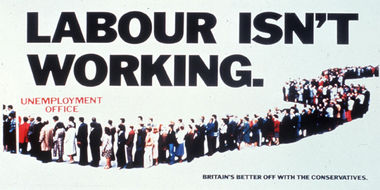
In 2024, there will be no defining ‘Labour isn’t working’ ad poster on every roadside poster site.

What’s happening instead is 14,000 tailored social media ads in the six weeks before the first three days. Each of those will be delivered to you based on your age, habits and beliefs as you scroll.

Much of what will drop through your timeline will be video. That’s certainly the message of an analysis of Labour and Conservative ad spend so far.  

As a communicator, elections are rather like the World Cup for football fans. Stories are told and new heroes and villains are made. But most of all I love that they are a petri dish for new communications tools.

In 2008, it was a creative use of email that gave the edge to Obama and social media that took him back to the White House.

But what will 2024 bring?

It’s absolutely not all about the posters

In 1979, analysts pointed to one single comms tool that made the difference for Margaret Thatcher. It was a roadside poster. Saatchi & Saatchi’s clever play on words ‘Labour Isn’t Working’ poster captured a national mood.

Even in 2010, the poster was still a vital part of the election armoury. Strategists of the governing party would book key poster sites to get a headstart and squeeze out the opposition.

The poster ‘We can’t go on like this. I’ll cut the deficit not the NHS’ was the defining image as Labour lost power. In the image, there is the fresh faced David Cameron. The Brexit vote was still ahead of him and everything seemed possible.

But in 2024, where are the posters? 

Have you seen any?

It’s all about the troll

Social media has democratised the information process. 

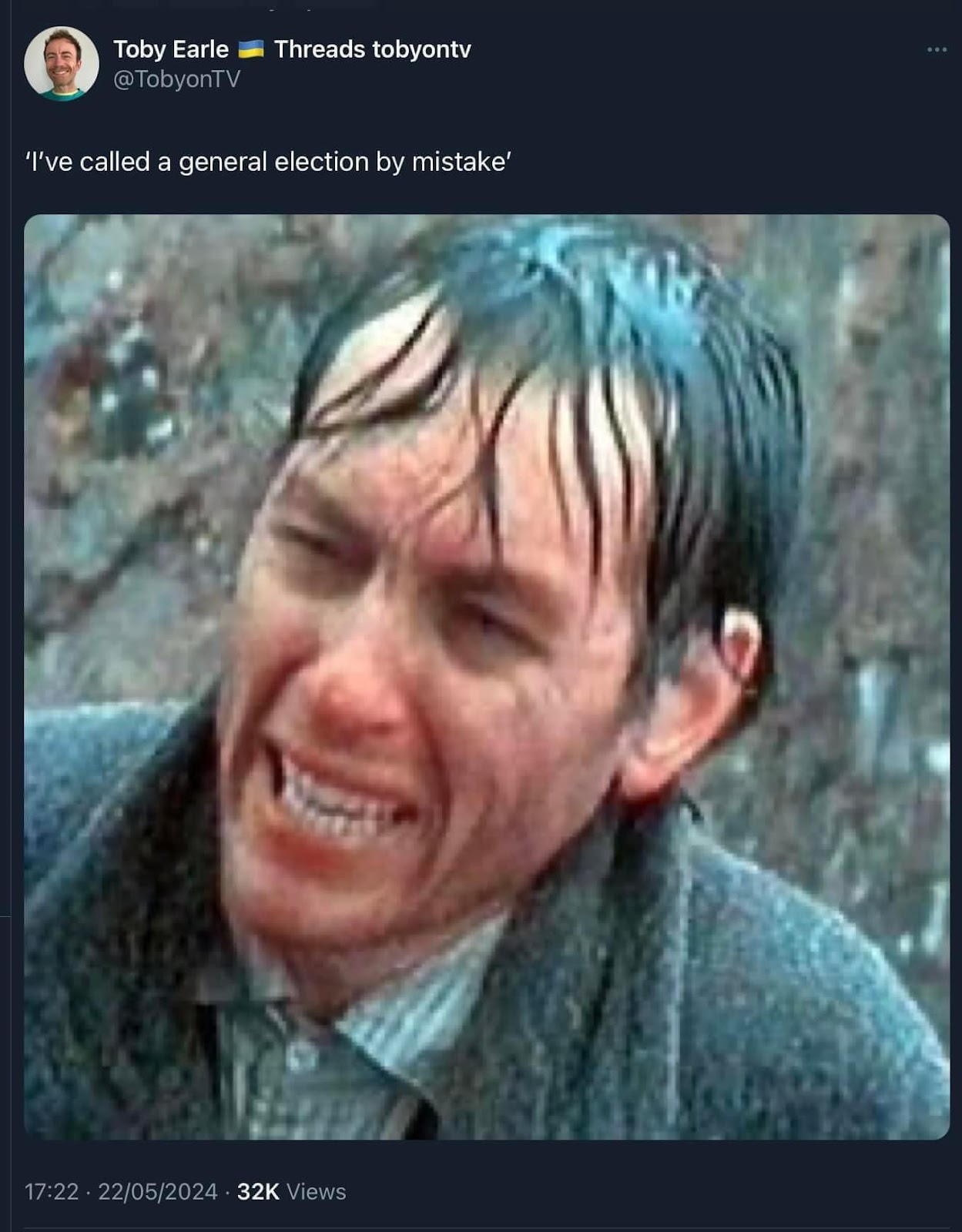
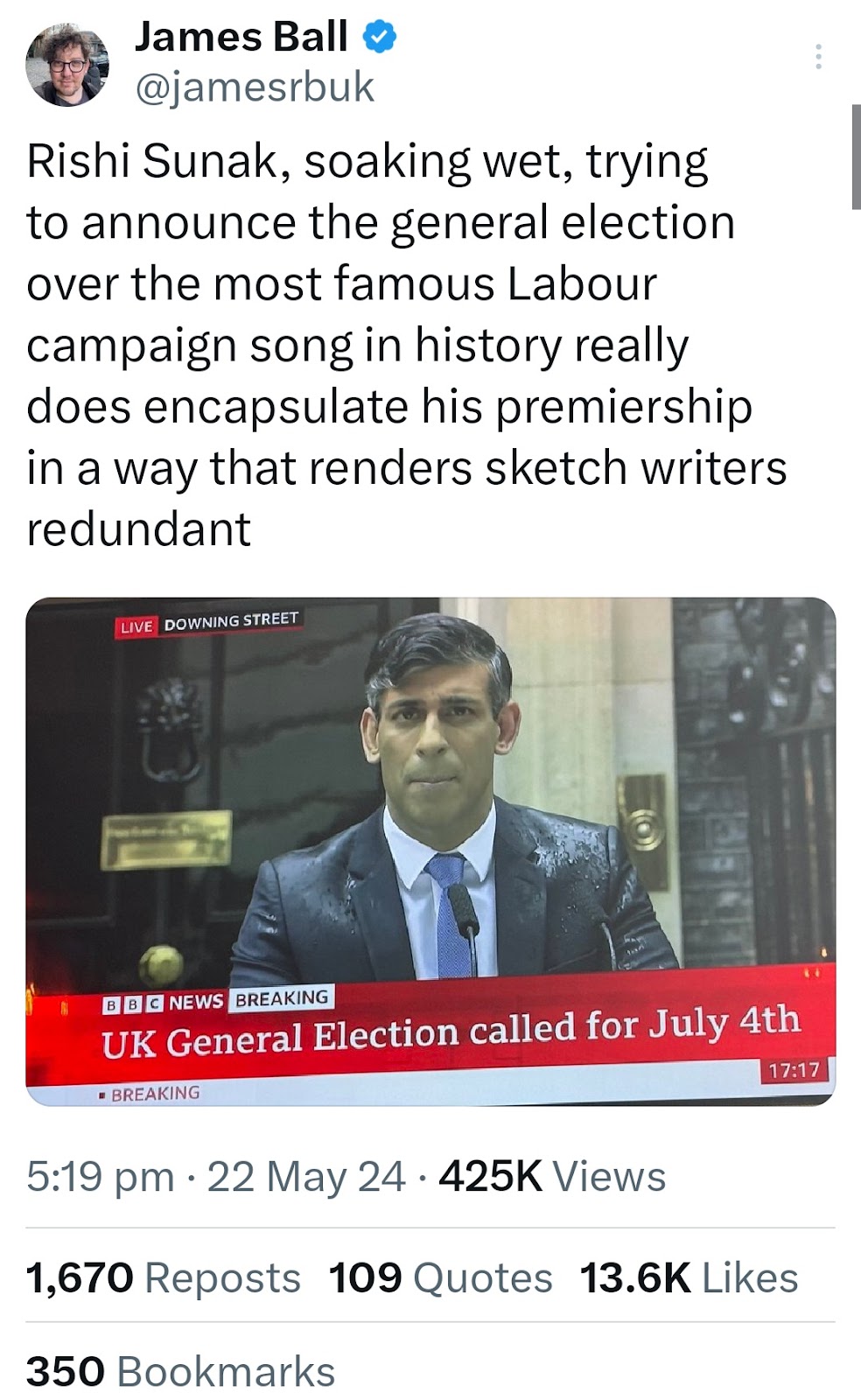
When Rishi Sunak called the snap General Election 2024 in Downing Street he did so in a downpour. Umbrella-less his words were drowned out by a soundsystem playing the 1997 Labour anthem ‘Things Can Only Get Better.’  

Of course, the footage of the Prime Minister being drowned out went truly global and truly viral. It’s noticeable that none of the main leaders have gone anywhere near members of the public. There have been no walkabouts through home countries shopping precincts. No wonder, with smartphones everywhere a heckler can command the news headlines.

This audio trolling only reflects the trolling and noises off that are posted across the broader internet. Sometimes this is good natured heckling. Sometimes it is abuse.  

It’s absolutely all about the meme 

Bleeding in from the Rishi Sunak announcement it’s clear that the internet meme has become a key way to shape opinion.  

There were many memes marking the damp Downing Street moment. 

This one inspired by the cult British classic ‘Withnail & I’ caught my eye. 

In the film, a bedraggled Withnail, the unemployed actor flags down a passing farmer on tractor. “We’ve gone on holiday by mistake,” he says before begging for fuel and wood. He is the piteous city dweller out of his comfort zone and suffering from his lack of planning.

In the meme, it pokes fun at the Prime Minister’s rained on appearance.    

It’s fascinating to think that in 1979, it was ad execs who were capturing the mood visually. Now, its being done for free by a battalion of people armed with smartphones. 

Indeed, it’s not just people who are looking to tap into this instant and ephemeral way of communicating. They are not built to last. They are built to click. 

But, wait. The main parties are at it too. 

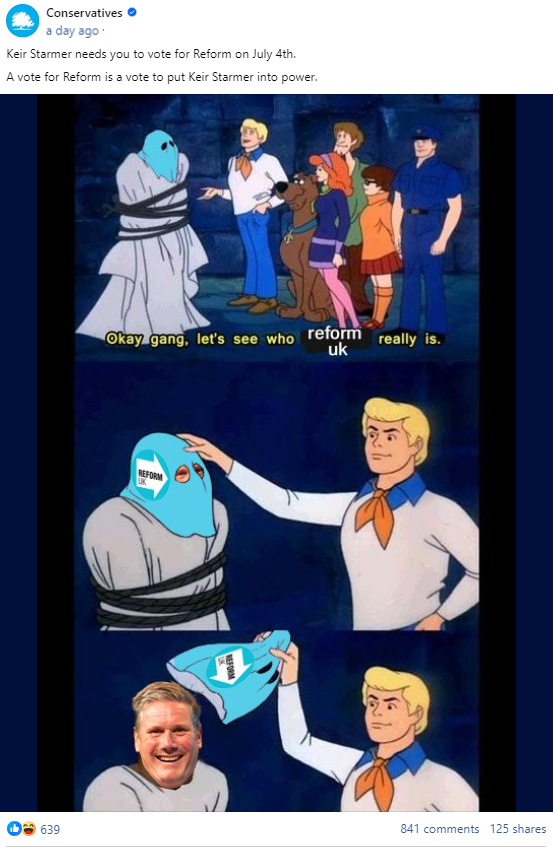
Here’s a piece of content from the Conservative Party that steals from the Scoobedoo meme where someone is unmasked as the real culprit. 

I’d say it saves on the bill for creatives. However, I’d expect that the sentiment captured in the meme will have been shaped by focus group feedback. Then the feedback will have gone through the creative process. The answer is different because we as media consumers consume differently. 

But stopping to think about it, this isn’t just a preserve of a political party. I’ve started to see this tactic used in other places online, too. TikTok is to blame. The platform is all about taking content and then remixing it. TikTok’s own editing tool Capcut allows you to do this easily by giving you a library of memes to work with. What may have taken hours now takes seconds.   

It’s about the email to supporters

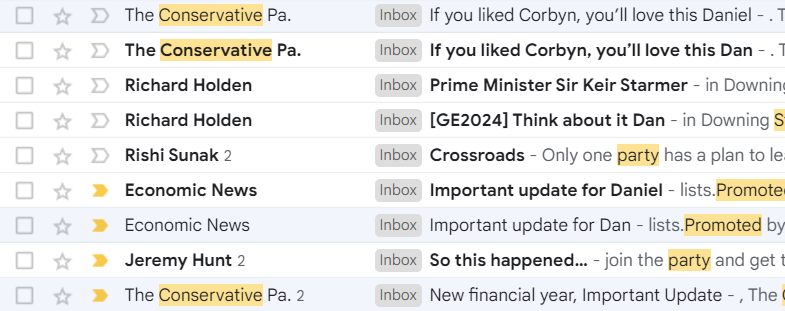
Each political party uses a variety of channels. For supporters, the parties are using email to motivate the troops and encourage them to get their credit cards out.  

Every message has a call to action to donate. Which can be wearing.  

It’s about the screen grab

This is bad news for the Prime Minister but the launch image of the wet politician in Downing Street feels like it has the makings to be epoch-defining. The screen shot taken from the armchair is out running round the world before the rebuttal team have got their boots on. 

It’s not about  the party political broadcast 

Before the internet, the only way a political party could get a film in front of people was the party political broadcast. 

The main channels were obliged to carry a short film from the main parties. Like this on in 1997 by the Liberal Democrats featuring John Cleese.

They were, looking back,  almost universally loathed. The words from the channel announcer ‘there now follows a party political broadcast by…’ prompted mass channel switching. The themes of these films were more of interest to political correspondents than the average punter. 

Ofcom still regulates them under the Communications Act 2003 but I’m struggling to see the point. 

It’s absolutely about the social media ad 

The battleground for political messaging has never been stronger than with the political ad. 

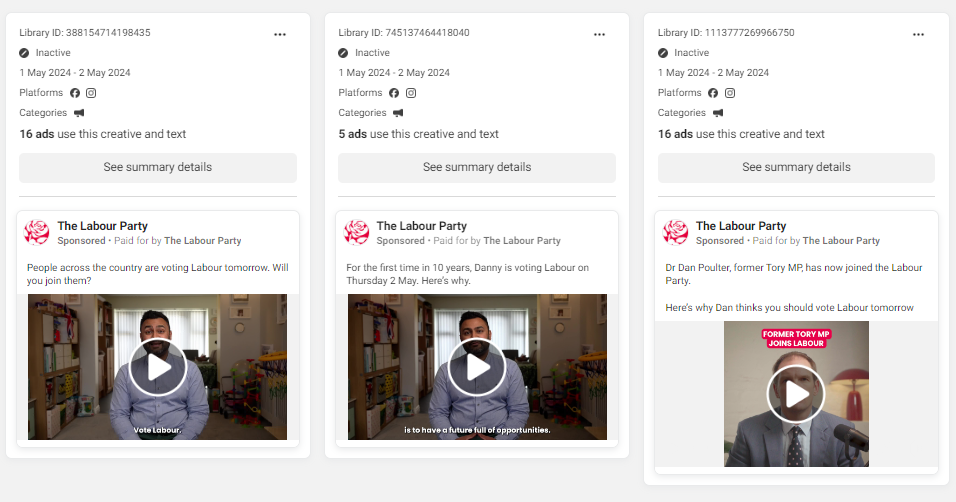
However, Facebook’s ad library shows that this is not about one image to rule them all. This is about creating and posting multiple pieces if tailored content for different audiences. 

I run a report of the Conservative Party’s ad library. In less than two months they have created a staggering 2,887 ads across Facebook, Instagram and interestingly WhatsApp. Each one has a tailored audience and a tailored message. Some were aimed at 18 to 24 while others were marked 65+.

Meanwhile, the Labour Party have posted five times as many ads in the same period with 10,405. 

Annoyingly, there isn’t an easy way of seeing the level of spend as the data just gives upper and lower levels of ad spend. But a trawl through the data shows each ad is often supported by a few hundred pounds. 

The construction of such an effort requires science, money, research, ad creation skills and more money.

It’s possibly about AI

The smart money talks about elections being especially vulnerable to bad actors who may use tools to create fake content that can derail a campaign. Fake audio will be the biggest threat. But with the pace tools are developing it will be interesting to see how they may arrive.

Conclusion

Things are changing and continue to change. That’s just how it is. Communicators would be well served to be watching how the political parties use the platforms. What was once experimental can quickly become the norm.

But while our eyes are taken by the new approaches and new tools there remains an army of foot soldiers who are out delivering leaflets and knocking on doors. The actual landscape of streets, houses and flats is mapped and logged into supporters, don’t knows and absolutely nots. This off-line battle will be taking place alongside the online one.

EMOTIONAL STORY TELLING: Communications lessons from Jurgen Klopp

There are only two types of football manager, the famous line says, those who have been sacked and those who are about to be sacked.

Add to that is a rare third type of manager who calls time on himself.

In that gravity-defying list is Jurgen Klopp who has left Liverpool after nine years with a Premier League, Champions League and five other cups.

He is an astonishingly good communicator but what makes him so good? 

I thought I’d look at two set piece pieces of communication that bookend his time at Anfield. His first press conference and the Instagram post he made before leaving.

In football, there are three key audiences for a manager. The fans, the players and the board of directors. Perhaps uniquely, so much internal communications at a football club is done publicly. Tony Pulis was a master at this

The start: the first press conference

The new manager press conference is one of the traditions of football. An introduction to the new man at the wheel and a mix of easy and hard questions. Brian Clough used to talk about making all the hard decisions in the first three months because that’s when you are most powerful. 

Let’s look at what Jurgen Klopp said in his first press conference. 

“I’m not a genius. I don’t know more than the rest of the world. I need other people to get perfect information,” straight away he was calling from help from those inside the club. 

“It’s important that the player feels the difference from now on. They have to think they can reach the expectations. You have to change from doubter to believer,” he addressed the players.

“It is the biggest honour I can imagine. It is one of the biggest clubs in the world. It is a good moment to come here. How the people live football here. It is not a normal club it is a special club,” straight away identifying the fans.

“I’m a football romantic. I love all the stories and the histories. Anfield is one of the best places in the football world I thought about how it would be. We start to play emotional football. That’s important at Anfield, it has to work together,” he was sealing the deal with fans and those who love the club.

Merseyside is an emotional city. My Mum was from Liverpool, so I know this. It is also a city where community is at the heart. You work for each other not for yourself. Their club anthem ‘You’ll Never Walk Alone’ underlines this.

A Hillsborough disaster campaigner described their fight for justice as ‘they picked on the wrong city.’ It points to the emotion and working together to support in adversity as well as success.

“I’m the normal one. I was an average player, I was a trainer at a special club in Germany,” in perhaps his most famous line.

Football clubs are weird. Some managers fit and some don’t. I was a student on Tyneside when Kevin Keegan first became Newcastle United manager. His success was built on football knowledge plus the foundation of knowing how the fans thought. They were passionate and wanted a fighting spirit.

Barcelona’s slogan is ‘more than a club,’ because it represents Catalonia.

Same for Newcastle United and Tyneside. 

Keegan got this. Others haven’t.

The end: The Instagram post 

It’s telling that one of his last pieces of communication was an Instagram post on a freshly created @kloppo account. He wanted to create an account to stay in touch, he said, and gained more than a million subscribers in less than 24-hours.

He shot the video as a selfie alone in his office overlooking the training ground surrounded by boxes of things he was moving out. 

“So, here I am. Last day in the office. Last session done. It was kind of strange, I would say. A few coaches got emotional. I didn’t. I told myself ‘tomorrow is a game and then it is holiday.’ 

“Obviously, I decide what I think until I get overwhelmed tomorrow. So, I will leave this place today which is… an interesting experience I would say.”

There is a pause as he dwells on the emotion of leaving Liverpool.

“Aye, aye, aye, aye, aye… See you tomorrow.”  

The audience is primarily those who love Liverpool. He addresses those inside the club but makes it far wider. It’s the merging of the audiences here that’s most powerful. The fans and the players and the board are as one. 

He sets up the game ahead beautifully. He hints at bigger emotions and a bigger message but first there is a football match to play and a job to be done. 

Without him knowing it, Klopp has actually mimicked an earlier Liverpool manager in his pioneering use of communications channels. When he was starting out as a manager at Carlisle United in the 1950s Bill Shankly would use the tannoy to address the crowd to tell them what his plans were.  

For all Jurgen’s Klopp’s communications skills, it’s important to say that he also needed a football brain and an ability to communicate to his players and coaches what he wanted.

The announcement of his departure three months before the event was made by an emotional video.

His last days was a full on communications campaign from long form interview on the club’s YouTube and Facebook to a letter to fans in the Liverpool Echo a last press conference and of course programme notes.  

In his first press conference he spoke about the stories, the histories and the emotion of playing at Anfield and now it has come full circle and he is part of those legends.

If you can learn anything from Jurgen Klopp it’s the emotion and the story telling.

FACEBOOK TIP: No really… stop posting links to Facebook

There’s a moment when I’m delivering training that I tell people they’ll like the first part but they’ll hate the second.

The first part is talking about what makes people share with examples that show emotion and story telling. It’s joyous and people enjoy it.

Then comes the second part when I go through the algorithms and show how much all the platforms really hate links and will actively penalise you if you post links. Hey, it’s a real mood killer. People shuffle uncomfortably.  There’s almost a thought bubble hovering over people’s heads with the words ‘but that’s what we do.’

Yet for all the uncomfortable feelings its important to know this.

A few months back, I blogged how Facebook data that showed that the percentage of people’s timelines that are made up with posts from a page with a link was now 0.0 per cent.

The numbers are simply compelling.

Data shows link traffic from Facebook to news sites has collapsed

Those are the numbers from Facebook itself. The numbers from publishers themselves are also bleak. Data from Chartbeat publisher by the UK Press Gazette show that referrals are a quarter of what they were in 2018.

In basic terms, there’s been a 75 per cent fall in people navigating away from Facebook to news sites.

That’s a huge number.

Yes, news sites are feeling extra pain after Facebook has fallen out of love with news. But public sector people shouldn’t just hurry past and think this has got nothing to do with them.

Why?

Because if you are STILL posting links on Facebook then this has got everything to do with you. Facebook have told you that this is a bad idea. Now publishers are showing you that they weren’t messing about.

In the UK Press Gazette article they also point to Reach plc sites such as Birmingham Live and Manchester Evening News being heavily penalised by Facebook.

So, if this is happening in the UK, too.

What this means for public sector comms

Firstly, this means a period of intense innovation in news sites. It’s reached a point of change or die and it’ll be interesting to see how this pans out.

A new generation of subscription email first sites have been attracting attention if not yet swathes of readers, for example.

But there are lessons to draw closer to home.

Stop posting links.

No, really. Really stop posting links. 

The phrase ‘drive traffic to the website’ is as obsolete as ‘answers on a postcard.’

There are ways to change your strategy. Tell the story on the platform itself so people don’t click away. Or if you absolutely have to have a link put it in the comments. Or support the post with a Facebook ad. 

Or use a different channel.

I deliver ESSENTIAL COMMS SKILLS BOOSTER training to help public sector comms people navigate the changing landscape.

BIG LIST: In 2024, there are now 14,106 marketing tools that use AI

The martech map has long been a good yardstick of the pace of change for AI.

The 2024 edition has been published at martechmap.com.

While it articulates visually the maze of tools that are out there it also works as an interactive map that checks and logs new tools by category.

Martech – short for marketing technology – lists applications and websites with added Artificial Intelligence.

Move your mouse across the link on the website you can see a range of different categories from PR, content marketing, display and programatic advertising, mobile marketimng, CRMs and also tools for print.

You can also find out basic information as your mouse hovers as well as click through to the site.

So, there’s a list of almost 80 tools that use AI that are PR-specific. This includes mainstream platforms such as Cision, Veulio and pr.com’s press release tool.

There’s also more than 300 for video including YouTube but also a tools that allow a range of skills such as animation, voiceovers and text to video.

It’s as close to a search engine for AI tools as I’ve seen which is going to make experimentation easier.

It’s also important to note that the 14,106 figure is a 27.8 per cent growth year-on-year. Less than three per cent of vendors have pulled out their services in the past 12-months.

There’s also hundreds that work with Open AI’s ChatGPT tool.

You can find out more about how to safely use generative AI tools within UK Government paramaters here.

TEMPLATE: How to write a comms plan

A while back I wrote a blog post on how to write a comms plan and the icebergs for you to navigate past. 

It’s a subject that keeps coming up so I thought I’d take a fresh look at it and simplify things. 

Yes, comms planning and evaluation is still important but its so often the thing that gets squeezed out.

Do it well and it saves you time in the medium and long term. It also demonstrates your worth.

Who should be involved in comms planning? 

You should be and you should be holding the pen, too. You should be involving the service area and maybe two or three others too. The service area bring the data and you bring your expertise. 

What can go wrong? 

The comms plan is shaped by one person. This is a collaboration between you and other people. If it goes wrong it’s the fault of whoever drafted it.

They’ve got no data. If they’ve got no data you’re stuffed. You need to understand where you are now and where you’re going. You’ve got 100 volunteers. You need 120. So, that’s 20 recruits. That’s a different shaped campaign compared to one that needs 200 recruits or 2,000.

They’ve already made their mind up. It’s posters we want, choppety chop. This is not a comms plan. This is the text of an email to Prontaprint. You need to sit down to work through this plan. 

They’ve left it too late. At  this point you are managing expectations. 

Here’s what an effective comms plan template looks like

Here are the questions for you to ask.

  1. Where are you now? 

2. Where do you want to go and why? (5 minutes)

3. You’ve done these two before the meeting, so there’s no need to spend too long on this. This points out on the map where you are.

4. Who do you want to talk to and why? 

5. What’s the one thing you want them to do and why? 

6. How much work time and money do you have to help you reach them? (15 minutes)

7. How long have you got? 

8. When and how are you going to evaluate? 

9. Who are you going to tell that you are doing this so you can tell them how it has gone? 

10. Whats the timeline of tactics for it all? 

Do this in advance and you’d got more chance of making the thing work.

The template can be found as a downloadable Google doc here

I deliver the ESSENTIAL COMMS SKILLS BOOSTER workshop which includes comms planning and evaluation.