LONG READ: What you can learn from Andy Burnham’s early social media content strategy

There’s been a slew of posts about new Prime Minister Andy Burnham’s use of social media as a communications channel.

There’s been some interesting reads. He’s recruiting a dozen more social media posts for the 10 Downing Street operation. He may or may not be the UK’s first social media Prime Minister.

Let’s been honest, two weeks in and he’s on his honeymoon period.  

But there’s enough there to intrigue me into making me spend some time evaluating his content. 

I’m anticipating the training request ‘we’ve been asked to make our senior people look as good as Andy Burnham.’

How politicians used to communicate

Growing up, the set-piece TV interview was the way politicians would communicate their thoughts and policy detail. Journalist Rob Burley’s excellent ‘Why Is This Lying Bastard Lying To Me’ traces the rise and fall of the 40-minute Sunday morning political interview.

The trouble is nobody outside Westminster wants to watch.

So, with more than 80 per cent of the UK population having a social media account it makes sense to be good these channels as well as media relations, strategy, policy, public speaking and all the other things a successful Prime Minister needs. For a Labour politician facing a hostile media it also makes sense. 

Were I still in regional media, I’d be asking why local news journalists don’t get to interview the Prime Minister so much when he visits town. And yes, other politicians are available.

So a post of three parts. First some data then some learning points and then some content.
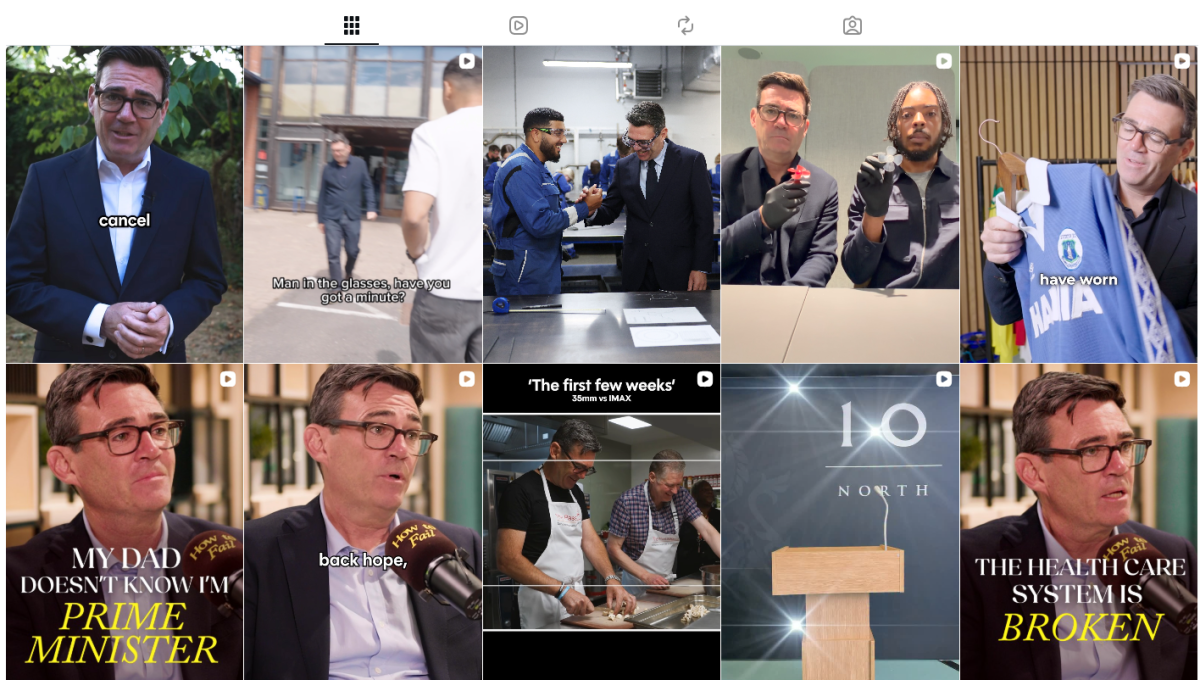
PART 1: Some data on Andy Burnham’s social media content

So, how are the numbers? I’ve taken a look at Andy Burnham’s own Instagram, TikTok and Facebook. I’ve not looked at the 10 Downing Street accounts.

At first, I looked at Instagram mapped content there. But exploring TikTok and Facebook it was clear there was content unique to those platforms. How come I haven’t looked at X? Hours in the day, mainly. X is still important to politicians and journalists but less so for the wider public. A quick glance over there shows much less engagement but strong reach. So, around 13,000 engagements on X for the two week and here’s what we’ve achieved listicle. That’s about half of the performance of the same content on Instagram.

I looked at engagements per post as a metric. Why? Because likes, comments and shares are a marker of people literally engaging of what is being said. They haven’t simply scrolled past. When people engage it also sends a signal to the algorithm to show it to more people. Not only that but they are more likely to be shown future content.

Instagram is his largest channel with 660,000 followers outranking Facebook (610,000) and TikTok (465,000). But follower numbers are less important. All of the platforms are showing you content from people you don’t follow if it performs well or you’ve shown an interest in related content.

I’ve also calculated the percentage reach for each of the channels. So, in other words, if you have an account with 100,000 followers reaching 5,000 would be five per cent. It’s a marker of how effective the content is. 

For Instagram this is 3.2 per cent. This is narrowly behind Hootsuite’s benchmark for Government of 3.5 per cent. For Facebook, Andy Burnham’s numbers are 4.1 per cent which is higher than the 1.5 per cent Hootsuite metric.

But its TikTok with a 16.6 per cent engagement rate that’s the real winner. That’s more than ten times the social platform’s suggested 1.5 per cent benchmark. That would be of interest no doubt to political pollsters.

The overall raw numbers pan out in a very similar shape for overall engagement numbers. On average, the 77,000 engagements for TikTok outrank the 25,000 engagements on Facebook and 21,000 on Instagram.

Part 2: What you can learn from Andy Burnham’s social media strategy

Collaborations, collaborations, collaborations. His team love to set him up with a collab. That’s working with an interviewee for a chat with content often being shared. Of the 25 posts, seven are collaborations. This works here to show a very human side. 4

He sits down with Elizabeth Day from the ‘How to Fail’ podcast which elicits an emotional moment where Andy Burnham reveals how his Dad’s Alzheimer’s disease is so advanced he doesn’t realise his son has been made Prime Minister. Imagine your crowning glory being taken away from you, you are invited to wonder. It’s a touching moment that probably wouldn’t work with a political interviewer. It reaches 100,000 engagements on Burnham’s Instagram but isn’t posted to TikTok or Facebook by his team. 

Instead, the ‘How to Fail’ channel is where you can find it on TikTok and Instagram along with eight other clips and a 54-minute podcast on Spotify and other providers. That’s the nature of collaborations.

He also meets @classicfootyshirts to talk about his love of Everton FC as well as the more heavyweight former diplomat Alexander Dragonetti. There’s also street voxpopper @robcolfer which allows him to talk about Sheffield music and science influencer Big Manny which has more than 100,000 engagements across Instagram and TikTok.

The basic sums of this is that he can break out of his own channel and reach other audiences who probably aren’t following much hardcore politics. It’s a smart move as part of a wider strategy. Critics may say this is not rigorous feet to the fire scrutiny.

Working with influencers will probably work in a honeymoon period. In times of crisis I’d expect this will probably be left in the toolbox.

Influencers. Yes, the public sector can work with influencers. But a bit of prep is needed to make sure you are not sitting down with a dark past or shady opinions.

It’s not posted across all channels. This is such an important lesson from this exercise. Content is posted to the platform where it’ll work best. So, stop the boats is reserved for Facebook. Posts about training for young people go to TikTok. That makes sense. Be aware of the channel.

Bespoke content. Sometimes there was Instagram-only, TikTok-only and Facebook-only content. I was surprised to see Andy Burnham’s admins experiment with text-only posts on Facebook which are also quite long form. Several hundred words on a topic is perhaps surprising. 

Softer content gets the audience for the drier policy stuff.. This is not the best performing content but posts which set out what the PM  has done that week. They feel like the meat and potatoes. They want you to know this. My guess is that softer content reels people in to create a bigger crowd for the more serious messages.

Video, video, video. There’s so much video. To someone who has been banging on about the importance of video this gladdens my heart. But it is not a cure all. There are times when it’ll work and times when it won’t. 

Not so much traditional politician content. The collabs by definition break outside of the politician at the Despatch Box or lectern. In fact, it’s notable how little traditional PMQs sound bite or lectern content there is. Why would he? He’s about doing things differently.

To camera and in conversation. Burnham sometimes delivers a piece to camera and sometimes is captured chatting to an interviewee. That feels deliberate. Mixing it up freshens it up and will deliver different results. The piece to camera can be the points he wants you to know. Counter intuitively, the conversations with interviewers reveal the most personal and intimate content. Revealing the point about his Dad’s dementia may feel a little too manipulative if it was in a speech. 

Hope. One of his early positions is the aim to restore a sense of hope. Indeed, there’s a video which captures this. So much of the internet can be powered by rage and there’s an absence of angry finger pointing here. In this snapshot of content he doesn’t mention his political enemies by name. They’re not even in the screen. His team would probably argue that the content reflects the hope message.

Speaking off the cuff. As an experienced politician he makes a lot of what he says look effortless. He has an ability to communicate without notes. This is rare. Warning: most politicians trying to emulate this will struggle. He has a well thought-out message and he delivers it in conversation rather than set piece soundbite from an autocue. There is no Tony Blair-style jarring of ‘This is no time for soundbites… but I feel the hand of history on my shoulder.’

All this will make it difficult for other politicians to replicate. The bright comms team will anticipate this. The more tightly scripted and tightly edited Oxford City Council approach feels a better route for the less experienced performer. 

Part three: the content itself

Dive in, have a look. It’ll change with time and events no doubt

VIDEO: A collaboration with @robcollfer (227k Instagram followers) who carries out voxpop interviews in the street. He stops ‘Man in glasses’ and asks Q: what is your favourite thing about Sheffield?  Answer: The Crucible for the snooker, Human League and Arctic Monkeys. Q: And least favourite? The transport links. A cunning way to talk about the poor transport links across the Pennines.

Likely to appeal to: Sheffield people, music and snooker fans and northerners fed-up with poor transport links.

Hook: “Man in the glasses, have you got a minute?”

Instagram engagements 10,200. 

TikTok engagements: not posted

Facebook engagements: not posted

Video length 1’25”.

PIC: A listicle of the week’s achievements with a shot of the PM meeting a factory worker. ‘My Government is getting things done’.

Likely to appeal to: Core audience of the page.

Hook: “My government is getting things done – here’s just some of the changes we’ve made this week.”

Instagram engagements 6,600.

TikTok engagements: not posted

Facebook engagements: not posted

VIDEO: A collaboration with @big.manny1 (1.5 million followers) an Afro-Caribbean man who makes science relatable to young people. In the clip, Manny narrates making a circuit breaker in the same way that the PM is making a circuit breaker by creating the Number 10 of the North in Manchester to make decisions outside London.

Likely to appeal to: Young people.

Hook: @andy.burnham is introducing a circuit breaker into UK politics with the new No. 10 North.

Instagram engagements: 51,500.

TikTok engagements: 68,800

Facebook engagements: not posted

Video length: 45 seconds.

TEXT: We’re changing the rules… are you creating British jobs?. This is text and Facebook-only. It’s also long form text. 

Likely to appeal to: Older Facebook natives.

Instagram engagements: not posted

TikTok engagements: not posted

Facebook engagements: 31,500

TEXT: We’ve all had some experience of struggles with mental health. Like the previous post, this is text and long form text.

Instagram engagements: not posted

TikTok engagements: not posted

Facebook engagements: 35,200

VIDEO: I’m back down at Ashton Bears. A selfie video shot in landscape in downtime revisioting the Rugby League club he visited during the recent by-election. 

Instagram engagements: not posted

TikTok engagements: not posted

Facebook engagements: 9,200

Video length: 1 minute 42 seconds.

VIDEO: AI is important so is engineering. A video direct to camera in hi-vis celebrating engineering and other jobs. This is related to the policy announcement also in this run about practical jobs being important.

Instagram engagements: not posted

TikTok engagements: 94,200

Facebook engagements: not posted

Video length: 1 minute 42 seconds.

VIDEO: Collaboration with @classicfootyshirts (1.5 million followers). The PM is shown a late 1970s Everton shirt, talks of his love of Everton and correctly names the player who would have worn the shirt.

Likely to appeal to: Football supporters especially Evertonians.

Hook: “What does Everton Football Club mean to you?”

Instagram engagements: 8,600

TikTok engagements: not posted

Facebook engagements: not posted

Video length: 33 seconds.

VIDEO: Collaboration #1 with ‘How to Fail podcast with Elizabeth Day’ (210,000 followers). In an emotional clip the PM describes how father’s alzheimers is sufficiently advanced that he doesn’t know he is PM.  

Likely to appeal to: Broad appeal but especially amongst those whose family have experienced Alzheimers.

Hook: “My Dad doesn’t know I’m Prime Minister.”

Instagram engagements: 100,000

TikTok engagements: not posted

Facebook engagements: not posted

Video length 1 minute 30 seconds.

VIDEO: Collaboration #2 with ‘How to Fail podcast with Elizabeth Day’ (210,000 followers). In this clip, its more a platform for the PM to explain what he is standing for and talks about the need to ‘bring back hope’.

Likely to appeal to: Core audience.

Hook: Bring back hope.

Instagram engagements: 5,000.

TikTok engagements: 11,200

Facebook engagements: 8,500

Video length 1 minute. 

VIDEO: A show reel of places the PM has gone in the first few weeks. Using ‘Can You Hear the Music’ from the film Oppenheimer plugging into the cinema meme of showing something in 35mm as opposed to the more expansive IMX shot.  

Likely to appeal to: Scrolling audience.

Hook: ‘The first few weeks.’

Instagram engagements: 12,800

TikTok engagement 25,200

Facebook engagements: 49,200

Video length: 29 seconds.

VIDEO: Ask me anything. Taking questions posted on a range of subjects some tricky and some not. While one shot with captions, it is made visually more interesting by jump cuts that crop in on each closer creating pace and intimacy. This plugs into the internet convention ‘ask me anything’ when famous people take questions from the public. 

Likely to appeal to: A scrolling audience.

Hook: ‘Ask me anything’.

Instagram engagements: 5,900.

TikTok engagement: 21,300

Facebook engagements: 10,900

Video length: 1 minute 30 seconds.

VIDEO: Collaboration with @ellisplatten (138,000 followers) the man who owns classicfiootballshirts. Ellis uses the Number 10 podium to joke how his first policy would be to make everyone wear a football shirt.

Likely to appeal to: Football fans.

Hook: ‘Good evening, Britain.’

Instagram engagements: 11,500.

TikTok engagements: not posted

Facebook engagements: not posted

Video length: 15 seconds.

VIDEO: Collaboration #3 with ‘How to Fail podcast with Elizabeth Day’ (210,000 followers). A major policy shift acknowledgiong the need to tackle social care.

Hook: The healthcare system is broken.

Instagram engagements: 16,000.

TikTok engagements: not posted

Facebook engagements: not posted

Video length: 1 minute 30 seconds.

VIDEO: It shouldn’t just be about University education. This is shot with an off-screen interviewer the PM is engaged with. It covers a significant policy change. Young people should be encouraged that vocational education is a good route foir their career.

Likely to appeal to: Parents and young people.

Hook: “For too long, young people have been told there’s only one route to success.”

Instagram engagements: 7,600. 

TikTok engagement: 22,000

Facebook engagements: 7,400

Video length: 52 seconds.

PICTURE: Andy Burnham in Downing Street. A recap on the first two weeks as a listicle.

Likely to appeal to: A scrolling audience. 

Hook: “Two weeks ago today, I admitted that politics has not been working for you and that we all need to raise our game.

Instagram engagements: 21,200

TikTok engagements: not posted

Facebook engagements: not posted

VIDEO: A press conference-style set-up. To tackle the issue of small boat crossings. 

Likely to appeal to: People for who the small boats issue is important. 

Hook: The number of crossings is down by 50 per cent. 

Instagram engagements: 9,700

TikTok engagement: 6,200

Facebook engagements: 21,500

Video length: 1 minute 30 seconds.

VIDEO: A super carousel of images shot in the opening weeks. Dozens of shots of the PM meeting a range of people from the King to members of the public. 

Likely to appeal to: Scrolling audience.

Hook: Behind the scenes – the first two weeks… 

Instagram engagements: 3,900

TikTok engagements: not posted

Facebook engagements: not posted

Video length: 20 seconds. 

VIDEO: A piece to camera summary of the first two weeks. A verbal listicle. 

Likely to appeal to: A scrolling audience.

Hook: Second week as Prime Minister .

Instagram engagements: 33,800

TikTok engagement: 187,000

Facebook engagements: 48,900

Video length: 1 minute 9 seconds.

VIDEO: The need to devolve power. A piece to camera celebrating the regional differences of a roll / barm / tea cake / cob to make the point that local people know what’s to be done locally.

Likely to appeal to: People from the Midlands and North.

Hook: Now this is a barm and no-one can tell me any different.

Instagram engagements: 36,100

TikTok engagement: 72,900

Facebook engagements: 27,900

Video length: 50 seconds.

VIDEO: Criticising online job interviews. A sit-down interview-style interview approach about online job interviews. 

Likely to appeal to: frustrated jobseekers and older people who don’t like technology.

Hook: I’m not a fan of this online job interview culture. 

Instagram engagements: 11,400

TikTok engagement: 35,100

Facebook engagements: 36,700

Video length: 30 seconds. 

VIDEO: Collaboration with former diplomat, columnist and influencer Alexander Dragonetti (240,000 followers) on tackling social care. A chat on benches with a two shot of the two of them.

Likely to appeal to: People who have experience of care for a family member.

Hook: “I would never forgive myself.”

Instagram engagements: 10,300

TikTok engagements: not posted

Facebook engagements: not posted

Video length: 1 minute 35 seconds.

VIDEO: The need for Number 10 North. An informal fireside-style interview to allow the main points to be delivered.

Likely to appeal to: People in Northern England.

Hook: “I think we need to be more ambitious.”

Instagram engagements: 4,800

TikTok engagement: 7,100

Facebook engagements: 8,000

Video length: 38 seconds.

VIDEO: Practical jobs are important. A TikTok-only piece to camera with mortar board and hard hat props to underline the importance of practical jobs.

Likely to appeal to: Young people.

Hook: “For decades, young people have been told a mortar board leads to success but this doesn’t. I’m not having that.”

Instagram engagements: not posted

TikTok engagement: 420,000

Facebook engagements: not posted

Video length: 38 seconds.

VIDEO: A speech given to real people without notes standing amongst a seated audience

Hook: “I speak from the heart…”

Instagram engagements: 22,500

TikTok engagement: 33,100

Facebook engagements: 29,200

Video length: 1 minute 25 seconds. 

That’s it. Thanks for reading. It would be interesting to compare to a figure on the right of British politics. If I can find the time, I may.

For more, I deliver training to help you make sense of the changing landscape. 

ESSENTIAL AI FOR PUBLIC SECTOR COMMS

ESSENTIAL COMMS SKILLS BOOSTER

ESSENTIAL MEDIA RELATIONS

ESSENTIAL VIDEO SKILLS REBOOTED.

SHOT LIST: How to draw-up your own video style guide

The argument for shooting, editing and posting your own content is well and truly won. But how should it look? 

There’s a few things to consider when you are drawing up a video strategy for your organisation. Content would be one. A style guide would be another once you’ve got some confidence.

This would dictate things like the typeface you’d use and maybe where your logo sits.

You are probably used to using brand guidelines in marketing and print. What you do with video needn’t feel as onerous but some basic pointers will make your collective output look much better.

Here are some things to think about. You can use as much or as little as you like with this. Certainly, as an extra task it’s going to add some time onto the end of your workflow but you need to ask yourself if the process adds any or takes away.

Certainly, there’s sometimes where speed is of the essence.In that case maybe it can all go to the wall. It’s up to you. 

The steps here aren’t that hard and can be replicated using a smartphone and an editing app. I’ve used Kinemaster here.  

I’ve editing some editing points in italics showing you the steps I took. 

Video isn’t print

First things first. Breaking news: video isn’t print. The idea of picking up your brand guidelines and dropping them lock stock and barrel into video is a really, really bad one for me. What’s been developed for print works best in print.

The NHS brand, for example, is a thing of wonder with a clear typeface that directs people around the hospital. It immediately reassures people that they’re getting health information. But a sign isn’t video.

For me, the starting point may be your brand guidelines but you’ll need to start with a spirit of flexibility. BBC News on TikTok, for example, has some broad pointers that identify it as BBC but it doesn’t drop in the opening music of a news bulletin, for example.   

A typeface

Video editing tools give a variety of different typefaces. If you’re using something like Kinemaster you’ll get some free. If you upgrade to Pro you’ll get access to plenty more which is where the value of Pro pays dividends.  

If you’ve got a font you use but you’re maybe not clear on what the font is called there’s a great website called whatthefontis.com. Drag and drop a piece of content and it’ll tell you what the font is and a number of close matches. Then look for the matching font that’s available to you in the video editing app.

Making your typeface work

Once you’ve got your typeface you’ll need to think of a size for the title, maybe you’ll need to use the editing tool to create an outline for the title to make it stand out. 

A title

You’ll maybe think of how you’d like titles to appear and depart the screen. Using an editing app it’s very easy to create an in-animation and an out-animation. Fade is a pretty standard one but having one makes your content look that bit better.

Here’s a title created using Kinemaster Pro and uses Plus Jakarta Sans Bold downloaded from the shop. 

Text on screen 

This is the part where you want to tell the story using text on the screen maybe with some supporting footage. 

This uses Plus Jakarta Sans Bold.

A caption 

This is the additional information that maybe shows the name and the job title of the individual in question. It’s sometimes know as a lower third. What would you like your template to look like? You may want this to be part of the family of typefaces you’re using for the title. 

I’ve created two separate lines. For the first one, the name, I’ve created a text layer, enabled background colour, changed the colour to red, changed opacity to 100 per cent. This creates a solid block of colour. If I wanted it to be really opaque as a background I may knock this down to something like 30 per cent.  I’ve used Plus Jakarta Sans Extra Bold. The default text colour is white. I’ve then duplicated this to create a second text box. I’cve switched the typeface to Plus Jakarta Sans Light. I’ve changed the colour of this second textbox to red and I’ve changed the background to white. In other words I’ve flipped it round entirely.  

A sub-title

This is the accessibility-friendly part of the video where you’re adding the what the person on screen or voice is saying.  

There’s two ways of doing this. Yes, you can do this on Kinemaster. Yes, you have to do it letter by letter. No, there’s no shortcut. I’ve changed the typeface here to Plus Jakarta Sans Extra Light. It’s part of the Plus Jakarta family of fonts I’ve downloaded but it’s lighter so more suited to a sub-titling role.  

A logo

You may be watching something like Al Jazeera English and you’ll see a logo in the top left or maybe top right corner of the screen. This is really useful as it reminds the viewer the source of the information. It plays a supporting but helpful role.  

Here I’ve emailed myself the logo and I’ve added it as a media layer. I’ve changed opacity to 75 per cent. Feel free to experiment with your own. My own logo is white text on an orange background. You may feel that white is less obtrusive. Go with what works for you.  

A style guide

All of this builds up a style guide. Mine may look like this…

Title: Plus Jakarta Bold with fade for in and out animations.

Caption: Plus Jakarta Sans Extra Bold for the name and Plus Jakarta Sans Light for the job title.

Sub-title: Plus Jakarta Sans Extra Light 

Logo: Orange logo top left corner at 75 per cent opacity. 

You may want to add to it as you go along using this as a starting point. Maybe your style guide may include something like resolves – how each clips bleeds into each other – or other things. That’s all fine.

Remember that all these things are part of the language of film. It’s fine to play around with them from time to time.

The bottom line is with a bit of teaching being able to do this isn’t hard. The results outweigh the effort you put in. 
For more on video, I deliver ESSENTIAL VIDEO SKILLS REBOOTED on planning, editing, and posting video. You can find out more here. I also deliver ESSENTIAL PORTRAIT VIDEO FOR TIKTOK & REELS. More on that here

LONG READ: Now half of all time spent on Facebook is spent on video… so what are you going to do about it?

Five years ago I came across a stat that changed the direction of whast I do… that 70 per cent of the internet would be video by 2017.

I looked at the data and I looked at the skills that comms people have and saw the gap and saw the need for bespoke training for comms people to plan, shoot, edit and post to the web using a smartphone.

By 2019, in the UK Ofcom confirmed that it was.

By 2021, that pace of change is accelerating.

I’m pleased to say working with filmmaker Julia Higginbottom over the past few months I’ve rebooted the Essential Video Skills for Comms workshop to deliver it online. You can find out more here.

But rather than just blog about the exciting new workshop I’ve been quietly beta testing I want to blog about where video is in 2021 and why these skills matter.

Firstly, two big announcements.

Half of Facebook is now video

For public sector people, Facebook is now the key primary route to reach peiople aged 30 to 70. In the UK more than 40 million people use the platform and two thirds use community Facebook groups.

It is the Parish pump, the local noticeboard and the place to learn, ask and check in with friends and family.

So, the news from Mark Zuckerburg in a conference call to Facebook investors that Facebook users now spend half their time consuming video is now deeply significant.

The direction of travel from a couple of years ago has become faster.

Video, in particular, is becoming the primary way that people use our products and express themselves. Now I know this is a theme that we’ve been talking about for a few years now, but we’ve been executing on this for a while, and video has steadily become more important in our product. Video now accounts for almost half of all-time spent on Facebook and Reels is already the largest contributor to engagement growth on Instagram.

Mark Zuckerburg, earnings call transcript to Facebook investors, July 2021

To put that clearly, if half the time people spend on Facebook is video, you need to be factoring in video content for Facebook.

Instagram is becoming a video platform

Follow that up with the news that Instagram is moving away from the still picture to become a video network.

Video is driving an immense amount of growth online for all the major platforms right now and its one I think we need to lean into more… I want to start by saying we are no longer a photo sharing app. The number one reason people say they use Instagram is to be entertained so people are looking to us for that. We’re trying to lean into that trend into entertainment and into video. Because, lets be honest, there;’s some really serious competition right now. TikTok is huge, YouTube is even bigger. We’ll be experimenting with how to embrace video more broadly.

Adam Mosseri, head of Instagram, June 2021

You can see the full clip here:

From Zuckerburgh’s comments and those of Mosseri, a key direction Instagram will take will be its TikTok take off Reels. These are portrait videos that may now be full screen as they are on TikTok.

Right now, I’m not so convinced that Reels are a competitor to TikTok. They haven’t really developed their own sense of spece and innovation but it’ll be fun to see.

And TikTok

I’m spending more and more time in my downtime on TikTok. I’ve blogged before that I think that the platform is moving away from it being a platform just for under 24s and into a space where older demographics and brands are.

Not just that, TikTok have been also being busy wooing small business too. It’s not the global brands like Adidas that TikTok are after. It’s business with a more local reach, too.

While the Facebook ad-engine is undoubtedly more powerful and able to reach more segmented people there’s a sense that TikTok is making strides in that area.

And the UK data supports video as a booming channel

I know what you are thinking. All these big picture trends are all well and good. Right now my chief executive / councillor / Minister just wants a poster / tweet / Facebook update. That’s fine. But I firmly believe that its the job of comms to understand the trends and educate the client. A comms person in 2008 who just wrote press releases was an asset. They have long been a dinosaur.

The good news is that the Ofcom UK data support these global tectonic shifts. In Ofcom’s 2021 Online Nations report, 97 per cent of internet users had used video. Under 24s spent on average an hour and 16 minutes a day on YouTube with the figure for all over 18s being 35 minutes.

Daily users of social video are also significant. Almost three quarters of under 24s fall into this bracket. The figure remains high with 45 to 54-year-olds with almost a third watching on a daily basis.

Arghh! Public sector video? Where do I start?

Research, experiment and learn. Have a good planning process to work out if its a video you need at all and then a swift workflow. You’ll need big ticket expertise for that really important film to showcase your town to new investors. But you’ll also need video skills across the team to shoot the Mayor / Councillor / Minister / Leader’s response to breaking news or a Punjabi doctor speaking in Punjabi to other Punjabi speakers.

I’ve helped train more than 3,000 people in person over the last five years but I wanted to wait to get the online delivery right before letting you know about it. After trials and working with Julia I think we’re there.

For more information about ESSENTIAL VIDEO SKILLS FOR COMMS REBOOTED head here or drop me a note via the web form.

Picture credit: istock.

← Back

Thank you for your response. ✨

VIEW VIDEO: What the Ofcom’s stats on booming video means for public sector comms

You’ll not be surprised that video consumption boomed during the pandemic but the data behind the headline does surprise.

Overall, video consumption soared by 47 minutes a day for adults in 2020 reaching a rather significant five hours 40 minutes of screentime.

However, the headline figures only take you through part of the story. What’s particularly interesting is the demographic breakdown of age groups.

As a communicator, its hugely important to know the age of your audience as this may significantly skew the way you need to think about reaching them.

Because I love you, I’ve gone through the Ofcom Media Nations 2021 report to look at age ranges for the UK. If you are from Wales, Northern Ireland and Scotland there are supporting reports with a bit more local colour.

Glancing through all of them, there aren’t huge difference between the Home nations.

Here’s how people spent that five hours 40 minutes a day.

Live TV (162 minutes) accounted for most with streaming video sites like Netflix (65 minutes) and YouTube (41 minutes) supporting.

Trends are accelerating

Things are getting faster and video is hoovering up people’s time.

“The pandemic caused an acceleration of existing viewing trends as people spent more time watching on-demand services.”

– Ofcom Media Nations, 2021

Aside from the overall boom, subscription TV services are now used by 60 per cent of all UK households adding just over an hour to the telly. Terrestrial telly has proved resilient in 2020.

Half of UK households now use a smart speaker daily with two thirds using it to listen to streaming services and 39 per cent carrying out voice search.

Radio also remains resilient with live radio on a DAB device the most popular use (63 per cent) with podcasts flat at 15 per cent.

The boom in social video remains vibrant with 82 per cent of online adults – that’s almost nine out of 10 people who are web-connected – watching it at some point in the last 12-months.

Video booms amongst all age groups

Delving into the data, video is no longer the preserve of the young. While 97 per cent of under 24s watched some kind of social video in the last 12-months that’s to be expected.

More surprising is the older 24 to 34 group were only two per cent behind and ratcheting through the age groups almost three quarters of 55 to 64-year-olds watch. Just short of half of over 65s also have watched short video in the last 12-months.

But video has been consistently high performing over the past five years.

It’s something I’ve been flagging for a good five years.

Social audio

The hot topic of social audio is also showing up in the data.

The Clubhouse app which introduced the concept hasn’t cut through with only 0.3 per cent of the population using it by March 2021.

The report flags up audio for Twitter and Facebook as something to watch. That’s fine. I’ll wait to see them become a measurable thing.

What the public sector needs to know

Toto, we’re not in 1998 anymore.

The pace of change is ever changing and it’s never going to be this slow again. The trick is to evaluate the data before flying headlong into new trends but be across those trends.

Video remains increasingly important.

Telly and radio are in a slight decline but they remain a significant chunk of how people consume the media. For the most part, what’s happening on Netflix is irrelevant as far as the public sector is concerned. But radio, that Cinderella platform, remains a thing.

I help train communications people in how to plan, shoot, edit and post effective video. You can see more here.

PRO VIDEO : How to get the most out of LinkedIn video

At last, LinkedIn has joined the race to encourage people to consume video on the channel.

The long-predicted move sees the platform for professionals allow you to upload directly to the site.

How you can upload video to LinkedIn

Easy. You can do this by adding a video when you are adding an update from your own profile from a PC. There is a video button as part of the range of options. You can also shoot video from your phone or add a video from your camera roll.

At the moment, this is limited to updates in your own name. You can’t do this yet from the company page. For me, this isn’t a huge loss. People connect to people on LinkedIn and let’s face it, the company page is a pretty dull place.

So, cat memes on LinkedIn now is it?

What this does is add some extra dimension to the field. This is unlikely to see an explosion of cat memes on LinkedIn. This isn’t Facebook. But it does mean that when you are looking to communicate a new field has opened-up.

How you can use LinkedIn video

LinkedIn themselves have published a short guide to using video on their platform. This is going to be a bit trial and error, I suspect. You can read LinkedIn’s own advice here.

In short, LinkedIn think:

  • Something work related.
  • Less than five minutes in duration.
  • Tips, a talk or a how-to guide they are keen to share

Interestingly, they are after candid, not-overly produced and over-selling, too. This should pave the way for in-house video that doesn’t cost the earth.

At the moment, they don’t have a live broadcast functionality but I can see that changing.

Five ways to use LinkedIn video

Consultation. If the audience is more professional than other channels, that’s fine. This is where business people and others are. So if you need to get their feedback try here. A short video may work as part of the mix.

Recruitment. If your HR team are looking to recruit a short video may help.

How to guides. There are a range of things that professional people need. Advice on how to complete a planning application, take on an apprentice and many other things present themselves.

Professional opinion. Best practice guides or vlogging could lend itself well to the platform.

Experiment. The field is clear. Dip a toe in the water.


CONTENT TIPS: Six laws for content that works on the web… Ooo! Aaah! Wow! OMG! And I didn’t know that!

Six laws for content that works on the web… Ooo! Aaah! Wow! OMG! And I didn’t know that!

Every day we read, write, be amazed, shout, laugh at and share content online.

We do it after we wake-up, go to work, get to work and get home from work. The we do once we’ve kicked our shoes off.

Research would say we see 285 pieces of content every day. I’d say when I’ve got time on my hands it’s a lot more.

As communicators we are every day trying to compete with content that is shouting more loudly. Nobody is waiting for your press release. Or your video.

But how do you make yourself heard over the din?

I think it starts by looking at what works. What works for you? The meme? The 10-secondfd clip? The image? Think for a second.

It got me thinking how if I can catagorise the stuff I see that works. For me, it boils down to five words of phrases… Ooo! Aaah! Wow! Ha! And I didn’t know that!

Sometimes, if you are clever you can tick several of these boxes.

If you are not ticking any of them you need to think if that man in a suit against a wall for 20 minutes is going to fly. The chances are it won’t.

Ooo!

This is the spectacle. The arresting sight that makes you stop and stare.

Colourflow 3 #ColourflowProj #davidmcleod

A video posted by David McLeod (@david_mcleod) on Jan 4, 2016 at 1:58pm PST

Aaah!

This is the story of the dying dog’s last walk. Or the cute child. The thing that tugs on your heart strings.

Wow!

This is a spectacle. The sight that makes your jaw drop slightly.


OMG!

This is the one that makes you stop and plays on your fears. Like the RNLI breath test produced to try and persuade people not to swim out-of-their-depth in the sea.

Ha!

This is the funny one. The one that makes you want to laugh and share it with your friends so they can laugh too.

I didn’t know that!

This is the helpful one. The YouTube clip of the Indian student telling you how to fit a new cricket bat grip or the American showing you how to change a tyre. You look it up to help you. You’re amazed at how easy it is to follow and how complex the written instructions sound.

So, if your content isn’t any of those, should it be content at all?

Picture credit: Andrea Levers / Flickr

LIKE WTF: “A like’s a like… never fall in love with a liker.”

This cropped up as a Facebook memory thing this morning. It’s brilliant.

Take a look at it here:

“She took a screenshot of his snapchat and he tried to deny it, he said I didnae like her instagram, I just liked her facebook post that was a screengrab of her instagram, it wisnae her actual instagram.”

If you need to know how the youngstrells are communicating with each other, it’s marvellous.

By the way, this is a YouTube of the actual embedded Facebook. Not a screenshot of their instagram.

10 places to distribute your video to make it a success

You’ve made a cracking video but you’re really not sure what to do next.

So what do you do?

For the past 12-months I’ve looked, made, researched and co-delivered workshops on essential video skills for comms.

As a comms person I’m convinced that video has a powerful role in creating engaging content. As I’ve said before, a large chunk of the internet is now video and that’s just going to grow.

The two things you need for engaging video

Think of Pearl & Dean. Think of sound and vision. It’s two things that go together. There’s a balancing act for creating successful video as part of a comms campaign. On the one hand you need good content. But on the other hand, good content that’s sat on your mobile phone isn’t going to reach anyone. So think about when and where you can post what you’ve made.

Live streaming is a bit different

Live streaming using Periscope, Meercat or Facebook Live is video. But this is video of the moment which is disposable. If the advantage is to be five yards away from the firefighter explaining the incident is now under control then it makes sense to use that. Speed and realtime point you to these platforms.

Don’t be blinded by numbers

Have a think about your audience. If you are keen to reach 16-year-old students about to decide which college to go to then your idea of success is not to chase Taylor Swift numbers. But if you’ve only reached a dozen then you may need to have a think about your distribution. In other words where people have the chance to see the video.

10 places where people can see your video

YouTube direct. This is the grand daddy of internet video. It’s used by more than a billion people a month. In the UK, more than 40 million people use the platform every month. Post your video to YouTube but keep it at around three minutes. Add tags and a good description so people will find it. Metadata is your friend. Optimum time: around three minutes.

Facebook direct. A new kid on the block compared to YouTube. At the moment, Facebook is rewarding you for adding video content to a page. It likes video because video keeps people interested, engaged and sharing. A hundred million hours of video is watched on Facebook every day. There is a battle going on between YouTube and Facebook but it’s worth posting video here too. Facebook can soar in the short run and is outperformed by YouTube in the long run. So think about posting to both. Optimum time: 21 seconds.

Twitter direct. Like Facebook, Twitter is liking that you post video direct to itself from the Twitter mobile app. But annoyingly, it’ll only let you upload a video from elsewhere if you are using an iphone.Optimum time: less than 30 seconds.

Instagram direct. There is a tendency for organisations to sit back and think that YouTube, Facebook or Twitter means the internet is covered. What hogswallop. If you know your audience you’ll have an idea which platforms they’ll be using. If instagram or snapchat is on their wavelength then think about how you’ll be using those channels first. By doing that you’ll have an understanding of what video may work.Optimum time: Instagram was up to 15 seconds maximum but now can be 60 seconds. Doesn’t mean you should use 60 seconds, mind.

Snapchat direct. Younger people are opting for snapchat. Again, disposability rules in the content. The platform now has 10 billion views a day. Organisations who are using it well have got to know snapchat first and make specialised content. It’s not a place to throw your three minute YouTube video.Optimum time: less than 10 seconds.

Email the link internally. Once you’ve posted the video cut and paste the URL and send it to people. Embed it in the weekly email. Or send it to the 10 people in the team you’ve featured. Invite them to share it and you can start to tap into your staff as advocates. YouTube links are good for this.

Embed in a webpage. It never fails to surprise me that video carefully shot and posted onto social channels then never makes the webpage. If you look after a museum, embed the video onto the right webpage so when visitors come they’ll have more than just the opening times to look at.

A staff meeting or event. You have an audience of people corralled into a room. Of course you should show them the film you’ve made.

A link attached to a press release. If you’re sending out a press release it is becoming increasingly important to add a video or an image to it to register an interest with a reporter. Even if it’s a short video it’s worth doing.

Target influencers. If the blogger, the reporter or the big cheese are people you’d like to see the video don’t hope that somehow they’ll pick up on it. Email them direct. Tweet them direct. Tap them on the shoulder. “I’ve got this video that I think you’ll like.”

On a welcome screen on a loop. If you have a reception or a place where people gather show the video on a loop. You may want to screen it with the sound off if you’ve only got 30 seconds of good footage. Think about silent film techniques and sub-titles.

To learn more about planning, editing, shooting and posting video using a smartphone come to a comms2point0 essential video skills workshop.

Dan Slee is co-creator of comms2point0.

VIDEO CONTENT: A cute baby will beat a man in a suit everytime

Often, when I’m helping deliver video skills training I’ll show a video towards the start.

It’s a video that I’ve taken from Facebook that I’ve not gone looking for. It’s found me. Someone has shared it and after autoplaying I’ve got distracted looking at it.

So, here is one that stopped me in my tracks just this week. So, here is one that stopped me in my tracks just this week. .So, here is one that stopped me in my tracks just this week. You can watch it here:

It’s a video of a Chinese-looking baby laughing at a man counting notes. The man pretends to spit on his hand. The baby chuckles. It makes me beam. It’s not long. I could watch it over and over.

Why do I show it?

To show that this is what we are up against competing for our attention.

Statista calculates that 32 million people use Facebook in the UK in 2016. As they scroll through their timeline they are usually not looking for content. It finds us, shared by a friend or a page we follow. The most arresting content is cute, funny and short. It can be the puppies having a bath. It could be cats. It could be something comic.

Now look at your organisations YouTube channel to get a flavour of the type of video they post.

Chances are you’ll find a man in a suit stood against a wall in the classic frightened bunny firing squad pose. There’ll be a couple of dozen views. At most. As a video, it has failed.

Here is breaking news. The world has too many videos with important people in them sagainst walls. 

Think of what people are watching. Put yourself in their shoes. If your next video is short, cute, witty or informative you stand a chance of getting people’s attention.

If it’s none of these nobody online cares.

A cute baby v a man against a wall? The cute baby wins hands down.

Isn’t it time you re-thought your next video?

Essential Video Skills for Comms workshops are staged across the UK. For more information click here.

HERE NOW: video is not the future, it’s the now

The title I was given for the session ‘video: it’s the future’ made me think. It’s actually already here.

It’s been clear for some time that video has been getting more important.

These aren’t bold predictions from industry analysts that may or may not come off. They’re the here and now.

The four reasons for video’s rise

What has convinced me is first anecdotal data of travelling on buses and trains watching people with their mobile phones. Where once they read newspapers now they are on their phones swiping through emails, websites and social media. People’s smartphones have got more powerful. They can watch and shoot their own video. Behemoths like Facebook and Twitter fall over themselves to make video more accessible in your timeline. Besides, we are inherently lazy. We are drawn to images.

The data makes the case

All that is true and where it is confirmed is the data. Ofcom say that 66 per cent of UK adults have a smartphone and almost half are happy to watch short form video. That’s footage less than five minutes.  TV is still here. So is TV news. But in the battle for your attention it is getting out-gunned by the clip of a new-born panda. No wonder BBC journalists are being taught how to make more short-form content.

People want to learn

It’s been an amazing experience co-delivering video skills for comms workshops with Steven Davies. People do want to learn and with a few basics they are off making good use of video. The barrier? Often it is the tech and time. An android or an apple device will cut it. A blackberry won’t. As you practice more the quicker you get at thinking through, creating, editing and delivering video.

But where does video go?

Convention has it that YouTube is the only show in town. That’s not the case anymore. Facebook at the moment is rewarding you for uploading video to a page by showing it to more people.  Twitter joined Facebook in autoplaying video as you scroll through your timeline. It’s made it easier to post video from your phone. But the idea of making one video and posting it everywhere is dangerous. The optimum time for a Facebook video is 22 seconds and on YouTube far longer. Vine is six seconds and Instagram not much more than 10 seconds. What counts as a view is opaque. On Facebook it is three seconds and YouTube 30 seconds.

The what is next?

We’re moving as fast as the tech is moving. A few years ago watching video on your phone would have been unimaginable. Today? It’s common. Two important steps are realtime and what can be grouped together as virtual reality.

Realtime is the posting video as live. Your smartphone becomes an outside broadcasting truck and as the super-portable clip onto yourself GoPro cameras are now integrated with livestreaming Twitter app Periscope the climber livestreaming his ascent up the north face of the Eiger is now possible. Even with a smartphone you can post within minutes an Environment Agency officer talking during the floods of how the Morpeth dam was working:


Virtual reality is something I’ve blogged about before. It’s watching footage that sees you standing in the scene and allows you to look down and around. New York Times are pioneering new ways of storytelling.

Facebook’s 360 video allows you to watch footage on your smartphone and move it around to see a different perspective. Footage of US fighter pilots taking off show this. YouTube has also allowed a 360 video and Flickr has done something similar.

But the tech

A few years ago virtual reality could be said to be a niche. Now a Google cardboard headset costs a tenner and allows a more immersive experience. But you can watch just with your tablet or smartphone. It’s not strictly the same experience but you get a flavour.

Two helpful things

We’ve created an ever-updated resource for video and comms. You can see it here.

We also co-deliver workshops for comms people with University lecturer Steven Davies who has worked as a cameraman with BBC and as a filmmaker across the public sector.

Exit mobile version