The human, interesting and engaging content can be found widely on the internet.
Looking through my timeline, as aI scroll I see @thisisrangerkeith the environmental educator from, Tennessee with a TikTok on whether or not birds talk to each other in the wild. Spoiler: yes, they do. In winter they often forrage for different things in the same spot.
On Instagram, there’s a colourful pic of Chinese New Year from Manchester City Council.
Should the public sector use TikTok? Of course if that’s where theiraudience is. Trailblazer Niall Walsh explains the broad strategy Liverpool City Council has adopted.
I closed that blog by saying that while it was a platform for young people, the demographics will shift, older people will start using it, and those building their audiences will more likely succeed in the future.
I have been correct on that front, the world going into a global lockdown and people lip-syncing and dancing their way out of boredom did speed that process up massively, but I’ll take it.
Being an early adopter of Tik Tok has meant that Liverpool City Council has experienced some ‘success’ on the platform. Over the last 18 months or so, I have been asked many times by various public sector organisations what our short video strategy is, can they have a copy of it etc. Now I love a strategy as much as the next public sector comms professional, and I’m always happy to share, but I have never written it down until now, I’d love to say it is really clever but it is actually very simple.
Don’t just make videos with ‘asks’
Back in 2013/14 I read a book called ‘Jab, Jab, Jab, Right Hook: How to Tell Your Story in a Noisy Social World’ by Gary Vaynerchuk (well worth a follow), and while lots of the content is dated, the main principle still rings true. To summarise the book, Jabs are the value you provide your customers and the right hook is the ask.
To illustrate that, consider your favourite Saturday morning cartoon when you were younger; the cartoon was free, but the action figure they then tried to sell you cost money. Cartoons were the jabs that pulled you in, and the action figures were the right hook.
How does that relate to Liverpool City Councils short video strategy? Well, we throw lots of soft, easy to engage with content out there. That content is essentially a jab, helps build engagement and an audience, so when we decide to throw a hook — a key message we want to get out there, it seems to land better. This is partly because we have already established a relationship with the individual and have built some brand equity. I always think it is strange to refer to councils as ‘brands’, but that is what they are to an extent.
My observation of many councils on TikTok is they are just throwing hook after hook — occasionally, you might get lucky, but as any boxing fan knows, you need to throw some jabs to set up that right hook.
Always create good content
That said, just because you jab and jab and jab, doesn’t mean you automatically get to land the hook. You still need to deliver good content and in terms of TikTok we have found that is the content that people most want to share with others.
TikTok is no different to any other social media platform. It is essential to understand subtle differences that make it unique and adapt your content to match. The best way of doing that is by trying stuff out and having some fun.
Niall Walsh is head of content at Liverpool City Council and he blogs here.
This week Facebook for the first time reported a falling user metric and within days I clocked the first think piece wondering if it was now dead.
Dead with almost two billion daily users? Really?
It’s time to have a rational think about where Facebook is and what comes next.
Facebook is a company that owns four of the top five UK social media platforms. It owns Instagram, WhatsApp, Messenger as well as the blue and white original Facebook platform.
What did the results say? In their press release Meta point to company turnover in 2021 increased by 37 per cent to 117 billion dollars and that daily active users were up by five per cent year-on-year. That said, clearly Wall Street analysts looked at the figures and didn’t like what they saw wiping billions of share value from the company in a day.
Facebook has long had its critics and there has been periodic movements to quit Facebook which have done little so far to arrest the upward trajectory.
There are definite legitimate criticisms with the Cambridge Analytica episode and others questioning the role that Big Tech play in the democratic process.
When I was a press officer I answered the phone to a range of titles I wasn’t personally keen on. But that’s just it. As a communicator what I personally think of a platform is irrelevant. The yardstick should be to ask if my audience is there. If it is then it makes sense to try and speak to people there.
That said, I’ve long joked that until there was a better way to share cat videos then Facebook would be around for some time yet. I first made that observation well before TikTok was an invention. I’d say that TikTok is far better at distributing feline clips for most of the time.
It’s next stated challenge is to build an immersive web ecosystem it has called the metaverse. This sounds too close to Second Life for my liking but we shall see if they succeed.
One day there will not be a Facebook just as there is no longer a News of the World.
But if if the data says your audience is there then its still part of the mix.
That gut feeling you have that people hate politicians, government and the media? Turns out there’s something in it.
More than just something in it, actually.
After two years of turbulence the Edelman Trust Barometer UK stats for 2022 are essential if hard reading and should be studied carefully by public sector communicators.
There is some encouragement if you look hard enough.
It’s bad, really bad for politicians
Firstly, the bad news and there’s lots of it.
People don’t have a high opinion of democracy. 57 per cent feel powerless and only 31 per cxent think their vote influences anything.
People don’t have a high opinion of politicians, either. 59 per cent thinking they are more likely to mislead or lie.
They don’t have a high opinion of MPs. That’s fallen to 36 per cent trusting them.
It’s bad for government and local government, too
If you’re hoping that people are maybe angry with just some national politicians you’re out of luck.
Government has seen a collapse in trust over the last 12-months. Trust in government has fallen by 12-points in a year to 29 per cent.
But it’s local government that’s also taken a battering. Trust in this sector has fallen by 13 per cent to 35 per cent.
And it’s bad for media and social media too
People think the the media is even more distrusted than politicians. Just 22 per cent trust it – a fall of 13 per cent – and only 24 per cent trust social media.
Not only do they not like the message they don’t like the messenger, either.
Trust in Government and media has fallen by more than 10 per cent.
But hang on,what about the vaccine rollout?
Public sector communicators have played a starring role in encouraging people to take a COVID-19 vaccination.
Just short of 75 per cent of people have done so. Campaigns and activity planned by public health comms have played a massive role in this.
How can this be explained?
I’m not sure of the data on this, but my gut feeling is that people can separate the difference between the MP at the despatch box and the urge towards basic common decency.
What’s not so bad… internal comms
For me the beacon of hope on the Edelman Trust Barometer is on internal comms.
Overall, 76 per cent trust their employer and internal comms are the most trusted of any channel.
If they don’t trust politicians they will listen to the organisation they work for.
If that is the case then internal comms people need to be reminded that they are the most important communicators in the organisation.
Business is trusted
One that comes through is that people feel more able to influence a business rather than government where they feel more powerless.
As business is getting more concerned with acting on issues like climate change people are closer to those levers of change.
Of course, it also raises the prospect of being able to tap into local employers’ internal comms networks.
For the public sector, this cross-cutting into internal channels should be mandatory. The fire & rescue warning on bonfire night may well work an audience in the NHS, for example.
So, doesn’t it make sense to do that and also try and build links with the town’s biggest employers?
When your message and theirs overlap, surely there’s an argument that they can share an occasional message?
The Edelman Trust Barometer is a survey that examines trust and is nowin its 22nd year. Field work in the UK was carried out in January 2022.
A blogger who I admire Euan Semple just this week remarked that he sometimes has odd dreams about technology and it got me thinking.
In his dreams, the BBC-trained engineer sees rooms dark and grey that used to be filled with the excitement of TV productions.
I was a journalist for 12-years and sometimes I still have newspaper-related anxiety dreams.
In the dream, I can’t scribble the story fast enough in my notebook to ring the copytaker and phone through the story ahead of the panic of an upcoming deadline. I struggle with an intro and I can’t read my words back.
I don’t know how to interpret dreams, but I reckon this is because I spent years polishing and getting good at a particular craft I don’t use anymore. My puzzled sub-conscious is asking me why I’m not using it.
The roots our early rule learning put down with us are so deep that they’re still there decades after being last used. Technology has made them irrelevant.
As I write this, a Facebook group has posted a picture of fishwives on the streets of Liverpool in 1900.
Maybe those women in old age too would dream of selling fish years after their trade died out.
And in years to come, reader, maybe you’ll dream too of struggling to get a fax machine to work.
The Taxpayers Alliance are a right wing pressure who demand openness on public sector spending despite having opaque funding. As an anonymous bloggerpoints out they’ve gone a bit shy when it comes to big ticket Government waste.
Phew, £5.7m, that’s an awful lot of foam rubber buds, but it doesn’t stop there. There was more than half a billion alone on a cancelled programme to modernise the Warrior armoured fighting vehicle, easily enough to run your average local authority for a year.
There’s a moral point here, this is our money, spent on stuff that’s supposed to protect the people who serve our country, yet due to general incompetence and faulty systems it gets wasted,
Just the other day the Treasury wrote off £4.3bn stolen from its emergency Covid-19 schemes. That’s money that was stolen, not misspent, and Government has decided not to pursue it. There are probably reasons for this, it may cost more to investigate and prosecute, but it still sends out a poor message.
As you’ll see from the links, this stuff was reported widely at the time, just swallowed up by a news agenda that was understandably concentrating on cheese and wine parties. We tend to accept waste as part of the process and it is true to say that in any complex system some money will be poorly spent.
But I think there is a bit of a double standard here. Look carefully at the website of the Taxpayers’ Alliance and you won’t find any reference to the examples I gave above. There is some focus on national spending – for example Government office space – but if you looked at their version of waste you’d think the local state was the prime offender.
Take the TPA’s exhaustive work on printing costs for local authorities. By a Herculean feat of largely pointless FOI-ing they managed to work out that UK councils spent £41,610,366 on printing costs between April 2020 and February 2021 (this was a decline of £31.9 million from 2019-20, or 43 per cent).
Sounds expensive, when you realise that a lot of the spend isn’t on Basildon Bond, it was fees paid to external suppliers to print stuff that helps our citizens find and understand services.
I’m sure there is room for some savings but this is justifiable spend, not money wasted, and the figure is going down not up.
The same with the salary figures in the TPA’s annual Town Hall Rich List. I’ve been that press officer who deals with media enquiries on the back a six figure payout.
I’ve patiently explained fruitlessly that monies paid to pension funds for departing staff are not really a fair measure of incomes received and that local government leaders need to be paid well for a job of huge responsibility.
The thing is, I kind of get what the TPA argue. It is hugely important that the state spends its money wisely and transparently. Like them, I believe in a smarter, and probably smaller, state that better serves its citizens. However, I also believe that we should treat investment in local services as an investment not a cost burden.
Of course, money should not be wasted in either locally or nationally, but by focussing on the Town Hall rather than Whitehall, the TPA and others often have the wrong target.
Maybe we should just push back more?
The author is a public sector communicator with more than a decade of experience.
Many people have opted for a fresh start with a new job after a long slog pf pandemic. But what happens when your WFH – working from home – office is just the same as it was before? You can make a fresh start with that space too, says Lucy Salvage.And you can do this without changing job, too.
January. It’s a funny old time. A time we reflect on how well we’ve adulted over the previous twelve months and hoping that some of the things we learned (both good and bad) will help us to have a better stab at the next twelve.
The pandemic has robbed us of this annual tradition somewhat.
The last two years appear to have merged into one hot mess of over-working from home, not socialising, and generally burning out both physically and mentally.
It has felt harder this year perhaps to see ahead to the positive change that a new year can bring and leave the old, but still ever present, behind.
For many, myself included, the new year is a time for fresh starts. New beginnings. Saying goodbye to the old and hello to the new. For a lot of people it’s cutting loose from an existing job to seek a new opportunity. Nearly 9 in 10 (89%) UK workers were looking for a job around this time in 2021, I would wager that the figure is just as high going into this year.
Out with the old: but is it?
At the end of 2021 I myself joined the hordes of millennials who continue to take part in the “Great Resignation”. Having got my feet firmly under the table at my local council for the last nine years, I was just as surprised as anyone to be handing in my notice last November.
Suddenly, I found myself in the exact same position as millions of other professionals over the last two years – I was about to start a brand-new job with a different organisation and with people I didn’t know, and all from the comfort of my own home. Yikes. At one point it looked like I might be lucky to meet my new team in person over Christmas, at one of those things called a “party” (and not the cheese and wine kind). But sadly, it didn’t happen for reasons we know all too well.
For someone who has never freelanced, I struggled to get my head around the notion that I would be downing tools on 17 December at my desk from home as Media and Communications Officer for Wealden District Council, and in January 2022 I would start my role of Digital Content Creator for the Chartered Institute of Environmental Health at that very same desk.
In the same room, staring at the same four walls, watching the same rain fall out of the same sky, landing on the same cat. Suddenly, a new year for me wasn’t necessarily going to be as new as I thought it was. I was going to have to make a real effort to make it feel different and exciting; and that itself felt quite daunting.
In with the new: some tips
So, what did I do to make the transition from one remote job to another feel fresher and newer? Well, lots of little things that may not seem significant, but together they have made a difference. I’m hoping that these small changes will also encourage some new longer-term habits:
Workspace prep
I shifted some furniture around – repositioning some of the furniture in the room helped to make it feel visually different.
I de-cluttered – I used the time between Christmas and New Year to go through all the old paperwork and “stuff” that occupied the room. What didn’t get binned was recycled or sent to the charity shop.
Happiness is houseplants – I resisted the urge to buy yet more houseplants, but instead gave the existing plants in this room some extra TLC. I even swapped some of the pots around to give the illusion of newness.
I set up my new tech the night before – saving myself unnecessary stress by getting it in situ and making sure the laptop was fully charged and working.
I started a new notebook – my decluttering unearthed a plethora of notebooks in all shapes and sizes. Nothing beats a fresh notebook when starting anew!
Time management prep
I bought a planner – 2022’s answer to the Filofax! Planning journals are a big thing right now, and as someone who has always struggled to keep up with both my work and personal commitments, it’s been a revelation to get back to basics with a paper diary. I can have it in front of me on my desk as a constant reminder of what I’m supposed to be doing and when. Planning journals also include other features, such as daily to do lists, and space to note down goals and achievements. I also love the motivational quote and mood stickers for personalising each page.
I downloaded a time logging app – I’m not required to officially log my hours in my new role, but I wanted to keep track of my time. It’s also help keep structure to my day so that I’m not tempted to sit at my desk all day without taking a proper break. There are numerous free apps available; I settled on Timesheet and so far it’s working a treat.
I committed to “me time” – one of the first pledges I made to myself as I started my new job. I am now consciously making effort to take regular breaks and at sensible times. No more eating my lunch at 3pm!
Morning routine prep
I get dressed the night before – not literally! Thinking about the night before what I’m going to wear the following day has really helped to speed up the morning routine, as does laying your chosen attire out ready for a new day (or just throwing it on the back of a chair).
I set my smart speaker to work – I found a banging playlist full of motivating songs to wake-up to. Each evening I select one to be woken up by and ask my smart speaker to set a morning alarm to it. I’ve found it helps to change the song every so often, otherwise the jump start effect can soon wear off and it becomes too easy to sink under the covers and sing to it instead!
I sacked-off the snooze – rather than having a five-minute snooze that turns into 45 minutes of additional sleep, I now make sure that as soon as my alarm goes off, I sit up in bed. Even if I’m not quite ready to get out of it, sitting upright helps to get the blood re-circulating and resets the mind.
I have breakfast before starting work – I’d gotten into a bad habit, especially over Christmas of not eating breakfast until gone 10am, sometimes not until 11am. Now I make sure I have breakfast before logging on. Eating at proper regular intervals has helped me to feel more alert and energised.
Make the most of what you have
I know I am very lucky to not only have a spare room, but one that I have been able to dedicate to office space (and an extended wardrobe – see also floordrobe). Like a lot of people back in early 2020, I took root in my local Homebase so that I could prettify the space I was going to be spending a good 80 per cent of my time in. To keep the spend low, I made better use of my existing space by sourcing a lot of my furniture from Facebook Marketplace and upcycling.
Finally, something else I am going to try hard to be this year is more present. Less dwelling on what has gone before, more living for each day, and stressing less about what may or may not happen in the future. Also, having gratitude for the smaller things and putting less pressure on myself to achieve perfection when nearly perfect will more than do. For we can do as much de-cluttering of spare rooms as we like, but unless there is also the space in your mind, we can never truly feel refreshed and renewed.
Bringing in these small changes to my workspace and my behaviours has made the transition from one job to another from home a lot easier. It has allowed me to mentally separate one from the other and feel a sense of new beginning, even in the same surroundings. How long my new good intentions will last, I can’t say; old habits do tend to die hard. However, now that I’ve told all of you what they are, I guess it’s going to be a lot trickier to not keep it up. Damn.
Lucy Salvage is digital content creator at the Chartered Institute of Environmental Healthand social media strategist at Talking Mental Health.
Human comms is something that works. We can sometimes forget to do iut as a communicator. Catherine Molloy shows how it can be easily done.
It is the responsibility of the communicator to be understood. But beyond that, it is the responsibility of the communicator to write in such a way as to evoke the desired response. Do acronyms and council-ism’s help you to be understood? Do they encourage a positive response? Referring to ‘Members’ rather than ‘Councillors’? Referring to the ‘AQAP’ rather than the Air Quality Assessment report? Many still feel that writing to customers’ needs to be a version of a 1970s formal letter….
“Dear Resident, I am writing on behalf of the Council regarding your application for…….”.
Stop! Stop! Stop!
Our written communication needs to be show we are human. We need to use ‘normal’ language, demonstrate understanding, show we care in finding a solution or listening to the problem…. ultimately, we need to show empathy. It is only when we communicate on a human level that guards come down, anger and frustrations fade away to be replaced by acceptance and perhaps even understanding.
As communicators we know all of this and like me, you probably spend much of your time trying to explain this to others in your organisation or rewriting letters, emails, web copy etc etc.
To aid you in your internal endeavours, I offer my tips for writing with empathy.
Tips for writing with empathy
Think about how you like people to talk you
How do you feel when you receive an overtly formal email? Chances are your customers will have the same reaction. Stop, think and write as you would like to be spoken to – open, honest and not overloaded with information.
Throw out that template email / letter – how old is that thing?
How many iterations from different people has it had? Let’s not create work for ourselves but at the very least begin an email should refer to the specific correspondence you have received. Of course that is not…”I refer to your letter of 6 November 2021..” but rather “I can appreciate your frustration and I would like to help you. Let me start by recapping on the situation…..”
Treat people as important
You may have received the same query / complaint from numerous other people, but individual circumstances differ, and we should take the time to acknowledge that.
Show your personality in your writing
That doesn’t mean writing as if you were replying to What’s app message of course, but the reader should be able to get a sense of you from your writing (or your Chief Executive or Leader if you are writing for someone else).
In a world where people are bombarded by so many pieces of written communications each day, it is those written with empathy and thought that will stand out and positivity support us in our work with our communities.
Catherine Malloy is communications manager at Elmbridge Borough Council in Surrey.
LinkedIn is sometimes a tough nut to crack. But it can be a positive channel as Connor McLoughlin of Wokingham Borough Council says.
LinkedIn? Shouldn’t we give control to HR? That’s where people go to find a new job right?’
Sure, it can be used for recruitment, it’s where people go to talk about work after all.
But LinkedIn is a legitimate news feed. And it’s one where we can adjust our messages to help reach more even more of our residents and partners.
Since we opened our account at Wokingham Borough Council two and a half years ago, we’ve more than doubled our followers by repurposing content with the right emphasis.
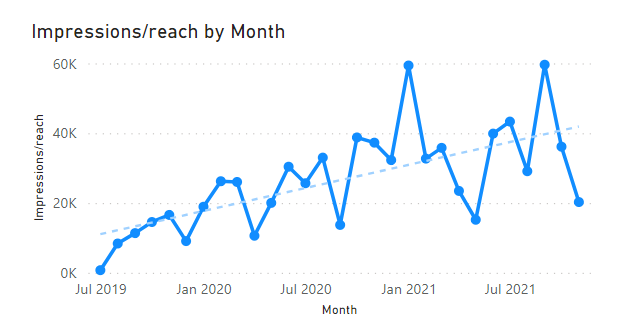
As this has grown, we’ve found that more people who see our content each month has trended upwards (see graph below).
You don’t start with a NextDoor-sized following (those generous people giving us five-figure audiences), but you’ll probably have a few thousand. We started at 2,500.
We’ll top 400,000 impressions in 2021 and that’s the kind of awareness which I’m sure all public bodies want to tap into.
Easier to repurpose
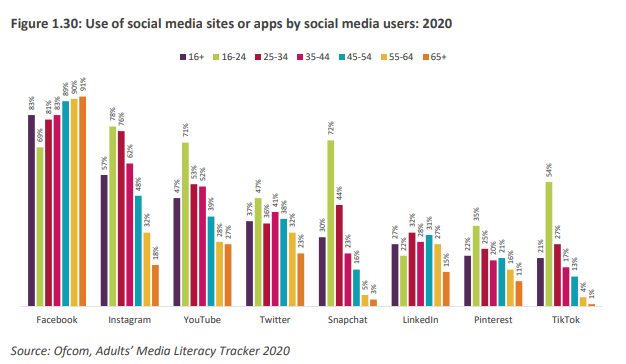
The Ofcom Online Nation 2021 report says 27 per cent of adults aged 16 or older use LinkedIn, making it the sixth most popular social media platform.
But crucially it’s the third most popular where the content is arguably not video-led, like Instagram (second), YouTube (third), Snapchat (fifth), and TikTok (eighth).
Your Facebook and Twitter content is more easily put onto LinkedIn than any other channel.
If you’re lucky enough to have one of those social media scheduling tools, you might just need to tick an extra box and make a few changes to your copy.
A simple change to emphasis, or bringing something else to the fore, maximises engagement for LinkedIn. Things we find which always work are:
Shout about great news for your area
Leverage your partners on shared projects
Celebrate your colleagues and their successes
Example: Safe place for successes
For example, this post about the borough being a healthy place to live here.
We find LinkedIn is a place where our great news for our business and our area are celebrated by our audiences.
New film studios in our area and our borough coming top of the ONS health index (see above) are two examples of this in 2021. Both had more impressions (6,000+) than we have followers (less than 4,500 at the time of posting).
On Facebook these items were dampened with pessimism from a few residents, the type all local authorities deal with on that channel.
But on LinkedIn we only see positivity and it helps us to higher engagement rates. Colleagues, residents and partners amplify this with their networks and help us celebrate the success.
We are always happy to be the hook people work from to promote something themselves.
In the public sector partnership working is essential. It’s also essential it’s celebrated.
We find when we draw these partnerships out in our LinkedIn posts, tagging our partners in, they always perform better.
The companies/businesses, and sometimes their staff, we work alongside want to mark these too. People are proud to work with us and bring benefits to our residents.
We’re fortunate to have several large construction projects taking place across the area, linked to additional housing in our borough in recent years.
There’s also a chance to share content, hence some of the excellent video content we’ve been able to promote in the last 12 months.
Put your colleagues at the front of the story
Our work is done by great people. LinkedIn is the right place to talk about them and what they do for us.
Look at your stories. It might work better on LinkedIn if instead of talking about the thing, we talk about the person who did the thing.
Or we make sure we factor the people who were involved into the wording of a post in a way we wouldn’t on another channel.
We’ve all had to re-nose a news story or press release, apply the same to your social content for LinkedIn and you’ll see the engagements jump up.
And if you are using LinkedIn for recruitment, no potential staff member is going to be deterred by a workplace that shouts about the great work of its colleagues.
But what does the data tell us?
These points of focus have helped us more than double our following in two years, with consistent growth in the number of people who see our content and engage with it.
In the last year, we’ve seen total engagements alongside audiences of local authorities with followings five times ours (see table below). LinkedIn provides this data for ‘competitors’ in its native analytics if you’re interested.
There’s no competition for audience but it helps to know if what we’re doing is resonating and providing value to those who do see our content relative to similar organisations.
Council
Followers
Posts
Engagements
Average engagements per post
Engagements to followers ratio
Wokingham Borough Council
5,640
288
8,393
29.14
1.4881
County council 1
26,111
216
8,543
39.55
0.3272
County council 2
26,674
195
8,777
45.01
0.3290
New, large unitary
4,983
488
7,016
14.38
1.4080
Similar sized unitary
6,536
241
2,848
11.82
0.4357
Data correct as of 13 December 2021
Make it work for you
If it’s a channel you’re already using or one you’re looking to unlock, these are a great place to start with adapting some of your content from other channels.
Lift and shift. Repurpose with purpose. It won’t involve a 9:16 video.
You could bring lots more eyeballs on some of your biggest projects and get to highlight your perfect partnerships or celebrate your colleagues. After the last few years, we could all do with a bit of the latter.
Connor McLoughlin is senior communication, engagement and marketing specialist at Wokingham Borough Council.
Here they are in the list as the highest UK channel in 5th behind global brands Alphabet (i.e. Google) Meta (i.e. Facebook), Amazon and Microsoft.
Why is this significant?
It’s significant because it represents a reminder of the importance of traditional media and that they are re-inventing themselves.
It’s a reminder to take local media seriously.
Reach plc have more than 100 print newspaper titles and more than a dozen web presences like Staffordshire Live. They also have national titles The Daily Express and Daily Mirror.
Reach have done some great work with changing from the traditional print focussed model to the hybrid of print and web.