
Because you’re on the ball, you’ll know Meta are rolling out the biggest change to social media in decades.
Called Meta One, this subscription model brings in pay-to-play for pages for links and reach with basic prices starting at £150 a year rising to £5,000. For that you get one Facebook page, one Instagram account and one WhatsApp for Business account covered.
I’ve blogged how the changes that will impact Facebook pages as well as Instagram and WhatsApp. If this is news, you may want to catch-up here.
But judging by an email from a concerned local government communicator, Government pages are banned.
So, I looked and they’re right. They are banned.
Buried in the terms and conditions is the line:
Meta subscription paid benefits are not currently intended for use by government or political entities, including politicians. Failure to comply may result in subscription revocation.
In other words, if you are a Government account you can’t take advantage of the benefits a subscription has to offer.
Third Sector admins are clear to pay for it. So, its an expensive sigh of relief of sorts.
The only category exempted from having to pay for Meta One at all are publishers. For now.
What the Meta One Government ban means for public sector pages
This makes a tricky situation trickier.
Many people who I’ve spoken to have said they refuse to pay for a Meta One subscription. In the cold light of day those people may change their minds. But if your page is marked ‘Government’ you flat out aren’t able to.
But here’s the thing. Not every public sector page is marked as ‘Government.’
You can tell how the page admin have classed the page by looking at it.
For example,
The DVLA is Government.
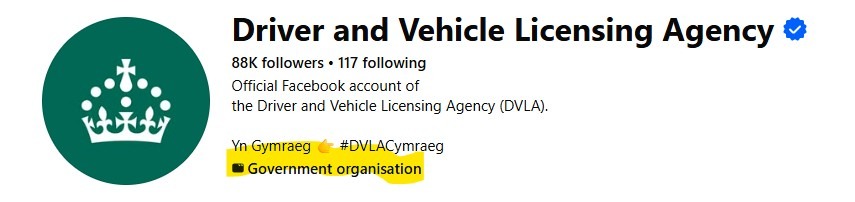
But their publication the Highway Code page is classified as a ‘book’.

So, on the face of it, one page can take out a subscription while the other can’t.
There is no seperate explanation for this. But Meta’s own Code of Conduct requires itself to be politically neutral.
So politicians AND Government are taken out of paying for Meta One benefits.
How does the Meta One subscription Government ban impact the public sector?
It depends.
I’ve taken a look at more than 100 UK Facebook pages from local government, police, fire and rescue, NHS and Government Agencies such as the Environment Agency in England and the heritage organation Historic Scotland.
Here’s the lesson:
- A majority of Government agencies as well as fire & rescue are classed as ‘Government’ on Facebook.
- A minority of local government and police are classed as ‘Government.’
- One in 10 NHS pages are classed as ‘Government.’
All this means that SOME could technically take out a subscription while others are blocked outright.
Here’s the data:
For local government
As a brief straw poll, I chose a council in the Midlands and went through the 19 Facebook pages listed on their website. Less than half were marked as ‘Government’ pages. But others were not.
In this case, the public health Facebook page was marked as ‘Medical & Health’ while a series of community pages created for towns in the county was marked as ‘community.’
If you were local government and were admin of, say, a theatre page marked as ‘Arts & Entertainment’ you could have a reasonable expectation that Meta’s robots may not realise you are in fact a council-run page.
For Fire & Rescue
I counted 10 of the 19 fire service pages from an English county classed as ‘Government’ Facebook pages. The corporate page absolutely was classed as ‘G’. But community fire stations were split between Government and ‘Fire Station’, ‘Interest’ or even ‘Emergency Response.’
For NHS
I went through more than 20 Scottish NHS pages and a combination of corporate pages, service pages and hospital charities. This time, three were classed as Government page including the NHS Scotland Facebook page.
Others were classed as ‘hospital’, ‘non-profit’ or ‘charity.’
For police
I looked at police pages in Northern Ireland and Wales. The split was eight Government and 16 not directly listed as Government. So, definitely classifying was the Northern Ireland Policing Board page but other pages were not so direct. South Wales Police Swansea & Neath Port Talbot was ‘law enforcement agency’ while Police East Belfast was ‘Police Station.’
So, not strictly Government but government adjacent.
For Government Agencies
Across the UK, more than two thirds of agencies checked like Environment Agency as ‘Government’ on Facebook. Meanwhile, Nature Scot is classed as ‘environmental conservation organisation’, National Trails is ‘hiking trail’ and Historic Scotland is ‘NGO’.
So, if you’re not classed as ‘Government’ on a Facebook page you’re alright?
To answer this question, I think we all have to take a deep breath and count to 10.
Can you change your status away on an existing page to a more Meta One-friendly one? I’d bet they have that avenue covered.
But it does raise the question for pages not classed as ‘theatre’, ‘health’, ‘venue’ or even ‘fire station’ or ‘community.’ On the face of it, you’re good to go. Until you are not. The choice is yours.
But part of me makes me wonder about the risk of building a strategy on sand.
It all points to communicators using Facebook quite differently in future. I’ve blogged some workarounds here.
For more, I deliver training to help you make sense of the changing landscape.
ESSENTIAL AI FOR PUBLIC SECTOR COMMS
ESSENTIAL COMMS SKILLS BOOSTER
ESSENTIAL VIDEO SKILLS REBOOTED.
Creative commons credit: Stop sign along Swepstone Road by Mat Fascione.