Back in the olden days all a press officer had to do was a write a press release and book a photo call.
Boy, how things have changed and more to the point are changing rapidly.
How web 2.0 and web 3.0 will affect the communications unit – or press office in old money – is something that I’ve spent a great deal of time mulling over. Why? Because it’s my job.
I’m a senior press officer at Walsall Council. The job I walked into in 2005 is almost unrecognisable to the one I do now. Yes, it now includes, Twitter, Facebook and other forms of social media – or web 2.0 if you are a bit of a geek. But it’s also open data and the challenges of web 3.0.
The nice people from Local Government Improvement and Delivery have asked me to lead a session at their Local by Social online conference on November 3 2010 at 3pm. Looking at the speaker line up it’s something of an honour. There’s plenty for people to get their teeth into on a whole range of subjects.
I’d very much like to hear what your thoughts are. Take part ion the session. Chip in. Listen. It’s all fine.
Firstly, here is a presentation designed as a starting point and to get the ball rolling…
Secondly, here are a few thoughts I blogged a month or two back. You can read the full version here.
In the days before the web the press office needs to:
Have basic journalism skills.
Know how the machinery of local government works.
Write a press release.
Work under speed to deadline.
Understand basic photography.
Understand sub-editing and page layouts.
For web 1.0 the press office also needed to:
Add and edit web content
For web 2.0 the press office also needs to:
Create podcasts
Create and add content to a Facebook page.
Create and add content to a Twitter stream.
Create and add content to Flickr.
Create and add content to a blog.
Monitor and keep abreast of news in all the form it takes from print to TV, radio and the blogosphere.
Develop relationships with bloggers.
Go where the conversation is whether that be online or in print.
Be ready to respond out-of-hours because the internet does not recognise a print deadline.
For web 3.0 the press office will also need to:
Create and edit geotagged data such as a Google map.
Create a data set.
Use an app and a mash-up.
Use basic html.
Blog to challenge the mis-interpretation of data.
But with web 3.0 upon us and the pace of change growing faster to stay relevant the comms team has to change.
Oh, the weather outside is frightful but the idea of doing cool things is always delightful.
Last year, the idea of tweeting when your gritters was going out was revolutionary.
Around half a dozen councils were leftfield enough to do it and the idea spread.
Public sector web standards organisation SOCITM picked up on it making it mainstream with their report for subscribers.
Is that enough?
Can we stand still now?
The fact is local government needs to innovate like never before.
Someone famous once said when you innovate, you’ve got to be prepared for everyone telling you you’re nuts.
So, where’s the innovation this year? Here’s some ideas and pointers on how straight forward they are…
1. MAP YOUR GRIT ROUTES
In the West Midlands, there’s some amazing innovation from mapping geeks.
Bright people from Mappa Mercia including the excellent Andy Mabbett last year built a grit map on Open Street Map to show grit routes in Birmingham. They dug out the routes from pdfs on the council website.
Birmingham City Council have linked to it from their transport pages and we at Walsall Council are tweeting it when the weather gets bad.
That’s a good example of working with a talented and community-minded online community.
Advantage: Community engagement.
Disadvantage: You need mapping geeks to be grit geeks too.
2. TWITTER GRITTER
Everytime you go out you tweet the fact. If you’re not doing it you should. It’s not enough to provide a service at 2am. You need to tell people. Why? Because they won’t know your council tax is being spent in such a way and they may well ring your harrassed staff at a time when they are thinly stretched.
Advantage: Community engagement. Cuts down unneccesary contact.
Disadvantage: You’ll need some kind of rota or it’ll all fall on one person’s shoulders.
3. YOUTUBE
A short clip to explain what the gritting service is all about. Shot on a Flip video It’s a good way of communicating what is being done.
Embedding the video in the service’s pages should be straight forward. Linking to YouTube and posting via Twitter and Facebook is easy. Tweet the link when you’re team are hitting the road
Advantage: Creates blog-friendly web 2.0 video content.
Disadvantage: You need a Flip video. The process isn’t instant.
4. MAP GRIT BIN LOCATIONS
Publish grit routes as open data? Why not.
But beware the perils of derived data that quicksand argument that means anything based on Ordnance Survey is mired in dispute.
Advantage: Publishing open data increases transparency
Disadvantages: It can’t be based on OS maps.
5 FACEBOOK
As local government Facebook sites mature and grow there’s more reason to post grit updates there too.
Drawbacks? Not all phones will allow you to post to fan pages and you may have to log on at a PC or a laptop.
Advantage: You reach the massive Facebook demographic.
Disadvantage: Your Facebook fanpage is harder to update than a profile.
6. LIVE TWEET
A trip around the borough in a gritter with a camera phone geo-tagging your tweets. It works as a one off and builds a direct connection.
At Walsall, we tweeted the testing of the gritters in a dry-run for winter including geotagged shots from the cab itself as it trundled around the streets.
Advantage: A service from a different perspective.
Disadvantage: Labour and time intensive.
7. TEXT AND EMAIL ALERTS
Sometimes we can be so struck by new gadgets that we can forget the platforms your Dad and mother-in-law have.
Simply speaking, there are more mobile phones in the UK than people.
Many councils are charged around 8p a text to issue an SMS. That’s a cost that has to be picked up from somewhere. But using the standard costs per enquiry of around £7 face-to-face and £5 over the phone the 8p charge starts to look viable.
Advantage: You can reach large numbers of people and cut down potentially on unavoidable contact.
Disadvantage: It costs.
8. BIG SOCIETY TWITTER GRITTER
Not every council has the resources to tweet its gritting. In Cumbria, the community of Alsthom high in the dales regularly gets cut off in the snow. Fed-up with the council response the town clubbed together to buy their own gritter.
Community and digital innovator John Popham floated the interesting idea of the community stepping in to tweet gritting activity. In effect, a Big Society Twitter Gritter It’s a fascinating idea, would share the burden and may fill the gap where a council doesn’t have the digital skills or the staff.
Advantage: If there are residents willing it’s a good partnership potentially.
Disadvantage: It’s dependent on volunteer power.
9. QR CODES
What are they? Funny square things that your mobile phone can identify and can download some information about. I don’t pretend to fully understand them and I’m not sure if they’ve reached a tipping point in society just yet. However, Sarah Lay of Derbyshire County Council is looking at adding QR codes to grit bins to allow people to report problems. It’s a fascinating idea that needs looking at.
Advantages: Tech-savvy citizens can use them to pinpoint problems.
Disadvantages: A format that is still finding traction amongst the rest of the population.
10. OPEN DATA
What can you publish as open data? Wrack your brains and consult the winter service plan. There’s grit routes themselves. There’s the amount of grit stockpiled. There’s the amount of grit spread day-by-day.
Advantage: Open data is good for transparency.
Disadvantages: Day-by-day updating could be tricky as engineers are snowed under. If you’ll forgive the pun.
Links:
Creative commons:
Walsall grit pile Dan Slee http://www.flickr.com/photos/danieldslee/5087392858/
Four Seasons bridge http://www.flickr.com/photos/fourseasonsgarden/2340923499/sizes/l/in/photostream/
Twitter gritter Dan Slee http://www.flickr.com/photos/danieldslee/5115786276/
Jerry Springer built a TV career by making people in dysfunctional relationships sit down and talk to each other.
With burly minders flanking the stage Billie-Jo and her ex-lover Seth from an Arkansas trailer park would set-to in front of a studio audience.
Gripping stuff it was too, but you had this feeling nothing would change.
Two parties in a sometimes strained relationship came together at Hyperlocal Govcamp West Midlands in Walsall.
The session ‘What does a good blogger – press officer relationship look like?’ saw bloggers sit down with press officers.
For some, it was the first time they’d ever spoke to the other side.
Like a parish pump Relate, there were sometimes a few choice words. But unlike the warring couples on TV there was a growing appreciation of the points of view.
It’s a session that has been extensively covered.
Local government officer Simon Gray, who is not from communications, blogged brilliantly about the session here. When he said neither side appeared with full credit, he’s right.
He’s also dead right in calling on both sides to cut the other some slack.
Paul Bradshaw writing a guest post for Podnosh made some excellent points in how local government should make information easier to access.
Mike Rawlins, of Talk About Local, who also contributes to Pits N Pots in Stoke-on-Trent has written an excellent post from his perspective on this and dead badgers and does, as Simon suggests, cut some slack.
Sasha Taylor has also blogged from the session from a police perspective.
Twelve months ago I wrote a blog post on how the blogger – press office relationship was a source of conflict.
The 10 points I wrote then I still stand by. The full post is here. The edited highlights are boiled down to this
FIVE THINGS A PRESS OFFICE CAN DO:
Treat them as journalists.
Put them on press release mailing lists.
Use blog comment boxes as a press officer.
Accept not everything bloggers write is going to be favourable. Complain politely – and constructively – if things are wrong.
Respect what bloggers do.
FIVE SUGGESTIONS FOR BLOGGERS:
If you have courage of your conviction put your name to what you do you’ll find your voice getting heard far better.
Don’t be afraid to check stories.
Respect press officers. They have a job to do too.
Be accurate. The same rules for newspapers apply to blogs.
Buy a copy of McNae’s Essential Law For Journalists to save your life and potentially your house.
But listening to the both sides talk at the session, there’s also a few things a bright press officer can do.
1. Create blog friendly content – A conventional press release is tailored for the print media. That’s not necessarily blog-friendly. A short film posted to YouTube or Vimeo is. A two minute film to explain with an interview the points made in the release would work.
2. Add pics as a matter of course – Even if it’s a stock pic. Mike Rawlins of Talk About Local made the point that there is a demand for images. They’re going to source a pic from Google images anyway. Why not provide a good one?
3. Judge when to respond – the excellent Michael Grimes of the Citizenship Foundation re-purposed the US military’s flowchart of engagement with bloggers. It’s good advice when to engage and when to ignore the internet troll.
4. Build relationships – In print media you know you’ll get a better story about countryside placing it with a reporter who is passionate about green issues. So why not do it online too?
6. Learn about open data. It’s not a geek topic anymore. It’s come into the mainstream and bloggers are at the forefront. Local data advisor and hyperlocal blogger Will Perrin has pointed out that press officers will need excel skills. Why? Because you’ll need to interrogate data sets just as you’ll need to leaf through council minutes.
Creative commons credits:
No papers today – Katmere http://www.flickr.com/photos/katmere/51065495/sizes/m/in/photostream/
Antique clippings – D Sharon Pruitt http://www.flickr.com/photos/pinksherbet/4799271086/
It should be a quiz question: ‘Who is the biggest football team in the world on Facebook?’
You’d be forgiven for thinking it’s a major power of world football like Barcelona, Manchester United or Stoke City.
Here’s the surprise answer: Galatasaray.
Galatasaray? They’re a Turkish team formed in 1905. They’ve never won the European Cup but have a passionate army of supporters.
A third of all Turks support the team in a country that is the fourth largest on Facebook. That’s not even counting the huge world wide diaspora of Turks.
In 1993, Galatasaray supporters in a firey stadium of noise, flags, chants and flares met Manchester United with the banner: ‘Welcome To Hell!‘
In September 2010, 16 months after they set-up a Facebook page they had 4.5 million followers.
There’s a great blog in The Independent on how they did it. You can read the original here.
But whats this got to do with local government?
Because a Turkish football team and its fans have come across some universal truths that can work for other areas.
Here are four killer quotes from one of the club’s online team Ebubekir Kaplan that sum up the success….
INFORMATION: “They trust in us to give them information directly we respect their need and desire to know things directly from the club.”
SOCIAL: “Turkish people want to be socialable via Facebook and we’re using the right tools to reach them.”
FANS:“Players come and go, managers come and go, club officials come and go, but fans are constant. They’re the most important people.”
LISTEN:“We have to listen to supporters under all circumstances. So the main value is an outlet for the fans, and for communication with the fans.”
Okay, so maybe people aren’t quite as passionate on the face of it about local government as a football team.
But people DO form a passionate bond with places and that’s where the lessons start to come into play.
People may love their park, love their favourite bit of countryside or maybe their library.
Maybe they’re passionate about a venue or a museum or more to the point an exhibition at the museum.
Would activity on Facebook before and during help capture memories on an exhibition on coal mining in the Black Country, for example?
EDIT: From Istanbul on Twitter @kaanozkan_ wishes to point out that Galatasaray won the UEFA Cup beating Arsenal in 2000. Disliking Arsenal as I do – but not all their supporters – I’m happy to point that fact out : )
Creative Commons:
Curoninja: Fan Cop http://www.flickr.com/photos/curoninja/777611157/in/faves-danieldslee/#
Get out of the social media bubble, talk to real people and you may be surprised.
Digital skills may be valuable online but offline they’re part of a mix of things needed to make an event work.
One blogger has argued that its such a part of her life she didn’t think of ‘social media’ as such anymore. It’s part of life.
That’s fine for digital natives. But that’s not the case for people like Walsall artist Alan Cheeseman.
Together with a team of like-minded volunteers he helped stage a festival in the Caldmore in Walsall in the West Midlands.
Walsall Council chipped in with funding and support. So did social housing provider whg, the National Lottery and one or two other places.
Where’s Caldmore? First, it’s pronounced karma. Narrow Victorian terraced streets crowd around a small green hardly big enough to host a cricket square. Legend has it that Boy George lived there in his Walsall days.
Sari shops, balti houses, pubs and shops that sell cheap calls to the Indian sub-continent dominate the shopping area.
It’s a place where migrant workers settled amongst the indiginous English to take low-paid jobs in factories. The communities have remained while the factories they came to have gone to the wall.
It’s a place a mile square of three churches, a mosque and a Sikh temple.
It suffers from deprivation, crime and suffers the stigma of a prostitution problem that has eased.
But as the Caldmore Village Festival shows, the place has a powerful resilience and a creative and community-minded people.
In part its scores of micro-communities around the mosque, the church, the pub or the temple.
For this event they came together.
More than 11,000 came to 15 venues across three days for the festival.
Kibadi, Bollywood dancing, live music and dance brought people in. So did the Pakistani sport of stone lifting. An amazing sight where men lift carved stone.
Ask Alan what made it worth while and its not the numbers that excite him. It’s the little stories. It’s getting the tearaway kid to put a volunteer’s orange bib on and give him what could be the first piece of responsibility he’s ever known.
But what role did social media have in all this?
“Things like the internet. That’s for educated people really, isn’t it?” says Alan.
“I’m not sure how much of what we did actually helped.”
It’s a fair point and you have to admire Alan’s honesty.
In Walsall,the percentage of people online every day is below the national average of 60 per cent.
Caldmore is the place the Talk About Local project was invented for.
An initiative to bridge the digital divide and equip communities with an online voice the initiative trained Alan and set him up on a blog.
Sessions open to all backgrounds were run at a neighbourhood resource called Firstbase by community worker Stuart Ashmore where the basics of WordPress were explained.
As a tool for communities this blogging platform is as powerful as a printing press in the 19th century.
Easy to use and simple to master it gives an online presence to anyone with an internet connection.
Alan explained: “We used the blog. We’d update it maybe once a month and we had links to it coming from around 50 other sites.”
Alan was quietly impressed at the digital waves he did make: “I was quite suprised to see 1,000 hits in the week before the festival started.”
But as Alan says the main lesson is to see digital as just one part of the jigsaw. That’s something some forget. It may reach some people. It won’t reach everyone. So what does?
“Networking helps,” says Alan. “A piece in the local paper helps. So do leaflets.
“We made contact with several organisations and we found that their agenda was similar to ours in many places.
“But face to face is really helpful too. It is like a jigsaw. By doing several things you’ll reach a lot of people.”
In effect, Alan was doing the things that work on the web in the real world.
The message to the online community? Online is part of the answer. It’s not the answer on its own.
Or to put it simply, the equation is this:
Face-to-face + networking + leaflets + digital + newspaper support + community groups + public sector + council staff + ward councillors = a successful community event
The Caldmore Village Festival’s digital footprint…
Blogging – A WordPress blog with monthly updates.
Flickr – Walsall’s Flickr group members were invited along to the event too were made welcome. Some amazing pictures came out of it. A group was created as a repository for images.
Plug into the blogging eco-system – Walsall news aggregator The Yam Yam – named after the way Walsall people are supposed to speak – plugged the event through its website, it’s Twitter and Facebook streams.
Twitter support – Walsall Council Twitter stream @walsallcouncil linked to new blog posts.
Link support – Links to the blog ended up on around 50 sites.
YouTube – A short film of the stone lifting attraction helped raise the profile.
Ideas for future online activity…
1. Twitter — A face to the organisation on the @hotelalpha9 would work brilliantly. Or simply a festival stream.
2. Facebook — In Walsall, Facebook is the platform of choice with 197,000 people registered in a 10 mile radius. A fan page for the festival will capture that support.
3. Flickr — Use the images from year one to promote year two. Bring the Flickr group back for a second year.
4. Foursquare — Add the venues to the geo-location game. Leave tips for things to do.
Good pictures leap from a page to celebrate, amaze and tantilise.
Poor pictures shout loudly. But not in a way you’d like.
One source of good pictures is the website Flickr which has more than four billion images. It’s something I’ve blogged about before.
What’s on there? Think about any subject and there will be pictures. A whole heap of them. And Flickr groups too. It’s the civilised corner of the web where people are constructive and are happy to licence their images through a Creative Commons licence.
Residents have self-organised and are daily taking an avalanche of brilliant pictures.
It can be a community around a love of countryside. Or of cats. Or a geographical community brought together by an area.
In Walsall, a borough of 250,000 near Birmingham in the UK that’s expecially the case. There are more than 100 members, 5,000 images and a vibrant Flickr group.
People like Steph Jennings, Lee Jordan, Stuart Williams, Beasty, Tony M, Nathan Johnstone and others do brilliant things.
At Walsall Council, we looked at their shots we wondered aloud how good it would be to showcase their shots on the council website. After all, people taking pictures of the place they live and seeing them showcased on their council’s website HAS to be a good idea.
Our head of communications Darren Caveney and web manager Kevin Dwyer picked the ball up and ran with it.
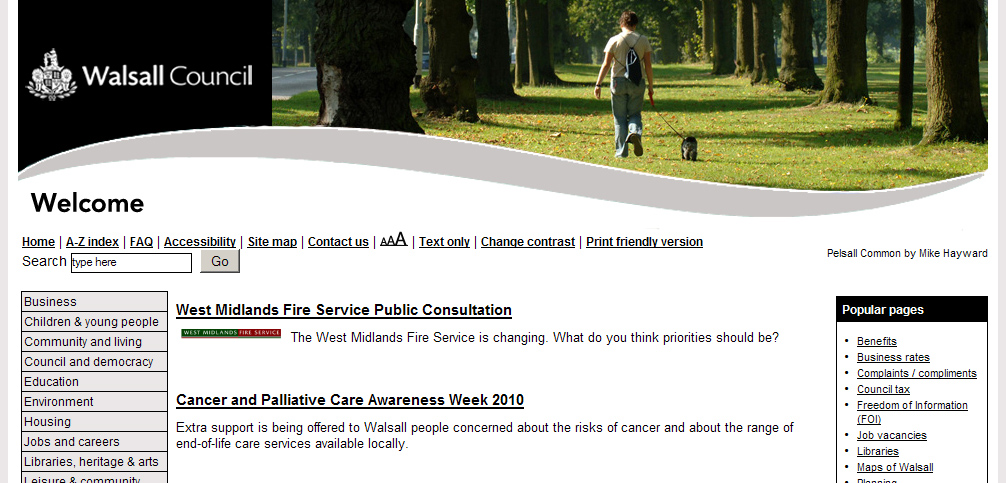
As part of a web refresh, Kev designed a Flickr friendly header that woud apply across all pages.
Next the pictures. A comment was posted on the Walsall Flickr pages to flag up what we were looking to do. We asked people to add the tag ‘walsallweb’ to each individual picture if they wanted the shot to be considered.
We were staggered to get more than 400 shots tagged for consideration in three days. An amazing response that showed the community support.
The postbox shape of the header ruled out scores of images. We also steered clear of people shots because of any problems with permissions.
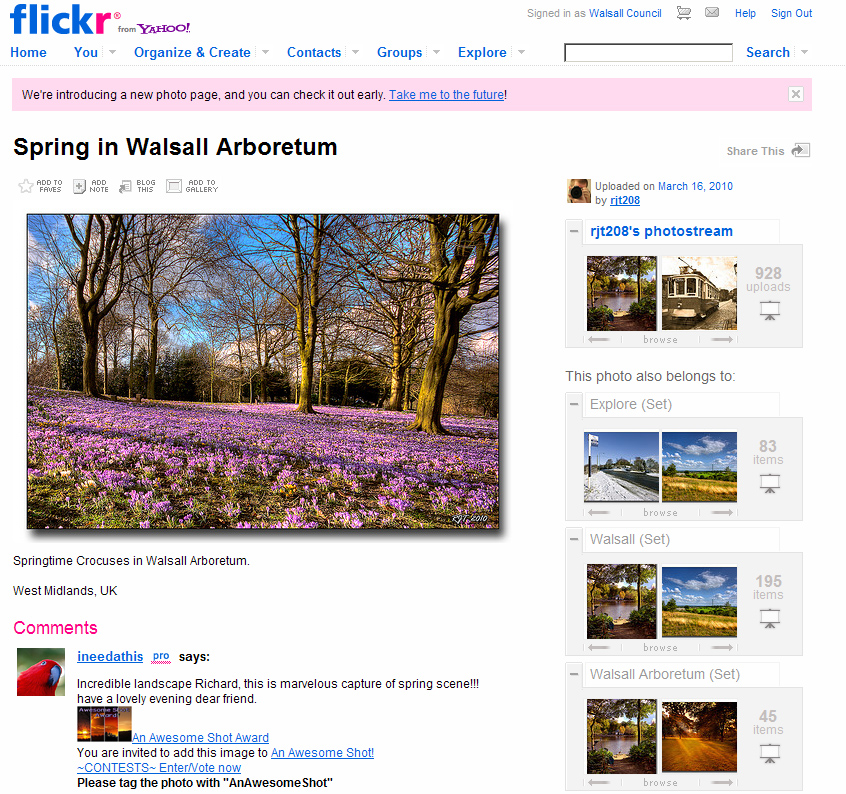
The first shot was a canalside image. By linking back from the council site to the original Flickr image we embraced the web 2.0 approach of sharing.
The image got more than 150 hits in just over two weeks.
1. Ask permission. Photographic copyright by default lies with the photographer. Even if there is a creative commons licence available I’d still ask. Just to be on the safeside.
2. Ask permission to name and link back to the original picture too. For some people photography is a hobby they don’t want publicity for.
3. Rotate images. Try and use pictures from around the borough. Not just the photogenic park.
4. Rotate photographers. Share the love around.
5. Use freelance pictures too. But ask permission. The licence you may have originally negotiated may only be for print use, for example.
6. Be seasonal. A cornfield in summer sun looks great in August. It may not be so at Christmas.
7. Change the shot regularly. Two or three weeks is enough to freshen up the site.
8. Stage a competition to encourage participation. Post a topic.
9. Use Flickr images across the site. A cracking shot of a park would work well on the park pages, for example.
10. Be aware of your policies towards people. Do you need to get permission forms signed in order to use the image for publicity.
11. Join Flickr. Contributing to the Flickr community is a good way to build bridges and understand how it works.
12. Acknowledge using a shot via a comment under the picture from the council Flickr account. Comments are a social part of Flickr and a way to give praise.
13. Create a gallery. A page on the council website to gather the header screenshots.
14. Stage a Flickr meet. Generate content and allow residents to take shots of their landmarks and building.
15. Showcase your area. It’s a chance to really show off.
16. Skill up. Make sure there is the skills base for several team members to add content.
LINKS:
bccdiy.com – A website for Birmingham put together by bloggers that uses Flickr images brilliantly.
Should this be the only way Local Government uses Facebook? Of course not.
For venues and events it works brilliantly. Anywhere where there is a community it can work. People respond strongly to bricks and mortar far more than they do to institutions. Have a look at the Warwick Arts Centre, New York Public library or Solihull libraries.
There’s four billion reasons why Flickr is brilliant.
Four billion? That’s the number of images uploaded to it over the past five years.
Best bit? You don’t have to be David Bailey to get something out of it. You could be Bill Bailey.
What is Flickr? It’s a photo sharing website. You join as an individual. You upload pictures. You can add them to groups. You can comment on pictures too.
There are tens of thousands of groups on a bewildering range of subjects. Football? Check. Walking? Buses? Cricket scoreboards? Clouds? They all have dedicated groups. There’s even one for Gregg’s shop fronts, believe it or not.
There are also geographical Flickr groups based on areas like the Black Country, Walsall or London.
Why bother with Flickr? Because a picture says 1,000 words. Besides, it’s a brilliant way to capture, celebrate and collaborate.
It’s a cinderella social media platform without a Stephen Fry to champion it. But there is a growing and exciting number of uses for it.
So what are the barriers for people to use it?
Like any platform, there are obstacles. None are insummountable.
There’s the usual cultural issues for an organisation using web 2.0. People can talk to you. You can talk back. You may have blocking issues too.
There may also be concern over images. Surely there’s room for dodgy pictures? Actually, not really. The Flickr community is a hugely civilised place. Your first uploads get checked over before they are seen. People comment constructively.
Isn’t it just for good photographers? No. Amateurs thrive here. Snap away.
How about copyright? Copyright is with the photographer. Even if you’ve commissioned it. Don’t upload someone else’s shots without their permission.
Eleven uses of Flickr in local government
1. Be a dissemenator – Stock photography – Newcastle use it as a way of allowing stock photography to be disseminated. With photographers’ permission. Like Calderdale Council’s countryside team.
8. Be a civic pride builder – Create a Flickr group for an area, like Sandwell Council did.
9. Be a picture tart – Post council Flickr pictures to different groups. Shot of the town hall? Put it in the Town Hall Flickr group.
10. Be a stock photography user – the Creative Commons is a licence that allows the use of shots with certain conditions. There is a category that allows for not for profit use, for example.
11. Be a digital divide bridger – favourite walks or a way to celebrate heritage is an excellent way to encourage people to log on.
There’s eleven. That’s for starters…
Steph Jennings from the Walsall Flickr group and the Lighthouse Media Centre in Wolverhampton made some excellent points at Hyperlocal Govcamp West Midlands on how Walsall Council used images on their website.
This YouTube clip helps explain it:
This blog is based on a session at localgovcamp Yorkshire and Humberside in York (#lgcyh) which also had input from @janetedavis, @allyhook and @barnsley55.
Much kudos to the Walsall Flickr group and to the inspirational @essitam and @reelgonekid.
Like a salmon returning to the river it was born Panini World Cup stickers are back. Irrestible. Alluring. Exciting.
And like those fish battling up stream it sparks something deep inside many men – and yes, it is largely men.
It’s a deep seated yearning to hunt and gather Honduras midfielders. Then stick them into a book.
It’s a desire to tell the world: “Switzerland? Yes, I have the complete team. Even their star midfielder Hakan Yakan.”
What are Panini stickers? They’re adhesive pictures of footballers. But they’re far more than that.
Growing up in the 1980s Panini stickers were the social media of their day.
Armed with a pile of doubles – or swaps – children would show them to other fellow collectors. The ‘got, got, need, NEED!’ commentary gave a status update.
They brought people together. They still do.
Here are some tales of the power of Panini.
1 My brother Paul’s best present
Somewhere on my brother Paul’s book shelf is a tattered Europa 80 Panini sticker book from the European Championships. It cost thirty quid on ebay.
Paul is a reserved man. He’s not given to flights of fancy. The album was the only present I’ve ever given that has caused him to leap from his chair and smile as broad as Marco Tardelli.
It was my way of punching him on the shoulder and saying: ‘Good on you, brother.’
Why? Because it was the first sticker collection we both collected. Not together, of course, but as sibling rivals in a sticker arms race.
We would use a Subbutteo pitch to play tournaments with the stickers as players.
Our mum often asked us why we didn’t join forces and collect them together. Pah! What did she know?
She didn’t understand the thrill of opening a packet of stickers to find Karl Heinz Rumminigge or the Chile foil badge.
2 Panini West Midlands swaps Facebook
Facebook as a platform for swapping. This is inspired. And not just because Russ Cockburn – @dwarfio on Twitter – sent me Stoke City’s Thomas Sorensen.
It’s a case of a digital native using the platform her knows to create something using social media to bring people together. As the Facebook group says ‘bringing the playground to Facebook.’
Si Whitehouse is good at maths. He’s good at lots of things, actually. He worked out how much it would cost to collect a World Cup 2010 sticker album. It’s more than £400.
I’m not sure whether I should be amazed or frightened at the sums of money involved in collecting these things. You’d get better value for money from a Build HMS Victory in 100 easy to follow steps.
They are from Modena. They started in 1960. Two years later they were selling 29 million ‘units’. Their first World Cup collection was 1970. Thank you, Wikipedia.
“We are the news supertanker,” an editor who shall remain nameless recently said. “And these bloggers will be swept aside.”
It’s not a view of hyperlocal sites shared by Marc Reeves who quit as Birmingham Post editor last November.
After more than 20 years in print journalism he moved firmly to digital launching the West Midlands version of thebusinessdesk.com – a site laser targeted at busy business people.
Sitting in Urban Coffee in the heart of Brum’s financial district he cuts a relaxed figure suited but tieless with a healthy tan.
Without the weight of a print works to keep warm and a 200 year old pension fund to service? No wonder he is relaxed.
To the National Union of Journalists Marc in the past has been a figure of suspicion. To the digital community an inspiration.
He’s here at a Jeecamp fringe event to talk to hyperlocal bloggers and students about his experience with his new start-up.
There are only a handful of news people who really understand the new digital landscape. Jeff Jarvis is one. So is the Bristol Editor. Marc Reeves is another.
This event Marc is talking at could just be an exercise of grousing at how journalism is going to the dogs. It doesn’t pan out that way.
Marc carefully explains the thinking behind the site. There’s a few surprises. And some lessons that can be learned by the local government, hyperlocals looking to monetise what they do.
Business people are busy people. They’re at their desk early planning their day. A targeted email with 15 relevant news headlines is sent before 9am. The email links back to the website.
MORAL: They’d looked into their audience. Who it was and how they could best be communicated with. Then they tailored it. They DIDN’T build it Field of Dreams style and hope they’d come.
How do they know what stories are popular?
Google analytics help tell the journalist what stories are popular and which are not. Extra time and effort is then spent on ones which are popular.
MORAL: Don’t work blind. Listen to see what is popular.
Where does content come from?
Refreshingly, it’s fresh copy. Stories emerge from networking, talking to contacts as well as through standard press releases and announcements. They started as a two man team and have increased to six in the West Midlands. With similar sites in Yorkshire and the North West as well as the West Midlands they have a turn-over of around £1 milion. That’s a serious figure.
MORAL: Well written content updated daily can work. Traditional journalism CAN work.
What about paywalls?
What are paywalls? They are barriers to content you need a subscription to get past. They won’t work, Marc says. But they’ll work beautifully to push traffic towards sites like The Business Desk. They won’t work for hyperlocals.
MORAL: Information is free on the web. Think of other ways to be self-sustaining.
So how does the thing pay for itself?
Site advertising pays but increasingly events do too. Niche events that 40 people will pay money for insights on work, for example. They also become ways to built the online community offline too.
MORAL: Don’t look at one way to generate funds.
What about the site traffic?
Unlike newspapers, Marc was hugely free with insights into his site traffic. There’s about 1,200 visitors every day with 2.5 to three page impressions per visit.
This is from a base of 4,282 and 2,400 email subscribers. Small numbers? Maybe. But this is a start-up. And remember, the Birmingham Post used to sell around 10,000 a week.
MORAL: Build a community around a niche.
Email? Isn’t that boring?
It generates 90 per cent of site traffic. That’s big figures. I’ll say that again. It generates 90 per cent of site traffic. That’s not boring. It’s brilliant. It’s not something unique to thebusinessdesk.com. The IDeA Communities of Practice site does something with a daily email update.
MORAL: E-mail is the overlooked communication tool of web 2.0. As late 90s as it is you can reach big numbers through it. It also acts as a tap on the shoulder to remind you that site you signed up to is there.
So, what’s to learn?
I’m convinced there are lessons here, not just for news websites but for web users in general and yes, that does mean the public sector.
1. Think basic. Email may not be sexy. But people use it. In large numbers. Get an email subscription going. Don’t be afraid to be web1.0.
2. Think sustainable (content). Think about how the site will last. Make sure there’s a team not one overworked individual.
3. Think sustainable (finance). Think through how it can last and if not be a not-for-profit at least be a not-for-loss.
4. Research. Put some thought into your audience. Think who you are writing for. Think how and when they’d like content delivered. Be niche.
5. Wear different hats. Be a journalist. Be a marketeer. Be an advertising sales person.