Birthdays are natures way of telling you to eat more cake.
Marvellous, but what exactly does a slice of carrot cake have to say about local government?
Actually, quite a lot. So do mixtapes as a session heard at the excellent Localgovcamp Yorkshire and Humberside revealed.
Why? Two things. First, because it’s all about messing about on a project in your own time so you can learn by your mistakes.
Second, it’s about doing something in a fun, interesting, creative way.
Why Cake? As a wheeze I built a cake blog based on a rash of pictures of cake tweeted by friends from Twitter. It taught me how to crowdsource, how to use WordPress and where a decent piece of carrot cake can be found in the charming Shropshire village of Ludlow (At the Green Cafe since you were wondering. The review is here.) Stuart Harrison (@pezholio on Twitter) then raised the bar with a beer blog.
The excellent Sarah Lay picked up the baton and created a cake map. She got to know about Googlemaps as a result.
Mixtapes? Same principle. A tweet by Sarah sparked a series of blogs, a Flickr group and a Tumblr site. Why? Because mixtapes even in a digital world spark happy memories of taping the top 40 and crafting a tape to say ‘thank you!’ or even ‘actually, I quite fancy you.’
There was even a mixtape built by song contributions at the barcamp built with the help of Janet Davis (@janetedavis).
So what do cakes and tapes teach? In short, go away and experiment in your own time. You can learn. You can do fun things. Then you can transfer some of those ideas to your day job.
Amongst web developers, there is a useful saying: ‘fail forward.’ If you are going to fail, make sure you learn something about it so you can take things just that bit further next time. Messing about on a scheme allows you to do just that, risk free.
Links: Nice ideas that have emerged by messing around…
The United Cakedom map: Really good if you are looking for good places to eat cake in Nova Scotia or the United Kingdom. Zoom in. Click on a tea cup and search to see if there is a good place for cakeage near you…
There’s four billion reasons why Flickr is brilliant.
Four billion? That’s the number of images uploaded to it over the past five years.
Best bit? You don’t have to be David Bailey to get something out of it. You could be Bill Bailey.
What is Flickr? It’s a photo sharing website. You join as an individual. You upload pictures. You can add them to groups. You can comment on pictures too.
There are tens of thousands of groups on a bewildering range of subjects. Football? Check. Walking? Buses? Cricket scoreboards? Clouds? They all have dedicated groups. There’s even one for Gregg’s shop fronts, believe it or not.
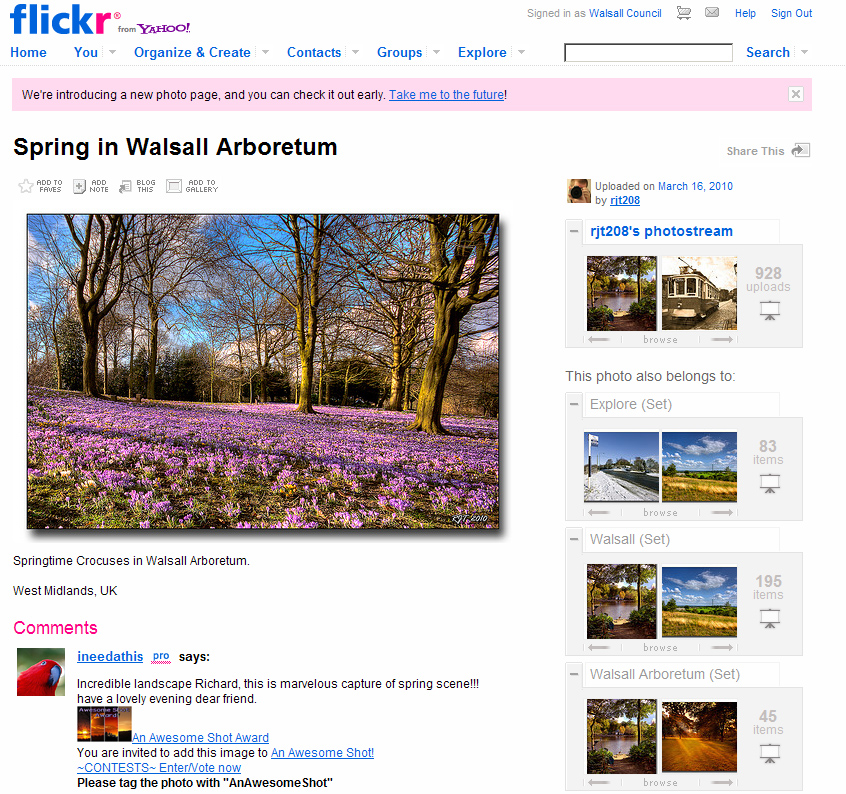
There are also geographical Flickr groups based on areas like the Black Country, Walsall or London.
Why bother with Flickr? Because a picture says 1,000 words. Besides, it’s a brilliant way to capture, celebrate and collaborate.
It’s a cinderella social media platform without a Stephen Fry to champion it. But there is a growing and exciting number of uses for it.
So what are the barriers for people to use it?
Like any platform, there are obstacles. None are insummountable.
There’s the usual cultural issues for an organisation using web 2.0. People can talk to you. You can talk back. You may have blocking issues too.
There may also be concern over images. Surely there’s room for dodgy pictures? Actually, not really. The Flickr community is a hugely civilised place. Your first uploads get checked over before they are seen. People comment constructively.
Isn’t it just for good photographers? No. Amateurs thrive here. Snap away.
How about copyright? Copyright is with the photographer. Even if you’ve commissioned it. Don’t upload someone else’s shots without their permission.
Eleven uses of Flickr in local government
1. Be a dissemenator – Stock photography – Newcastle use it as a way of allowing stock photography to be disseminated. With photographers’ permission. Like Calderdale Council’s countryside team.
8. Be a civic pride builder – Create a Flickr group for an area, like Sandwell Council did.
9. Be a picture tart – Post council Flickr pictures to different groups. Shot of the town hall? Put it in the Town Hall Flickr group.
10. Be a stock photography user – the Creative Commons is a licence that allows the use of shots with certain conditions. There is a category that allows for not for profit use, for example.
11. Be a digital divide bridger – favourite walks or a way to celebrate heritage is an excellent way to encourage people to log on.
There’s eleven. That’s for starters…
Steph Jennings from the Walsall Flickr group and the Lighthouse Media Centre in Wolverhampton made some excellent points at Hyperlocal Govcamp West Midlands on how Walsall Council used images on their website.
This YouTube clip helps explain it:
This blog is based on a session at localgovcamp Yorkshire and Humberside in York (#lgcyh) which also had input from @janetedavis, @allyhook and @barnsley55.
Much kudos to the Walsall Flickr group and to the inspirational @essitam and @reelgonekid.
Like a salmon returning to the river it was born Panini World Cup stickers are back. Irrestible. Alluring. Exciting.
And like those fish battling up stream it sparks something deep inside many men – and yes, it is largely men.
It’s a deep seated yearning to hunt and gather Honduras midfielders. Then stick them into a book.
It’s a desire to tell the world: “Switzerland? Yes, I have the complete team. Even their star midfielder Hakan Yakan.”
What are Panini stickers? They’re adhesive pictures of footballers. But they’re far more than that.
Growing up in the 1980s Panini stickers were the social media of their day.
Armed with a pile of doubles – or swaps – children would show them to other fellow collectors. The ‘got, got, need, NEED!’ commentary gave a status update.
They brought people together. They still do.
Here are some tales of the power of Panini.
1 My brother Paul’s best present
Somewhere on my brother Paul’s book shelf is a tattered Europa 80 Panini sticker book from the European Championships. It cost thirty quid on ebay.
Paul is a reserved man. He’s not given to flights of fancy. The album was the only present I’ve ever given that has caused him to leap from his chair and smile as broad as Marco Tardelli.
It was my way of punching him on the shoulder and saying: ‘Good on you, brother.’
Why? Because it was the first sticker collection we both collected. Not together, of course, but as sibling rivals in a sticker arms race.
We would use a Subbutteo pitch to play tournaments with the stickers as players.
Our mum often asked us why we didn’t join forces and collect them together. Pah! What did she know?
She didn’t understand the thrill of opening a packet of stickers to find Karl Heinz Rumminigge or the Chile foil badge.
2 Panini West Midlands swaps Facebook
Facebook as a platform for swapping. This is inspired. And not just because Russ Cockburn – @dwarfio on Twitter – sent me Stoke City’s Thomas Sorensen.
It’s a case of a digital native using the platform her knows to create something using social media to bring people together. As the Facebook group says ‘bringing the playground to Facebook.’
Si Whitehouse is good at maths. He’s good at lots of things, actually. He worked out how much it would cost to collect a World Cup 2010 sticker album. It’s more than £400.
I’m not sure whether I should be amazed or frightened at the sums of money involved in collecting these things. You’d get better value for money from a Build HMS Victory in 100 easy to follow steps.
They are from Modena. They started in 1960. Two years later they were selling 29 million ‘units’. Their first World Cup collection was 1970. Thank you, Wikipedia.
Think there’s a lack of good resources to get your head around open data? Not any more.
Two bright people – and me – have drawn up an easy to follow blog post and data wiki
to marshall argument and counter argument.
There’s also a series of links to more resources, examples and case studies.
Why bother? Two reasons. Firstly, open data is a revolution that’s sweeping government both national and local. Politicians in the US, UK and further afield recognise it is a vital tool for transparency and just plain better democracy.
Second and most important reason for the sites? Because there are lessons to learn from social media.
In 2008 visionaries in local government were seen to be taking risks by adopting social media platforms like Twitter and Facebook.
What helped win internal arguments were websites like this (insert link) that helped marshall arguments and build a repository of case studies.
I’m convinced the local data blog can play a role in doing the same.
It’s a true collaborative effort between two hugely talented people Michael Grimes from the Citizenship Foundation, Stuart Harrison from Lichfield Council and myself whose day job is at Walsall Council.
It occurred to all of us that a resource like this would be helpful after meeting at the West Midlands local data panel which helps feed back ideas to the people behind the excellent UK data respository data.gov.uk.
It aims to be a place to read arguments and counter arguments for open data and also to help answer the question ‘what is open data?’
In the spirit of web 2.0 and open data we are throwing open our effort to colleagues from the public sector and importantly to citizens too.
Go and have a look. Comment. Add a link or an argument.
It was Charles Dawin who wrote: “In the long history of human kind (and animal kind too) those who learned to collaborate and improvise most effectively have prevailed.”
We’d be happy if you came to the site to collaborate. Or failing that just come and have a look at the trams scooting about on the Helsinki realtime tram map. They’re utterly brilliant.
“We are the news supertanker,” an editor who shall remain nameless recently said. “And these bloggers will be swept aside.”
It’s not a view of hyperlocal sites shared by Marc Reeves who quit as Birmingham Post editor last November.
After more than 20 years in print journalism he moved firmly to digital launching the West Midlands version of thebusinessdesk.com – a site laser targeted at busy business people.
Sitting in Urban Coffee in the heart of Brum’s financial district he cuts a relaxed figure suited but tieless with a healthy tan.
Without the weight of a print works to keep warm and a 200 year old pension fund to service? No wonder he is relaxed.
To the National Union of Journalists Marc in the past has been a figure of suspicion. To the digital community an inspiration.
He’s here at a Jeecamp fringe event to talk to hyperlocal bloggers and students about his experience with his new start-up.
There are only a handful of news people who really understand the new digital landscape. Jeff Jarvis is one. So is the Bristol Editor. Marc Reeves is another.
This event Marc is talking at could just be an exercise of grousing at how journalism is going to the dogs. It doesn’t pan out that way.
Marc carefully explains the thinking behind the site. There’s a few surprises. And some lessons that can be learned by the local government, hyperlocals looking to monetise what they do.
Business people are busy people. They’re at their desk early planning their day. A targeted email with 15 relevant news headlines is sent before 9am. The email links back to the website.
MORAL: They’d looked into their audience. Who it was and how they could best be communicated with. Then they tailored it. They DIDN’T build it Field of Dreams style and hope they’d come.
How do they know what stories are popular?
Google analytics help tell the journalist what stories are popular and which are not. Extra time and effort is then spent on ones which are popular.
MORAL: Don’t work blind. Listen to see what is popular.
Where does content come from?
Refreshingly, it’s fresh copy. Stories emerge from networking, talking to contacts as well as through standard press releases and announcements. They started as a two man team and have increased to six in the West Midlands. With similar sites in Yorkshire and the North West as well as the West Midlands they have a turn-over of around £1 milion. That’s a serious figure.
MORAL: Well written content updated daily can work. Traditional journalism CAN work.
What about paywalls?
What are paywalls? They are barriers to content you need a subscription to get past. They won’t work, Marc says. But they’ll work beautifully to push traffic towards sites like The Business Desk. They won’t work for hyperlocals.
MORAL: Information is free on the web. Think of other ways to be self-sustaining.
So how does the thing pay for itself?
Site advertising pays but increasingly events do too. Niche events that 40 people will pay money for insights on work, for example. They also become ways to built the online community offline too.
MORAL: Don’t look at one way to generate funds.
What about the site traffic?
Unlike newspapers, Marc was hugely free with insights into his site traffic. There’s about 1,200 visitors every day with 2.5 to three page impressions per visit.
This is from a base of 4,282 and 2,400 email subscribers. Small numbers? Maybe. But this is a start-up. And remember, the Birmingham Post used to sell around 10,000 a week.
MORAL: Build a community around a niche.
Email? Isn’t that boring?
It generates 90 per cent of site traffic. That’s big figures. I’ll say that again. It generates 90 per cent of site traffic. That’s not boring. It’s brilliant. It’s not something unique to thebusinessdesk.com. The IDeA Communities of Practice site does something with a daily email update.
MORAL: E-mail is the overlooked communication tool of web 2.0. As late 90s as it is you can reach big numbers through it. It also acts as a tap on the shoulder to remind you that site you signed up to is there.
So, what’s to learn?
I’m convinced there are lessons here, not just for news websites but for web users in general and yes, that does mean the public sector.
1. Think basic. Email may not be sexy. But people use it. In large numbers. Get an email subscription going. Don’t be afraid to be web1.0.
2. Think sustainable (content). Think about how the site will last. Make sure there’s a team not one overworked individual.
3. Think sustainable (finance). Think through how it can last and if not be a not-for-profit at least be a not-for-loss.
4. Research. Put some thought into your audience. Think who you are writing for. Think how and when they’d like content delivered. Be niche.
5. Wear different hats. Be a journalist. Be a marketeer. Be an advertising sales person.
Striking pictures leap from a page and grab the reader by the throat.
They demand attention, illustrate a point and reel a reader in.
So why the ruddy heck are so many blogs laid out pictureless like telephone directories?
Am I being unrealistic? Maybe. I’ve worked in the media for more than a decade and I’m used to thinking text plus pictures. Not everyone is wired that way. Fair enough.
But I’m a reader too and you know yourself something that looks rubbish has a stronger chance of getting overlooked.
Yes, through blogging you swiftly publish content. Being able to chuck stuff up is a strength.
But please, remember that a dowdy looking page may not ever get read.
They’re a good marriage of words and pictures. You’re drawn into them.
FIVE things to do to add pictures…
1. Use your own pictures. It’s surprising what good images you have. Particularly if you are David Bailey.
2. Use Creative Commons pictures Flickr.com is a brilliant resource but it’s also a community so remember to be polite. If you are looking for a shot of a farm gate search ‘Farm + gate + creative commons.’ You’ll get some interesting results. Creative commons gives you permission to use a pic so long as you observe certain conventions.
3. Free to use stock image websites. Help yourself so long as you sign in. You’ll have to pay for the best ones. Not so best are usually free.
4. Use the ‘blog this’ button on Flickr. Many pictures you can add straight to your blog by following a set of instructions but be careful. The pic comes at the same size everytime and appears in the top right hand corner. It also publishes straight away which means you could have some surprised people scratching their head at their RSS feed of an empty page with a picture floating there unless you add pre-written content pronto.
5. Don’t steal. Yes, it’s tempting just to save to desktop but it’s better not to.
If William Wordsworth was alive today he’d be using Twitter.
Not the old stick-in-the-mud he became but the young man fired by revolution.
Why? Because he celebrated the English countryside through the media of the day.
How we think of the landscape was shaped by Wordsworth. Before him, mountains were frightful places. After? Beautiful. And Willie cashed in with an 1810 Guide to the Lakes that was the iphone app of its day.
Exploring how our countryside team could use social media made me trawl through some examples.
Whoever said places work can really well on social media were bang on. That’s especially true of parks and countryside. So how is social media being used by to promote the countryside? There’s some really good ideas in patches out there but nothing fundamentally game changing that makes you sit up and write verse. That says to me that there is plenty of potential.
Photography should be at the heart of what the public sector does with countryside and parks. Why? Because a picture tells a 1,000 words. Because they can bring a splash of green into someone’s front room or phone at one click. Criminally, many sites should be promoting the countryside relegate images to a postage stamp picture.
Here are 10 interesting uses:
1. The British Countryside Flickr group has more than 4,000 members and some amazing images. It’s a place where enthusiastic amateur photographers can share pictures and ideas.
2. Peak District National Park chief executive Jim Dixon leads from the front. He blogs about his job at www.jimdixon.wordpress.com and tweets through @peakchief. It’s a good mix of retweeting interesting content and puts a human face on an organisation.
3. Foursquare, Walsall Council added a landmark in a park as a location. The Pit Head sculpture in Walsall Wood was added to encourage people to visit and check-in. You can also make good use of ‘tips’ by adding advice.
4. On Twitter, @uknationalparks represents 15 UK national parks run a traditional Twitter feed with press releases, RTs and some conversation. With 2,000 followers it’s on 145 lists.
5. But you don’t have to be in a national park to do a goods job. In Wolverhampton, @wolvesparkies have a brilliantly engagingly conversational Twitter stream. There is passion, wit and information that make most councils seem the RSS press release machine that they are.
6. National Trust have an excellent Facebookprofile. You may get the impression that members are 65 and own a Land Rover. That doesn’t come across here. They observe one of the golden rules of social media. Use the language of the platform. It’s laid back and it’ll tell you when events are planned.
Yorkshire Dales by Chantrybee
7. Even more relaxed is the quite new I Love Lake District National Park is quite brilliant. It allows RSS, it blogs and it really encourages interaction. Heck, they even encourage people to post to the wall so they can move shots into albums.
8. On YouTube, West Sussex County Council have a slick short film on tree wardens that deserves more than 45 views in five months. Or does this show how much take up there is on YouTube?
9. The rather wonderful parksandgardens.ac.uk is an ambitious online tool for images of 6,500 parks and gardens and the people who created and worked in them. @janetedavis flagged this up. It’s a project she worked on and she should be proud of it. There’s a school zone to to connect to young people too and is populated by google map addresses and photographs. Really and truly, council parks and countryside pages should look like this but mostly don’t.
10. Less a government project, or even social media Cumbria Live TV celebrate the landscape they work in utterly brilliantly. Slick and powerful broadcast quality three minute films do more than most to capture the jaw dropping awe of the fells. They self-host some brilliant films on a changing site. Check them out here.
EIGHT things you CAN do aside from write bad poetry about daffodils and shepherds called Michael…
1. A Facebook fan page to celebrate a park or open space. Call it I love Barr Beacon. Yes, the Friends group can use it as a meeting place. But naming it after the place not the organisation leaves the door open to the public too.
2. Give a countryside ranger a Twitter account. Use @hotelalpha9 as an inspiration. Let them update a few times a day with what they’ve been up to. Post mobile phone pictures too.
3. Despite a dearth of amateur good examples there’s potential in short films to promote countryside. You only have to point a camera at something photogenic for people to come over all Lake Poet.
Flowers by Vilseskogen
4. Start a Flickr group to celebrate your patch of countryside. Walsall has 1,000 acres of parks and countryside with amazing views and vistas.
5. Start a blog. WordPress takes minutes to set-up and after messing around only a short time to master. Tell people what you are up to. Whack up a few images. Lovely. For no cost.
6. Make your countryside and parks pages a bit more web 2.0. Use mapping to set out a location. Use Flickr images – with permission – to showcase the place.
7. Add your parks and countryside to a geo-location site such as Foursquare. If the future of social media is location, location, location then venues, landmarks and places will score big.
8. Text. With more mobile phones in the UK than people sometimes the humble text message can be overlooked as part of the package of ways to connect with people. Most councils are also text enabled. Create info boards around a park or countryside with numbers to text to recieve info on what they can see. Change it for the seasons to make best use.
Picture credits:
Newlands Valley, Lake District, UK: Dan Slee.
Wordsworth: Creative commons courtesy of the University of Texas Libraries, The University of Texas at Austin.
In Ben Stiller’s blockbuster ‘Night at the Musem’ exhibits burst to life when the public aren’t around.
Cowboys and Indians come alive and a giant dinosaur plays fetch with a bone.
Walsall museum stores aren’t quite on a par with Washington DC’s Smithsonian but one thing is the same: You’d be amazed what you can find.
Thousands of items are stored as only a fraction can be put on public display at one time.
So how would social media connect a museum stores with residents? Here’s how. In a way that is way cooler than Ben Stiller.
THE EVENT ITSELF…
One Spring Saturday, photographers of the Walsall Flickr group were given special access all areas to take pictures at Walsall Council’s museum stores.
Street signs, an ARP helmet, and typewriters were just some of the treasure trove.
So were items of the nationally important Hodson Shop collection, a huge collection of working class clothes from the 1920s to the 1950s.
Eight photographers spent more than two hours poring over hundreds of artefacts.
What resulted in an amazing explosion of pictures of often rarely seen treasures. Take a look at some of the shots here.
More than 150 images were posted on Flickr in the days after and more than a dozen positive comments were posted on the group’s discussion board.
PLANNING FOR THE EVENT…
Why bother? Why arrange this?
It’s as simple as this: what’s not to like about pictures of Walsall artefacts taken by Walsall people?
Simple as the idea was, three months of planning led to the event itself.
Much praise needs to be given to talented photographer Steph Jennings (@essitam on Twitter) and the forward-thinking Walsall museum curator Jennifer Thomson supported by collections officer Catherine Clarke. Why praise? Because both parties started from different positions and arrived at not just a workable compromise but a groundbreaking piece of work that sets new standards.
REACHING AN AGREEMENT ON COPYRIGHT CONCERNS…
At the heart of everything was copyright.
Museums traditionally are very careful to guard copyright of their artefacts.
On the flip side, photographers are very careful to guard their copyright too.
In the past, museums have allowed photographers to take shots only in highly controlled circumstances with copyright signed away.
The Walsall approach was different.
The compromise that was brokered was this: photographers retain copyright so long as they accepted that they wouldn’t be able to bring tripods to take saleable pro shots.
That was fine as the Walsall Flickr members didn’t want to sell images.
The group also agreed to limit the size of the shots they uploaded to 1MB and agreed to ask permission before they used the images.
Crucially, what made this process work was the genuine commitment to make the event work by both Steph and the museum team.
When social media works well it sees a two way discussion. Brilliant things can happen.
An unexpectedly marvellous spin off led to the setting-up of a museum Flickr group to encourage people to submit images.
AN UNEXPECTED SPIN-OFF…
This isn’t just shots of the museum but a place where, as Steph suggested, pics can now be submitted for ‘shadow’ exhibitions. Planning an exhibition on seaside holidays? That shot of Great Aunt Maude paddling at Weston-super-Mare can be submitted and used as part of a revolving powerpoint of similar images. That’s something the whole family can go and see. Excellent.
This isn’t a Walsall Council success story, for my money. This is a Walsall success story. It was the coming together of museum staff, the communications unit and most of all the enthusiasm of the borough’s thriving and talented Flickr group that made this work.
What we found can work here can easily work anywhere.
Hosting a Flickr meet: Five benefits to the museum.
1. Connecting with non-traditional audience.
2. Showcasing exhibits and helping to find an online audience for heritage.
3. Art. Great pictures are just that. Art. What better way to showcase your artefacts?
4. A set of marketing pictures. At Flickr members’ suggestion the group were happy for their images to be used by the musem. Many amateurs are keen to get an audience for their work in return for a link to their Flickr page and a pic credit.
5. Pictures to link to via a Twitter stream.
Attending the Flickr meet: Four benefits to the photographer.
1. Rare behind-the-scenes access.
2. Being able to retain copyright of images.
3. A unique photographic challenge.
4. A chance – if you are happy to – to showcase your work through council marketing.
Thanks to: Jennifer Thomson and Catherine Clarke from Walsall museum. Steph Jennings and the members of the Walsall Flickr group who attended the session.
As brilliant ideas go the ‘unconference’ is as good as tea and a slice of cake on a summers day.
Get like-minded people in one place and then decide what you are going to talk about on the day. You’d be amazed at the hot house ideas that emerge.
Believe it or not the first event described by such a term was the XML Developers Conference of 1998 in Montreal in Canada.
How does an unconference – or Barcamp – work? Basically, four or five rooms are used with different subjects being discussed in each in hour long slots. Feel like saying something? Just chip in. It’s as simple as that.
They work brilliantly in and around government where there is a willingness to share ideas without being hampered by private sector hang up about competition and bottom lines.
They work well in the hyperlocal community too – Talk About Local have run excellent events – and they’ve even gravitated into the travel industry.
Some of the most exciting thinking I’ve come across has been at unconferences. It’s not exaggeration to say Localgovcamp Birmingham in 2009 utterly revolutionised the way I think and approach my job.
Elsewhere, UKgovcamp in January saw around 120 people with five rooms and eight slots. That’s 32,000 possible combinations. In other words, a lot of knowledge and conversations. Coming back from one such event in London as the train was passing through the Oxfordshire countryside one clear thought struck me.
Isn’t it about time we made the brilliance of the unconference fit into the day job?
Invariably, those who go are innovators. This is great. In local government, there is a need for these key events every few months if for nothing else than the sanity of those who blaze a trail sometimes with little support. But how do you get the message through to the 9 to 5-ers and policy makers who would also really benefit?
It’s an idea I’ve kicked around idly with a few people. Myself and Si Whitehouse mulled this over at the London Localgovcamp. I like the phrase ‘Locallocalgovcamp’ he came up with. It has the spirit of localgovcamp but it’s a lite version.
What it may be is this: A space where ideas could be kicked around in the informal, unconference style.
But crucially, there maybe an item or a hook pre-advertised that may encourage slightly less adept to come along. Besides, it’s easier to convince your boss to let you go to an event if you know you’ll get something out of it. The pitch of ‘Cheerio boss, I’m off now to drink coffee with geeks and I may just learn something’ is not as compelling as ‘Cheerio, boss, I’m going to this event to learn x and if y and z too.’
The idea of the local meet-up itself is not especially something new.
London digital people in government do something called ‘Tea Camp’. A 4-6pm slot in a department store cafe. Tea. Cake. Conversation. All seems dashed civilised idea. Besides, there’s a critical mass all working in a small area.
Perhaps it’s time for a regional version of this. The West Midlands where I live and work sees an inspiringly vibrant digital community. There is also seven councils within a 30 mile radius.
So what would an as-part-of-the-day-job West Midlands bostin social event look like?
Two hours? Two rooms? Two sessions? Or is that too short?
Once upon a time there was something more powerful than Twitter, MySpace and Facebook combined.
It was a platform that brought people together and allowed a you a chance to paint on a blank canvas with music.
This, ladies and gentleman was the mixtape.
This was a cassette filled with tracks you’d selected. It wasn’t just art. It was an art.
For over 25s the mixtape was the status update of the day. They could be a love letter, a sign of friendship or the grandstanding of musical knowledge. All recorded across two sides of a C90 cassette with 45 minutes on each side (or if you were a real oddball, a C60).
From the 1970s to the mid-1990s the cassette was a standard medium for music. With my bedroom too small for all but a ghetto blaster cassettes were the way I listened to music. I wasn’t alone. As a teenager, music was massively important. It help shape who I was. Through it all, mixtapes were how I circulated my thoughts.
Brian Eno used to make mixtapes for his mates. He’d record slow classical music movements back-to-back. They were a prototype to the ambient music he pioneered.
“Composers hadn’t caught up,” he recalled on BBC Radio Four’s Frontrow .
“People didn’t buy records and sit at home between two speakers listening to an LP.
“They bought music and they were cooking or washing up with music in the background.
“New technology means new music. Always.”
In 1990, more than 400 million cassettes were sold in the US. Many for home taping and unlike the slogan no, it didn’t kill music. But what did die was the cassette as a popular platform. By 2007 barely 200,000 cassettes were sold in the US. Those figures are likely to be reflected in the UK.
SO, WHAT ARE THE MIXTAPE RULES?
When making mixtapes I’d arrived at a series of golden rules. Always start with two fast paced corkers one after the other. Make the third slower. Surprise with a build between fast and slow. Be unexpected. And never, ever let the tape run out before the track finished. Ever.
In High Fidelity, Nick Hornby’s story of a music obsessive the mixtape is a way repressed men could communicate. He impressed his girlfriend with a mixtape.
In the late 1990s powered with red wine I compiled a cassette for a girl. With Stereolab, The Stone Roses, The La’s and The Beatles it was a combination of care and bravado. Just enough sensitivity with a layer of cool disregard just in case.
The girl who I made that tape for 12-years ago, dear reader, is now my wife. The tape? Somewhere in the loft.
MIXTAPE NIGHT SCHOOL? VIA TWITTER?
A rather marvellous conversation on Twitter sparked the idea of Mixtape night classes. Like woodwork or macrame these skills could be kept alive at Stafford College. What would those sessions look like? Check @janetedavis’ quite excellent Mixtape night school syllabus. There is input there from @sarahlay and @jvictor7 too.
Philip John’s excellent blog on how Spotify risks failure by not tapping into the social side of compiling play lists is here.
Jim Anning’s Twitpic of his mixtape. I could have had a borrow of that back in the day. The shot is here.
A mixtape USB stick. The dream present for geek music lovers over 25. Amazing. Thanks to @cahrlottetwitts it’s here.
You can rely on Flickr for having a mixtape group. They’re here.
Steph has written a fantastic post about the mix CD that her chap James game to her in the mid-1990s. It shows brilliantly the stories behind the homemade selections. Read it here.
Epic visionary Sarah Lay has written a great piece on what the mixtape means to her. It’s a great read and it’s here.
Jamie Summerfield blogged about how a mixtape helped provide the answer after his father died. You can read it here.
This is genius. An idea by Andrew Dubber for a mixtape making service was picked up by a Canadian web developer who created this wonderful, amazing, brilliant thing here.