CIVIC SOCIAL: How digital tools can help connect a Mayor

Mayors in Walsall go back to the 13th century. Yes, children it’s safe to say that even pre-dates Friends Reunited.

What helped spread the word then was probably a Town Crier with the useful profile of having a loud voice in the marketplace where people gathered.

Today, the landscape has changed. But a voice in the place where people gather is still important.

Since May when Cllr Garry Perry was appointed to the post he’s been successfully experimenting with digital channels. As a 33-year-old he’s the borough’s youngest ever appointment. As a Facebook native and as at home there as in the Council Chamber it made sense for him to experiment using the channel.

He’s also used Twitter and connected with the Walsall Flickr group. Jokingly, Cllr Perry has spoken about creating the Mayor’s Parlour as a location on Foursquare so he can become Mayor of that too.

But is this just a gimmick? Or have lessons been learned?

Facebook

A Facebook page was created for the Mayor of Walsall. The idea was to allow the Mayor to post updates and pictures from his phone when out and about. The aim was conversational. It also helps give an idea of where the Mayor had been and the people he’d met. It’s not a dusty civic position. It’s carried out by a person. For an organisation for people.

The stats speak for themselves. More than 160 people have signed up in about six weeks. There has been more than 8,000 page views in a four week period and people have responded posting enthusiastic comments. It’s clear that successful events also draw-in enthusiasm from residents.

The events functionality also allows a good way to flag up fundraisers.

As the Mayor of Walsall Cllr Perry says: “It’s been brilliant for getting feedback from people and for connecting with them. When you’re at an event you can post that you’ve been there with a picture. There’s still a tremendous respect for the office of Mayor and it’s good to be able to meet people. Using things like Facebook, Twitter and Flickr have really helped reach a different audience.”

Twitter

More than 180 people and organisations have signed-up with updates of visits and fundraising. Cllr Perry’s sporadic previous account was re-named @mayorofwalsall.

Flickr 

A Flickr meet was staged where members of the excellent Walsall Flickr group  came along to the Mayor’s Parlour and Council House one Saturday morning.

More than 200 shots were posted by six photographers to a specially created group to capture shots for the day. It was a chance for Walsall people to visit the 1905 building and meet the Mayor. As a visit it was a success. Those who came took some excellent pictures and Cllr Perry’s – and the Mayoress’ – easy going and informal approach saw the council giving a good account of itself. Staging a Flickr meet at a council venue is something I’ve blogged about before.

As a spin-off, and by no means the purpose of the event, the photographers were happy for the authority to re-use the posted pics for the website or for other marketing. That’s a good thing whichever way you look at it. You can see the pictures here.

Press releases

Yes, we’ll do the traditional things too for old media too. That’s part of the repertoire.

Lessons to learn

1. It can put a human face on an organisation. As Pc Rich Stanley does for West Midlands Police in Walsall so Cllr Perry does for Walsall Council. They use social media to put a human face on the organisation that can sometimes be seen as remote.

2. It depends on the individual. A social mayor who is at home with the channels or willing to learn will prosper. A remote character with few social graces and mistrust of technology won’t.

3. Little and often works. Updates on the routine day-to-day tasks work really well. Don’t think you need to crack the front page of the local paper with every update.

4. It works best if the Mayor writes it. A voice can be unique and despite being a fairly politically neutral post it’s not for council officers to update on people’s behalf.

5. Be prepared to JFDI.  Not everything with social media has a 100-year-old record to it. That’s a given. So just try things out.

Pic credit: Swissrolli (c) http://www.flickr.com/photos/swissrolli/5989959370/in/photostream

HISTORY PICS: How English Heritage are doing cool Flickr things

Okay, so I was wrong. I used to thing English Heritage were a crusty bunch who jealously guarded castles.

Like lighthouse keepers, you’re glad they’re there but nothing too much to get excited about.

Actually, that’s not totally the case at all. If you’ve children, you must take a look at their website for their family orientated programme.

Romans at Wroxeter in Shropshire I can vouch for. Select a venue and then take a look in the bottom right hand corner . There you’ll see a really great use of Flickr.

By posting into an English Heritage group you agree that you don’t mind if the image is linked to via the organisations’ website. That’s a brilliant idea. They’re also upfront about it too.

Forget leather patched tweed jackets, those people at English Heritage are actually pretty cutting edge.

Can this idea be used in local government? No question. Does it cost money? Not a penny. But what it does do is this:

  • It provide an extra resource for people looking to browse for a place to visit.
  • It creates a presence on a popular social networking site.
  • It builds links with the community who can really feel as though they own a small slice of the website.

At a time when budgets are tight and very painful cuts have been made at English Heritage, this is good work by the history geeks.

SOCIAL TOWN: Using social media to tell a town centre’s story

With Walsall 24 we told the story of what a council did across a borough in 24 hours.

With Walsall Town Centre 100 we’re looking to go a step further and tell a different story.

We want to tell a hundred things about the life of a town centre across seven days from May 17 to 23 2011.

It’s not just about litter getting collected this time. It’s the faces on the market, the people in the shops and what gets done to keep people safe and protect law and order.

In effect it’s the council, the police, businesses and other partners joining forces to tell people what they do. It’s also about letting residents speak with Q&A sessions for key people.

All these factors make up the life of a town centre.

In many ways, Walsall is a typical town. It competes against bigger neighbours in Birmingham and the Merry Hill Shoping Centre in Dudley 14 miles away.

There’s three indoor shopping centres, 400 shops, an 800-year-old market, a circa 1905 Council House, a New Art Gallery, two museums and a 35-acre Arboretum giving a splash of green on the edge of the town centre.

It’s a town with civic pride built on the leather industry and one that was once known as the town of a hundred trades – hence the name of this experiment.

What are the channels?

We’re looking to use the council website walsall.gov.uk, the Walsall police web pages, Twitter, flag up some locations on Foursquare and also keep people informed via Facebook. There’s even geocaching too and a Flickr group to celebrate the beauty of the town.

The purpose is not to use a whole load of web tools just for the sake of it.

It’s to talk to people on a platform they might want to use.

How can you follow it?

You can take a look at three main Twitter accounts as well as the #walsall100 hashtag.

@walsallcouncil from the council.

@walsallpolice from the town’s police force.

@walsalltown from the town centre management team.

There’s also historic updates from @walsalllhcentre.

There’s a web page on it to tell you all about it here.

Why more than one organisation?

Because what happens in an area isn’t just down to one. It’s down to several.

Why use social media?

Because it’s a good platform to communicate and listen.

What will it look like?

If you’ve seen Walsall 24, that was a barrage of information in real time. This is slightly different. There may be a background noise of tweets with more focussed on events this time.

For example, We’re live tweeting a pubwatch meeting, a day on the market and a Friday night with the police on patrol. All this is part of what makes a town centre tick.

What else?

There’s a Peregrine Watch staged by countryside officers, RSPB Walsall and the West Midlands Bird Club, a walk in the Arboretum and other things.

There will also be a chance to ask questions with Q&A sessions.

The full list is here.

Why seven days?

To show all parts of the town centre from Saturday morning shopping to a Friday night on the town to a regular weekday morning.

This is what linked social is about. It’s a range of voices from a range of places with input from residents and shoppers too.

Will there be resources from it?

With Twitter being the live action, we’ll look to pull together Match of the Day-style  highlights with storify.com.

Hats off to the following for their role: Kate Goodall, Jon Burnett, Jo Hunt, Gina Lycett, Darren Caveney, Morgan Bowers, Helen Kindon, Kevin Clements and Stuart Williams.

Pictures:

Peregrine Falcon on Tameway Tower http://yfrog.com/hs90k9j

Walsall images from my Flickr stream http://www.flickr.com/photos/danieldslee/

SOCIAL NEWTWORKING: A case study on how to use social media to promote countryside

Some things work better on social media than others.

Parking wardens and council tax collectors struggle.

Libraries, parks and countryside can work brilliantly. Why? Because people love them.

There’s several good librarians using social media. Not least the excellent @orkneylibrary.

But  there isn’t many examples of good countryside and park use I’ve seen.

Until now that is.

Countryside ranger Morgan Bowers  is doing some truly great things at Walsall Council. She works for the same authority as I do. But I’d be saying it whichever authority she was working for.

Morgan has set up @walsallwildlife on Twitter and tweets as an real person.

She is leading a team of volunteers recording wildlife across Walsall.   I don’t get newts. But her enthusiasm for her subject I do get.

She tweets about her subject and celebrates a newt find in the same way a football supporter celebrate a 93rd minute winner.

She also talks to people. How refreshing is that?

Rather wonderfully, it works across several platforms. She has also set-up a Facebook page to share her work and also has a lively Flickr stream.

All three are really good examples on how to use each platform. Morgan isn’t alone in Walsall Council’s countryside team in using social media.

Countryside manager Kevin Clements is gradually taking a more active role with Twitter too as @countrysidekev.

Their approach is similar in many ways to @hotelalpha9, the tweeting police officer in North Yorkshire.

A personal face and real time updates that are conservational. It’s a blend that seems to work.

Often, people who work in the public sector think their day-to-day job isn’t that interesting to people.

The fact is any job that you don’t do yourself is interesting to people.  And in 2011, in the public sector why not fly the flag for what you are doing?

Here’s why I think this approach works:

Twitter

A human voice helps put a human face on an organisation.

A niche Twitter stream can appeal to a cross-section of the population.

Responding and listening are good things for an organisation to do. It can drive traffic to other web pages.

It can work in real time.

Facebook

It can connect with people who use Facebook and no other network.

Because half the population are on Facebook in the UK.

It’s good to post pictures here as people can connect with a strong images

Flickr

It’s a good way to showcase images and connect with a wider community. Remember, there’s five billion images on Flickr.

It’s a good way to keep a record of images of what a project has discovered.

It  can can act as a bulletin board to the group and a wider community.

It’s a good way to map the changing of the seasons in an accessible way.

There are a few things that can work in parks and countryside and it’s fascinating to watch innovation in a corner of local government that people have a real connection with.

Pic credits: (c) Morgan Bowers.

CASE STUDIES: The place of social media in the marketing mix

Traditional comms is as dead as the boozy lunch with the Town Hall reporter.

Back in the old days a few beers with the right person may have been enough.

Not in 2011 it isn’t.

Not just because that reporter may now be based in an industrial estate 20 miles away.

The changing face of communications is something I’ve blogged about before.

There’s a whole list of things a press officer needs to do.

For some nice people at LG Comms Scotland I distilled much of this thinking into a presentation.

At their seminar in Dalkeith it was good to see people realising times have changed.

There were some excellent resources posted afterwards to the Communities of Practice site – log in is required.

Here’s my presentation too.

Basically, it covers the following ground:

  • Basic principles – What is social media? How does it work. Some basics.
  • Creating your media map – to see how things have changed on your patch. So you can work out where to put your resources. Not least a cunning way to get stats from Facebook.
  • Some case studies – What works in Twitter, Flickr and Foursquare and Facebook.

It’s not about abandoning the traditional approach that puts print journalists first. More it’s a long overdue re-calibration.

Social media should be part of everything that we do and the last thing it should be is an obstacle.

Or a bit scary.

It should be part of everything that we do.

FINE PIX: A basic guide to Flickr in local government

Brighton beach shot posted to the Brighton and Hove City Council

You know why Flickr is great? Because all you need is an ability to look at a good picture and say ‘wow.’

Slowly but surely Flickr is starting to spread across local government.

It’s a site that’s a brilliant mix of social and creative.

It’s also a place to celebrate the place where people live.

It’s something I’ve blogged about before with 11 suggestions how it can be used in local government.

This is a basic explanation sprinkled with a few good examples.

What is a Flickr photostream?

Anyone can take out an account free of charge. This let’s you post around 200 images.

Go past 200 and it starts to get trickier and you can’t always see your shots in the one place. Here’s mine as an example. There’s lots of pictures of a place called Beer in Devon. I went there for a week and went a bit bananas with my cheap Fuji camera that cost £70.

Fisherman's cottages posted to the 'Proud of Devon' group.

What’s a Flickr pro account?

For less than £20 a year you get analytics, better tools to upload and the ability to keep your shots in the one place.

How does the social part work?

First, when you create a Flickr stream you can make ‘contacts’. That’s the photo equivalent of a follower on Twitter. Thanks to this route you can see the image stream of your contacts. You can also comment on pictures and favourite them.

What’s a Flickr group?

Anyone with a an account can create a Flickr group on any subject or geographical area they care to. There really are some varied ones that cover all types of hobbies and interest. Big fan of canals, Roman history or gritters? There are groups for you, believe it or not.

Should a council create a geographical Flickr group?

There’s no reason why not but you may want to check to see if there’s not already one.
In Walsall, where I work, there is an excellent Flickr group who work with the council already. There’s no need to create an area-themed one.

But, heck. What do we call it?

Try and avoid the word ‘council’ if at all possible. It turns people off. Proud of Devon which is set up by Devon County Council is a perfect name with some great images.

What does a good geographical council Flickr group look like?

Brighton & Hove City Council with more than 1,100 items and more than 80 members is a worth a look. Not sure about including the word ‘council’ in the title.

However, it also runs in parallel to the long established Brighton group with almost four times as many members and a staggering 56,000 images.

There is the argument that if there is a residents’ group already then don’t muscle in and set your own ‘official’ one up.

A good user generated Flickr group is almost always the best one.

Go to where the crowd is if you possibly can.

There’s a fine example of a geographical Flickr group created by residents themselves. It’s packed with creative commons images of the borough of Sutton.

What if there is no geographical Flickr group?

Sandwell Council was formed in the 1970s merging West Bromwich, Wednesbury, Tipton, Cradley Heath, Old Hill and Oldbury. While people are proud of their town borough pride is slower to develop.

A Sandwell Council Flickr group works because it fills a gap.

How about a themed group?

The Winter Photos of Dudley Borough is excellent. With 160 members it has captured popular imagination.

It’s also a source of photographs with the clearly marked disclaimer telling people that submitting an image means Dudley Council can use it on the web or in print.

What about content forn our photostream? What can we post?

You can post stock images and commissioned shots – if the freelancer who has taken them is fine with it. You can post pics taken by staff. You can post pictures taken by residen ts for competitions too. That’s something Barnet do.

Can a public sector employee use Flickr?

Absolutely. San Fransisco Attorney Dennis Herrera has a Flickr stream which aims captures his office’s work.

What other areas of local government work on Flickr?

Unsurprisingly, its the visual that works well. Finance scrutiny do a fabulous job. They just don’t make interesting pictures.

The Black Country Museums sees museums across Wolverhampton, Dudley, Walsall and Sandwell join together for an interesting and varies collection.

Walsall Museum also has its own stream. It’s a great way to capture exhibitions to showcase what is on offer.

Wolves Parkies – the Wolverhampton parks stream – has an excellent stream with shots capturing nature and the seasonal changes.

Can it be used as a photo library?

Coventry City Council – real innovative users of social media – use Flickr well. They have a photo stream that acts as a photo library and a storehouse of stock images. When commercial image libraries cost thousands to use and operate every use theirs cost less than twenty quid. Hows that for value?

Media outlets as well as hyperlocal sites can go straight to the Flickr page rather than use poor quality images.

Coventry’s shots are largely tagged ‘creative commons.’ This means that they are available for re-use under certain circumstances.

How about campaigns?

Lancashire County Council’s libraries have a Flickr stream linked to the Lancashire Lantern initiative. This puts old pictures over current views rather like the rather brilliant History Pin.

Creative commons

Brighton: Henrike Godoy http://www.flickr.com/photos/godoypk/3912195480/

Notice board: http://www.flickr.com/photos/adrianshort/3962666155/in/pool-1038828@N20

Horse:  http://www.flickr.com/photos/gnuckx/4276963503/sizes/s/in/photostream/

TRUE GRIT: A localgov winter social media case study

Every mile is two in winter, the Elizabethan poet George Herbert wisely said.

True words then and true today and he never had to drive a Vauxhall Astra on the M6 in minus five degree weather.

In local government its worth going the extra mile in wintry weather.

Get things right in sub zero weather and you’re laughing.

Get it wrong and you’re not. Just ask the Scottish transport minister who resigned after scathing criticism.

For the past two weeks Walsall Council – the council I work for –  has been using social media as a key way to keep people updated on wintry weather.

It’s not the first time. Last year, we were one of a small number to use social media. We used Twitter to flag up gritting and service disruption.

This time, we expanded a touch. During the icy period of November 26 to December 11 2010 we used the council website, Twitter, Facebook and Flickr.

What did we do this year?

Staff were primed to email the communications unit, members of the team by 8am every day as well as individuals. When the gritters went out the engineers e-mailed and even called to flag up what they were up to.

Council website www.walsall.gov.uk

With new digital channels taking all the attention you’d be forgiven for overlooking your website. Don’t. It’s where a lot of your content can go.

We used one page on the website as a links directory to more than half a dozen potential service areas so people didn’t have to search around the website.

It’s where most people will go first.

Twitter @walsallcouncil

Stats: 2,200 followers (a five per cent rise in two weeks)

261 tweets at almost 19 a day.

Content: Updates on gritting, school closures, service disruption.
Links to council gritting pages, school closure page organised by education provider Serco.

Links to winter shots taken by residents and posted on Twitpic and Flickr.

Links to BBC weather.

Link to the @mappamercia grit map.

Did we RT?: Of course. Social media is supposed to be social. We retweeted the Met Office weather forecasts, neighbouring authority grit updates and advice on

Facebook: Our Walsall fan page

Stats: 345 likes (up 10 per cent in two weeks)

Daily post views up 3,105 or 82 per cent.

Updates: 27

Each status update received between 159 and 783 page impressions.

Content: Three to four updates a day with links to a general page.

Flickr and Twitpic

Stats: 6 pics posted on Flickr and 12 pics crowdsourced and retweeted on Twitter to provide content from residents themselves. Shots varied from the amateur twitpic to the almost professional here.

A set of pics were posted of the gritters in action at a training event in late autumn designed to test out the routes. These were posted to Flickr but the best pics came from residents themselves. In the spirit of web 2.0 we posted links to good shots.

One pic was crowdsourced for the council website header shot.

Content: snowy scenes taken by residents as well as shots of gritters posted by the press office.

Open data

It’s one of the great jobs of this winter to see a mapping project really take off in Walsall. The Mappa Mercia group are people I’ce blogged about previously. Last winter they drew-up a grit map on open street map for Birmingham. You can take a look here. They spotted the grit routes for Walsall and Solihull too and quietly added them. So, when winter came we were quite happy to link to their map. It shows residents spotting a need and doing it themselves.

Content: grit routes.

EIGHT things we’d suggest:

  • Get service areas to tell you what they are doing.
  • Communicate to residents in good time.
  • Monitor, respond and communicate every four hours. Have a rota to do this.
  • Put the same message across different channels. But in the language of the platform. Don’t RSS it across everything. It won’t work.
  • You can crowdsource good picture content.
  • Have an idea what the frequently asked questions are and think about the answers before you are asked.
  • Take a screen shot of the positive and negative comments from Facebook and Twitter. It gives the service areas an idea of what is being said if you email it to them. The positive stuff will go down very well and make them more supportive of what you are doing.
  • You can reply to negative comments. But if people swear or are sarcastic think twice. You may not have a constructive conversation.

SLIDE SHARE: How pictures can be used for civic good

A good picture jumps from a page with the power to make you laugh, smile, wonder or be inspired.

I’m passionate abut the fact you don’t need to be a photographer to do civic good with images on the social web.

What’s Flickr? It’s a photosharing website. I’m a big advocate of it and I’ve blogged about how it can work in local government before.

The very nice people at Future Gov and Local Government Improvement and Delivery organised Local by Social Midlands ediction in Coventry.

This brought residents, web people and local government together.

The format is simple and powerful. A few speakers to inspire. Circulate a pre-collected list of residents’ wishes.

Then with the residents, sit down and try and work out a solution using digital tools.

This was the presentation I gave on Flickr. Hopefully it helps answer the questions: what is Flickr? How does Flickr work and how can it be used for civic good?


View more presentations from danslee.

It has a summary of how Flickr works and four case studies of it in action.

Case study 1:

The Walsall Town Hall Flickr meet. How photographers from the community can take pictures of a landmark. You can see more of the images taken at the event here.

Case study 2:

How Flickr images taken by the community can be used by a public sector website as a way to celebrate the area and individuals’ work.

Case study 3:

The Caldmore Village Festival. How Flickr photographers recorded an event and shared the images to a wider audience. It’s mentioned on this blog too. Here are some shots taken at the event.

Case study 4:

Newman Brothers: How a campaign for funding harnessed the power of photography through Flickr. Here are some shots taken by amateur photographers and posted to Flickr.

Case study 5

This arrived too late for me to include in the presentation but acts as an excellent way for residents and local government to connect. Paul Clarke took a shot of a street scene when he was back in his native Ormskirk.

When he spent time looking at it properly he was appalled at a right yellow canopy from a cheque cashing outlet. Traditional routes failed but using Flickr and whatdotheyknow.com pressed planners to take up the case. You can read Paul’s excellent blog on the subject here.

Should local government fear this route? No. Not if people want to deliver a better service.

That shows that photography doesn’t always showcase the best of a borough.

Sun rise above Quarry Bank in Dudley. An image posted to several Flickr groups and celebrates this corner of the Black Country.

That’s a point echoed by Mike Rawlins and Nicky Getgood from Talk About Local.

Shaming pics of abandoned cars work on a community blog and can help prod a council into action, they argued.

A functional pic of a pothole can work on fixmystreet.com as a way to report a problem.

shot of the sun rising over an allotment, stained glass in Walsall Counci House or Spring bulbs celebrate an area.

Each stream is just as valid but has an entirely different character.

It can shame, remind and celebrate.

That’s the power of a good image.

BETTER CONNECTED: Case study: How a community festival used social media – with 4 extra ideas for next year

Get out of the social media bubble, talk to real people and you may be surprised.

Digital skills may be valuable online but offline they’re part of a mix of things needed to make an event work.

One blogger has argued that its such a part of her life she didn’t think of ‘social media’ as such anymore. It’s part of life.

That’s fine for digital natives. But that’s not the case for people like Walsall artist Alan Cheeseman.

Together with a team of like-minded volunteers he helped stage a festival in the Caldmore in Walsall in the West Midlands.

Walsall Council chipped in with funding and support. So did social housing provider whg, the National Lottery and one or two other places.

Where’s Caldmore? First, it’s pronounced karma. Narrow Victorian terraced streets crowd around a small green hardly big enough to host a cricket square. Legend has it that Boy George lived there in his Walsall days.

Sari shops, balti houses, pubs and shops that sell cheap calls to the Indian sub-continent dominate the shopping area.

It’s a place where migrant workers settled amongst the indiginous English to take low-paid jobs in factories. The communities have remained while the factories they came to have gone to the wall.

It’s a place a mile square of three churches, a mosque and a Sikh temple.

It suffers from deprivation, crime and suffers the stigma of a prostitution problem that has eased.

But as the Caldmore Village Festival shows, the place has a powerful resilience and a creative and community-minded people.

In part its scores of micro-communities around the mosque, the church, the pub or the temple.

For this event they came together.

More than 11,000 came to 15 venues across three days for the festival.

Kibadi, Bollywood dancing, live music and dance brought people in. So did the Pakistani sport of stone lifting. An amazing sight where men lift carved stone.

Ask Alan what made it worth while and its not the numbers that excite him. It’s the little stories. It’s getting the tearaway kid to put a volunteer’s orange bib on and give him what could be the first piece of responsibility he’s ever known.

But what role did social media have in all this?

“Things like the internet. That’s for educated people really, isn’t it?” says Alan.

“I’m not sure how much of what we did actually helped.”

It’s a fair point and you have to admire Alan’s honesty.

In Walsall,the percentage of people online every day is below the national average of 60 per cent.

Caldmore is the place the Talk About Local project was invented for.

An initiative to bridge the digital divide and equip communities with an online voice the initiative trained Alan and set him up on a blog.

Sessions open to all backgrounds were run at a neighbourhood resource called Firstbase by community worker Stuart Ashmore where the basics of WordPress were explained.

As a tool for communities this blogging platform is as powerful as a printing press in the 19th century.

Easy to use and simple to master it gives an online presence to anyone with an internet connection.

Alan explained: “We used the blog. We’d update it maybe once a month and we had links to it coming from around 50 other sites.”

Alan was quietly impressed at the digital waves he did make: “I was quite suprised to see 1,000 hits in the week before the festival started.”

But as Alan says the main lesson is to see digital as just one part of the jigsaw. That’s something some forget. It may reach some people. It won’t reach everyone. So what does?

“Networking helps,” says Alan. “A piece in the local paper helps. So do leaflets.

“We made contact with several organisations and we found that their agenda was similar to ours in many places.

“But face to face is really helpful too. It is like a jigsaw. By doing several things you’ll reach a lot of people.”

In effect, Alan was doing the things that work on the web in the real world.

The message to the online community? Online is part of the answer. It’s not the answer on its own.

Or to put it simply, the equation is this:

Face-to-face + networking + leaflets + digital + newspaper support + community groups + public sector + council staff + ward councillors = a successful community event

The Caldmore Village Festival’s digital footprint…

Blogging – A WordPress blog with monthly updates.

Flickr – Walsall’s Flickr group members were invited along to the event too  were made welcome. Some amazing pictures came out of it. A group was created as a repository for images.

Plug into the blogging eco-system – Walsall news aggregator The Yam Yam – named after the way Walsall people are supposed to speak – plugged the event through its website, it’s Twitter and Facebook streams.

Twitter support – Walsall Council Twitter stream @walsallcouncil linked to new blog posts.

Link support – Links to the blog ended up on around 50 sites.

YouTube – A short film of the stone lifting attraction helped raise the profile.

Ideas for future online activity…

1. Twitter — A face to the organisation on the @hotelalpha9 would work brilliantly. Or simply a festival stream.

2. Facebook — In Walsall, Facebook is the platform of choice with 197,000 people registered in a 10 mile radius. A fan page for the festival will capture that support.

3. Flickr — Use the images from year one to promote year two. Bring the Flickr group back for a second year.

4. Foursquare — Add the venues to the geo-location game. Leave tips for things to do.

Creative commons pics:

Swissrolli: Police officer: http://www.flickr.com/photos/swissrolli/4673534659/in/pool-caldmorefestival

Stuart Williams: Wigs: http://www.flickr.com/photos/swilliams2001/4656475393/sizes/s/in/pool-1470631@N22/

Stuart Williams: Parade: http://www.flickr.com/photos/swilliams2001/4656478577/in/pool-caldmorefestival

Stuart Williams: Drummer: http://www.flickr.com/photos/swilliams2001/4656478577/in/pool-caldmorefestival

BIG PICTURE: Case study: How Flickr can work on a local government website

Good pictures leap from a page to celebrate, amaze and tantilise.

Poor pictures shout loudly. But not in a way you’d like.

One source of good pictures is the website Flickr which has more than four billion images. It’s something I’ve blogged about before.

What’s on there? Think about any subject and there will be pictures. A whole heap of them. And Flickr groups too. It’s the civilised corner of the web where people are constructive and are happy to licence their images through a Creative Commons licence.

Residents have self-organised and are daily taking an avalanche of brilliant pictures.

It can be a community around a love of countryside. Or of cats. Or a geographical community brought together by an area.

In Walsall, a borough of 250,000 near Birmingham in the UK that’s expecially the case. There are more than 100 members, 5,000 images and a vibrant Flickr group.

People like Steph Jennings, Lee Jordan, Stuart Williams, Beasty, Tony M, Nathan Johnstone and others do brilliant things.

At Walsall Council, we looked at their shots we wondered aloud how good it would be to showcase their shots on the council website.  After all, people taking pictures of the place they live and seeing them showcased on their council’s website HAS to be a good idea.

Our head of communications Darren Caveney and web manager Kevin Dwyer picked the ball up and ran with it.

As part of a web refresh, Kev designed a Flickr friendly header that woud apply across all pages.

Next the pictures. A comment was posted on the Walsall Flickr pages to flag up what we were looking to do. We asked people to add the tag ‘walsallweb’ to each individual picture if they wanted the shot to be considered.

We were staggered to get more than 400 shots tagged for consideration in three days. An amazing response that showed the community support.

The postbox shape of the header ruled out scores of images. We also steered clear of people shots because of any problems with permissions.

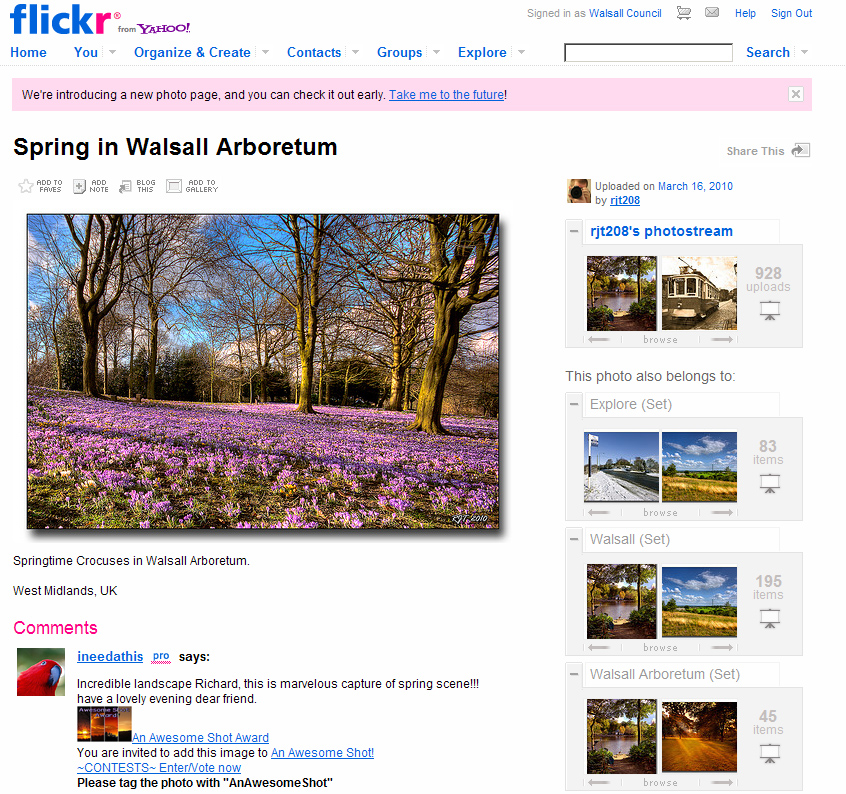
The first shot was a canalside image. By linking back from the council site to the original Flickr image we embraced the web 2.0 approach of sharing.

The image got more than 150 hits in just over two weeks.

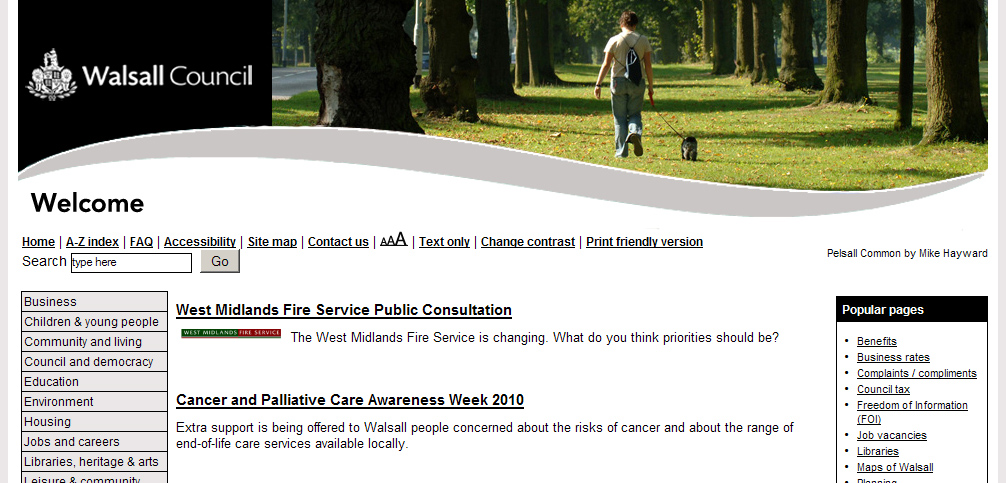
This is the revamped Walsall Council website that celebrates our residents’ work.

SIXTEEN THINGS WE LEARNED…

1. Ask permission. Photographic copyright by default lies with the photographer. Even if there is a creative commons licence available I’d still ask. Just to be on the safeside.

2. Ask permission to name and link back to the original picture too. For some people photography is a hobby they don’t want publicity for.

3. Rotate images. Try and use pictures from around the borough. Not just the photogenic park.

4. Rotate photographers. Share the love around.

5. Use freelance pictures too. But ask permission. The licence you may have originally negotiated may only be for print use, for example.

6. Be seasonal. A cornfield in summer sun looks great in August. It may not be so at Christmas.

7. Change the shot regularly. Two or three weeks is enough to freshen up the site.

8. Stage a competition to encourage participation.  Post a topic.

9. Use Flickr images across the site. A cracking shot of a park would work well on the park pages, for example.

10. Be aware of your policies towards people. Do you need to get permission forms signed in order to use the image for publicity.

11. Join Flickr. Contributing to the Flickr community is a good way to build bridges and understand how it works.

12. Acknowledge using a shot via a comment under the picture from the council Flickr account. Comments are a social part of Flickr and a way to give praise.

13. Create a gallery. A page on the council website to gather the header screenshots.

14. Stage a Flickr meet. Generate content and allow residents to take shots of their landmarks and building.

15. Showcase your area. It’s a chance to really show off.

16. Skill up. Make sure there is the skills base for several team members to add content.

LINKS:

bccdiy.com – A website for Birmingham put together by bloggers that uses Flickr images brilliantly.

Lichfield District Council – Some lovely shots of the Staffordshire city of Lichfield using Flickr.

San Fransisco’s District Attorney’s Office – Great blog on how a US office is now using photo sharing.

LGEO Research – Good blog by Liz Azyan on how Lichfield used user generated content.

Coventry – How Coventry City Council use Facebook to showcase official images.

Exit mobile version