Much of the national planning has already been done and what’s playing out is an approach long agreed.
However, locally, that’s maybe not the case.
This Twitter thread from Jim Whittington here is worth looking at and reflecting. Jim Whittington is US-based and provides consultancy around wildfires. He’s used to the long haul.
Most comms people in the UK may have experience of the big incident but not the incident that lasts for months.
Terror attack? We’ve got experience of that. Too much in some ways.
A big fire? Yup.
A medium-sized incident? In spades.
A 24-hour thing? Ten a penny.
Most teams will run to the sound of sirens when the incident first develops.
But once the adrenaline fades what then?
And what if you’re all burnt out and you’ve only just begun?
I’m struck by the advice of a former chief executive I worked with. In a big incident one of the first things he did was send a senior officer home. Why? To be fresh in a couple of days time when those at the coalface are worn out.
I’m struck by the Environment Agency in the UK who have dozens of people trained in using social media ready for when major flooding strikes. People who don’t have media relations roles can slip into the role.
I’m also struck at the lessons Greater Manchester Police took from their response from the arena bomb. Plan for the long term and ask for help early were two pointers.
Jim’s thread is here and it needs reading by public sector communicators. It’s packed with gems.
So, you’ve got the official advice lined up and the official channel set… your job is only half done
Scroll through Twitter and Facebook and you can find all sorts of weird conspiracy theories. And that’s before venturing onto Instagram, TikTok, Snapchat, Messenger and WhatsApp.
There’s a whole load of information circulating despite the best efforts of platforms like Facebook and Twitter who are promoting the right resources.
But to know the problem you need to understand the solution.
This is what misinformation and disinformation looks like
Scrolling down I came to the Birmingham Live Facebook page. That’s the Reach-owned platform that’s the Birmingham Mail online. It is a significant platform with almost 400,000 likes.
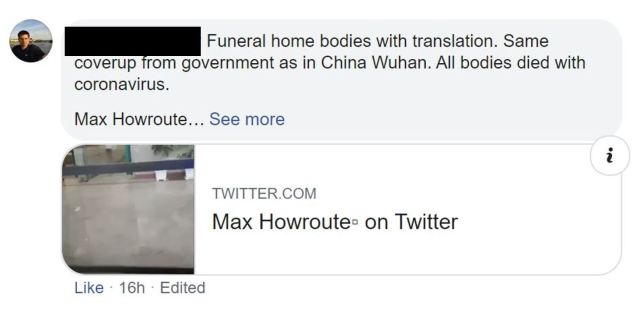
On the first coronavirus story I found this meme posted as a comment.
The comment thinks that the virus is a vehicle for a sinister New World Order conspiracy. Laughable? Once a Trump presidency was seen like that.
On Facebook, critical faculty largely goes out of the window. Research from Reuters Institute for the Study of Journalism said that almost half of people can’t remember who shared the content on Facebook in the first place.
The handy thing about Facebook is also its weakness. Your mate Dave shared it. He’s bound to have checked it. Anyway, Dave’s a good guy. But chances are Dave hasn’t.
Scrolling further, a link from Birmingham Live takes me to an unofficial coronavirus page that is filled with conspiracy like this:.
So, what to do?
You could hide under your desk. Or do something about it.
Expecting everyone to go to the official site for the official information is for the birds.
How you can build a defence against a wall of misinformation
Thankfully, history has the answer.
In 2011, after riots swept the UK The Guardian and academic researchers spent time analysing first hand accounts, Twitter data and court action to map what and how things happened.
Their conclusions Reading the Riots can be found here and they’re worth spending time with if you haven’t already. While the research is eight years old they hold some universal truths.
Our findings confirm that police, emergency services and government agencies face
difficult problems in making effective use of social media platforms such as Twitter during crises. In particular, though our analysis of rumours on Twitter suggests that false rumours are ‘self-correcting’, we argue that there is a public safety case for providing information and advice via sources that the public can trust in a more timely way.
In short, while some rumours will be shot-down by people online it would be helpful if they had the tools to do it and also be encouraged to do do.
Create the content. But actively get a team of people to share it from their own channels. Staff. Community leaders. Active citizens. Neighbourhood Watch people.
But first create sharable content
So, sharable content is an absolute must.
Kent County Council’s video update here from their Director of Public Health is an example of that. Short, concise and to the point its on the money and got re-used by the media and elsewhere.
You sharing your sharable content
But being pro-active feels like a thing to do, too. Going into Facebook groups as yourself with sharable content feels like a must. I’ve blogged about this before and part of the Vital Facebook Skills workshop deals with this. In short: make friends with the Facebook group admin and see if they’d be receptive to you or your page joining.
An example of this is Barking, Havering and Redbridge University Hospitals Trust who posted content this into a Facebook group.
By all means take the central message from Public Health England or elsewhere but present it in a way where it can be shared online.
Recruiting others to share your sharable content
In emergencies, its striking to see the good people as well as the bad. There are people who want to help as well as those who are busy photoshopping sharks into Cockermouth High Street.
But also you need to think about how you can build bridges with bloggers, hyperlocal site owners and most of all Facebook group admins as well as your staff.
A whatsapp group with those who can fight your corner with links feels like part of this.
They could be doing the hard work of myth-busting if only they knew they had a valued role.
So, play whackamole with rumour.
Play whack-a-mole yourself.
But recruit and encourage others to do it for you with the tools you create.
A few weeks back I finished reading ‘The Secret Diary of Anne Frank’ book with my daughter.
I’d never read the tale but I was aware of that story.
She was a teenager whose story starts with her life as a girl in Holland. The fact she is Jewish is a side issue that drags the direction of her life into a new direction. After years in hiding with her family and others she is arrested by police and taken to Auschwitz where she dies weeks before the end of the war.
It’s a book that isn’t just a book about hiding. Anne emerges as a vibrant girl with thoughts of her own. Her steps into adult life are mapped out.
Anne Frank is one of six million who were murdered in the Holocaust.
But how to tell the story of the others who dies is difficult.
The Auschwitz Memorial, who run the site of the death camp in Poland, have taken the approach of tweeting images and a short biography. It’s an arresting process which gives a human face and also oddly restores a degree of dignity, They’re no longer a number. They’re a person with a story to tell.
In the random images I’ve chosen, French girl Ida Fistel who aged eight and 41-year-old German woman Kate Farber and Vera Popperova, 19 who all died. All are images taken in happier times.
Lastly, I’ve chosen Kazimierz Piotrowski whose prison mugshot and striped pyjamas fits the description of what you imagine an Auschwitz prisoner to look like. He has a shaven head and looks malnourished.
In 2020, with impending coronavirus we have all become public health communicators whether we like it or not.
We’re faced with the most serious pandemic for a century although the World Health Organisation has not formally declared it as such.
We’re also faced with the most powerful disinformation engine mankind has ever made in social media.
There’s two things every organisation must crack when it gears up for this.
Social media.
Internal comms.
Like some kind of stress test, this is a check-up on how organisations function and communicate public sector or not.
Normally a public sector communicator has to fight to get their messages in front of people. They can be niche. This time, everyone really is the audience.
Stephen Waddington has blogged here concisely about the path coronavirus has taken and correctly identifies that a fact-based response is needed. He’s spot on with that.
Normally, I get a bit tetchy when people say ‘everyone’ as their audience because it very rarely is. This is one of those rare times. But it’s worth avoiding the classic mistake of making one-size-fits-all take-it-or-leave-it content. Create content for your channels, answer media queries but think about where your audience actually is and create content with that in mind.
Facebook are running something similar when you run a search.
If you’re public sector and responsible for communicating coronavirus
Here’s a glass half full fact.
Since, the confused response to foot and mouth how the public sector will communicate has been codified. There are local platforms in place in England and Wales to respond through Local Resilience Forums that bring police, council, NHS and others together. In Scotland and Northern Ireland there’s an equivalent.
The message will be pretty prescriptive.
Create content that’s short, fact-based and shareable.
I’m not convinced by screen shots of hard-to-read text shared online. So, create written content directly onto the platform as they can be read more easily. Support with date-stamped images. Threads for Twitter and text for Facebook and other platforms.
Create video with a straight-forward fact-based summary. Especially if you’re public health.
Public Health has been a local government thing for some time. While the politician may be keen to be seen to take the lead for me, the public health official themselves should absolutely be the one taking the lead.
Brighton and Hove Council’s coronavirus advice page here is a pretty good standard to aim towards. It has pages for the public, businesses, public transport and others. It mixes links to UK Government advice with some local flavour.
If you’re not responsible for creating content share the right content
But above all the best tip? If this isn’t your gig leave it to the experts and share what they’re saying. I’ve seen some cut and paste advice guides that claim to be from a doctor in Wuhan and you know what? I’m not convinced. If you’re police, fire or looking after a library account just share the local advice.
What public sector communicators can do
Don’t be tempted to go off piste with inside info from your mate’s cousin who works at the hospital. This should be obvious. But it’s a point that’s worth repeating.
Importantly, if you’ve got lots of accounts across the authority, you’ll want them to be singing from the same hymn sheet. Ask them to share the main voice for the area. Yes, I know they may be a library but they have followers and they have trust. The helpful message needs to be shared. A whatsapp group for page admin across an organisation isn’t such a bad idea with this in mind.
Facebook groups have been a growing trend. Like digital Parish pumps they are where people meet online. Make your content on Facebook shareable and look to go through group admins. Think about a Facebook Q&A with your public health official. Facebook Live is one option although trickier to manage. Just words is easier.
On internal comms
While external comms is important it’s not nearly as important as making sure your staff know what the situation is and how they can get the right information.
Make it fact-based and create it in places where people are.
Again, this isn’t time for one-size-fits-all communications. Have the same message and repeat it.
I’ve got absolutely no doubt that the public sector and other communicators will rise to this challenge.
Absolutely nothing teaches you the change in the media landscape more than how local newspaper cover their local team.
It’s the story of how an industry sat on a 3-0 lead, gave away three own goals and appear to have pulled ahead again.
My own team is Stoke City. I’ve supported them for the past 35-years. I’ve seen us go 2-0 up away and lose 6-2. I’ve seen us lose 8-0 at home and I’ve seen us win majestically an FA Cup semi-final 5-0.
My lifeline to my club has always been through the media. Especially the North Staffordshire media.
This is a post about my obsession with Stoke City and what I’ve learned.
Newspapers go 3-0 up… a century of near as dammit monopoly
Back in the day, every town had a newspaper and every big team had a sports reporter to cover them. The town newspaper as near as dammit had a monopoly. You want the football club news? You head to the local paper. Me? I cycled to the paper shop on a Saturday evening to buy a late edition of the Evening Sentinel. Veteran reporter Peter Hewitt’s match reports were deadline skewed and would start with lengthy descriptions of injury news with the last 10 minutes of play condensed into four paragraphs.
I’d plough through a long account of how Chris Maskery (ankle) had been replaced in midfield by John Devine who had passed a late fitness test before racing through to the perfunctory late goal flurry.
Monday’s paper would feature a more considered match report and some breaking news on the backpage. That formula had lasted for a hundred years.
As a teenager, I’d cut out each report and stick them into a scrapbook. I could hold them in my hand and re-read them.
Martin Smith rises like a salmon at the far post to plant an unstoppable header past the despairing dive of the keeper.
On a wet Potteries day in 1988, Division 2 Stoke played the Division 1 champions Liverpool in the FA Cup 3rd Round.
That day, 32,000 packed into the Victoria Ground with me on the Boothen End terrace. Pre-Hillsborough crowd surges at the game were all part of the tradition. Something was not right. An hour before the game, the crowd was horribly over capacity and moving freely was impossible. Trapped, worried and seperated from my brother I had a feeling that if I’d have fallen there was no way I was getting up again. On Monday, all the Evening Sentinel carried was 10 paragraphs on an inside page about how a man had died of a heart attack because St John’s Ambulance staff couldn’t get to him. Football supporters had no voice. At worst, hooligans and at best ignored.
Around that time The Oatcake fanzine started a 30-year print run. That publication gave fans a voice. Published every home game The Oatcake for years was the best thing about watching Stoke City. Newspapers had lost the monopoly.
In the last few years, the excellent Duck Fanzine has picked-up the baton.
Newspapers slip up to 3-2… GOAL! Scorer: The Internet (55 mins)
Lee Trundle fires one in after a mazy dribble.
Most of what I learned about the internet I first learned from The Oatcake’s online messageboard. This old-style forum emerged in the late 1990s and I no longer needed to go to the paper shop for Stoke news. I learned how not to trust every rumour.
My mate says he’s seen Lee Trundle in an estate agents in Trentham? He must be signing!
I learned instead to weigh-up credibility. I learned how to deal with online snark, how mobs develop and Ithat without decent admin an online community will go to pot.
It also taught me how the internet could be viciously funny.
Around this time, the character of Valiantitus emerged. Apparently, a Port Vale supporter he was a hoax with a screen grabbed picture who would welcome each Port Vale goal on a League Two online Forum with…
BOOM! BOOM! BROOKER AWAG! LIQUID FOOTBALL GOAL EXPLOSION.
Little of his writing remains on the internet although some can be found here. It remains some of the funniest stuff I’ve ever read online.
Newspapers slip up to 3-3… GOAL! Scorer: Fans’ use of social media (87 mins)
Twitter scores an easy goal as the opposition appear to have dozed off.
When social media first emerged newspapers were left as flat-footed as Stoke reverse legend Paul ‘Donkey’ Dyson at an inswinging corner. Defensive of their print product it was left to fans to fill the gap. Breaking goal news on Twitter? See if more than a couple of people have posted a YEEEESSSSSS!!!!! 1-0 STOKE!!!! and leave the print edition gathering dust.
Newspapers go a goal up 4-3… GOAL! Newspaper use of social media (89 mins)
Pete Smith and Martin Spinks combine to score a well-worked set-piece.
They’ll be jumping for joy in newsrooms as newspapers finally learn how to make sense of the changing media landscape.
This is where it gets interesting.
Across 35 years, The Evening Sentinel has changed to The Sentinel in print and Stoke on Trent Live online.
There are now two dedicated Stoke City reporters at what I still think of as The Sentinel. Pete Smith and Martin Spinks are web visionaries and should be revered throughout the newspaper industry and by Stoke fans As an ex-journo and Stoke fan I deeply admire their work. Why? Because newspapers now have a creative use of the internet. Thorough, exhaustive and with high accuracy they’ve taken the best of internet culture, social media and journalism to tap new audiences.
So, Smith and Spinks have match reports on the newpaper website and in print. They also have a Facebook Live after the game to debate the main points. They’ll post to their Facebook and Twitter profiles. But they’ll then take the URLs into the places where Stoke fans hang out and seed a discussion in those groups too.
There must be a personal cost to such near 24/7 coverage as others who have done the job have spoken about. That’s something to be aware of. Being exposed to comment around the clock must be wearing. But public sector comms people who look after a page will know this.
But if there is a single over riding lesson from Stoke City in the media to communicators it is to go where the audiences are.
If there is a lesson to supporting Stoke City its patience.
And that Robert Huth is a better centre half than Paul Dyson.
And that beating Cardiff City in the play-offs remains truly beautiful.
Great floods have flown from simple sources, William Shakespeare once said.
And great cursing will have flown from more than one person caused by the UK floods of 2020.
Few parts of the country have been unaffected by weeks of heavy rain.
But in any emergency there are lessons to learn for all comms people.
In any crisis, people perform well or if they don’t people tell them and they learn quick. It’s been the case since bonfires were built to warn of Viking ships on the horizon.
Forget the emerging channels such as TikTok or instagram. In an emergency, your website, Twitter and Facebook are the three places to concentrate resources.
All this may be flood related. I’m convinced there are approaches you can transfer to your regular comms.
A website done well… clarity is the lesson
Simple information clearly presented.
What warnings there are and where.
Flooding alerts can be found in England, here, Wales here, Northern Ireland here and Scotland here. A map accompanied by clear messages helps point people towards their part of the country so they can read the relevant update.
But aside from gov.uk a page on the council website can be handy to provide extra information. But if the CMS is clunky and you struggle to update it then a pop-up WordPress site ideally you’ve made in quieter times can be useful as a way to get the message out.
Email alerts… sign posting from your inbox is the lesson
If you’ve opted in for Midland alerts through the Met Office here for example then that’s what you get. Which takes you to the relevant webpage.
Again, clarity is the lesson.
Video on social media… real time updates are the lesson
We don’t trust text that much. We trust photographs a bit more but right now in this era of deep fakes we trust video the most. So, updates from the scene in selfie mode are fine.
One of the weaknesses of Twitter is that it has slipped to 7th in the rankings of most popular channel. One of its strengths is that it has a lot of journalists and opinion formers on it. So, if you want to get this out by the regular media let West Mercia Police show you how to do it.
Facebook… sharable content is the lesson
Here, Telford & Wrekin Council give a real time image with a real time date stamped warning. Such sharable content mean it can find its way into community Facebook groups.
On Facebook, people really want to stay on Facebook and never leave. So, chucking the link to the flood warning page won’t really cut it. Post the content in its entirety if you can so you put the information where people are.
You shouldn’t expect people to come to you.
You should be going to them.
WhatsApp… an internal group is the lesson
Email is great but the flexibility of a whatsapp group can cut through really effectively. One for the comms team, absolutely. But also one for people who are on duty. It’s an excellent way to channel back footage and images that help the decision makers and also inform the public, too.
Facebook… reaching the right community group is the lesson
A Facebook group is a digital Parish pump. It’s where people get together and share notes. So, when Ironbridge is at risk of flooding the Ironbridge Gorge Community group is where the community goes.
Social media… Devolving it to the frontline is the lesson
I’ve been banging a drum for this for the best part of 10 years. Police and the Environment Agency are still those who have picked the ball up and run with it best. Give frontline staff training and the tools to access social media and in an emergency you can tap into that. Like this Environment Agency officer.
Web resources… pre-prepare is the answer
Where can you get sandbags? What do I do if my property is flooded? These are part of a list of questions you’d be asking if you were a resident.
Chances are if 500 homes were at risk of flooding there’d be 500 people all demanding answers to the same questions and the phone would be ringing off the hook. If you have a place where people can go for the answers you’ll have the info provided.
What’s extra clever is that they don’t just have it as a web resource but they have it as a printable advice guide, too. Why printable? Simple. Because sometimes the power is out and people don’t have access to the web. If that’s the case then printing of resources can be useful. If your team is thinly stretched friends, family or others can do the task too as its on the website.
Clever.
With thanks to Heleb Evans, Nigel Newman, Michelle Atkinson, Becky Allen, Mirian Louise Brown, Charlotte Walker and Nicola Davies.
You may have seen the very warm public response Yorkshire Tea got this week after enduring some severe trolling.
If you missed it, the brand got a kicking after the Chancellor Rishi Sunak was pictured with a big bag of tea bags.
The attack follows a backlash at Heck Sausages for hosting Boris Johnson. In turbulent times, brands being associated with a politician of any colour is a risk. Sure, they were different. One was a photo opp and one was a politician drinking tea but the broad principle stands.
How Yorkshire Tea handled it
Getting fed-up with the online kicking the Yorkshire Tea social media manager drew a line in the sand, pointed out that Jeremy Corbyn had also drunk their brew and asked people to be kinder.
Their human response won applause and sympathy. Being human online should be easy but often isn’t and their response was masterful. It’s no fun being at the centre of a Twitter pile-on. I know. I’ve been there. I’ve blogged before on the unique pressures a social media manager or admin faces. To make an account work they need to put something of themselves into the account. Criticism is easier to make and can be felt more deeply.
So, is Yorkshire Tea the template for the public sector? Actually, I’m not sure.
Why the public sector can’t be Yorkshire Tea
For starters, I’m going to rule out the suggestion that public sector accounts can’t be human in their tone. They absolutely can when the time is right and there’s lots of examples of just that.
But the sticking point is this: Yorkshire Tea do tea bags and the public sector don’t.
The public sector do some amazing life saving things.
But since 2008, they’ve also closed libraries, not always respond to pothole complaints, explained why the bus service has been cut, asked people not to turn-up at A&E because its closed, explained a department’s Brexit policy to exporters and told people about the nine pump fire that’s blocking the motorway.
Sometimes, the human voice is achievable but sometimes its not.
If you look after a public sector account, be fine with people disagreeing with policy. They’re allowed to. It’s a democracy. The world does not smell of paint.
Don’t be fine when people shout, swear or start being anti-social. You’re an employee not a virtual punchbag.
How the public sector can respond
The Centre for Countering Online Hate produced cracking guidance on how to respond to online hate. Ignore it. Don’t give it oxygen. Switch off notifications. Don’t show you’re hurt because that’s exactly what they want. The report is here.
What they also suggest is getting some offline reassurance and support. I’m down with that. That’s when tea is relevant. Make a cup of tea with a friend or colleague.
So, do nothing?
Not exactly.
Over the past 10 years I’ve realised there’s there’s two ways to respond when someone has got something wrong. Firstly, be polite. Secondly, be factual. If you’ve been an engaging presence online you’ll have some social capital with your followers that may be turned into supportive comments.
What you’re doing is politely drawing a line in the sand and setting the record straight.
Be polite.
Be factual.
That’s it.
From experience, THIS is the best way the public sector can respond.
More than 12-months ago Facebook set the cat amongst the pigeons by changing their optimum video lengths.
What was once a 30 second length clip as an ideal length jumped up to a three minute suggested length.
But one question that has often presented itself… does Facebook really penalise shorter clips?
Is there a guillotine that drops on your unsuspecting clip if its less than 180 seconds?
I thought I’d find out, so, I’ve crowdsourced a quick survey with members of the Public Sector Comms Headspace Facebook group.
What the survey said
As part of the survey, people went onto their Facebook profile and logged their first three videos survey organically. I then crunched the numbers. More than 40 people logged almost 150 videos.
What wasn’t too surprising…
The average length of a Facebook video in the survey was 2 minutes 46 seconds.
The most popular segment of time for a video was between three and four minutes.
However, what was surprising…
60 per cent of Facebook videos served organically were less than three minutes.
The longest video in the survey was almost 16-minutes long.
Table: Facebook video lengths by duration
So, in short, there isn’t a sword of Damocles over three minute video length. You can make something shorter or longer.
The Facebook algorithm is an ever-changing and complex thing and there is more to judge in a clip than just duration.
I’m tempted to think that if a video is engaging and creates shares and likes then whatever length it is it’ll work. I’d be tempted to think of 30-seconds as an absolute minimum and see how you can create a longer clip.
I do try to avoid self-aggrandising posts but I’ll make an exception for this, do you mind?
I was pleasantly surprised to see I’d been listed as 8th in the 10 best PR blogs by Vuelio.
I’ve been blogging for 10 years and couldn’t imagine a time when I wouldn’t be. What started as an experiment has become somewhere where I wouldn’t be without.
Sometimes I’ll work things out in public and at other times I’ll share things that’s caught my eye or I think I’ve nailed.
If you’ve read, shared or commented on a post thank you very much indeed.