OPEN FLOODGATES: What publishing Whitehall data means for local government

As one wag said: “A Prime Minister addressing a room full of geeks about open data? I’ve waited years for this.”

At the Wellcome Trust in London more than 200 people gathered for the International Open Data conference.

David Cameron delivered a recorded message and Minister Francis Maude was there in person. So was uber-geek Tim Berners-Lee.

Arranged by the Open Knowledge Foundation This was a chance to launch the UK Government’s data set of its department’s spend over £25,000.

That’s 194,000 lines of text and £80 billion of spending. The link to it is here.

What’s the point in that? The aim is to open the Government’s books to allow residents, journalists and business a chance to have a look.

Pithily one newspaper commentator posed the question: ‘A great leap forward or masochistic folly?’

It is madness isn’t it?

Tim Berners-Lee.

Actually, no. It’s a movement supported by left and right alike which has the aim of cutting waste, allowing entrepreneurs to flourish and a fairer society.

The event may have been Whitehall focussed but there are powerful golden strands that run through all government. Local and national.

Local government has already been asked to publish items of spend over £500 under the label ‘spending transparency.’

They have until January 1 to do it and as Cameron and Maude 100 of more than 300 odd councils had published.

There is a feeling within Whitehall that some will quietly choose not to publish calculating the flak they get for not completing a slightly arcane process is less than the grief a particular financial skeleton may pose.

It’s unlikely Whitehall will allow this to pass without prompting closer inspection.

Walsall Council House.

It’s also unlikely local government will not be asked to publish more as open data. There is more to come. Much more.

Here are some broad messages from the day for local government:

SO, WHAT’S THE BIG PICTURE?

Open data won’t be an easy ride for people in authority. As Francis Maude said: “It’s going to be very uncomfortable for government and local government. Media outlets will find things that will cause embarrassment.”

It’s not going to go away. It’s easy to like open data in opposition, says Maude. You can shine a light at others’ decisions. However, he pledged there were two key advocates – him and the Prime Minister.

The aim is to move influence away from the traditional centres – “information is power. This is a power shift,” says Maude, “to move the decision making away from Westminister.

Expect better decision making on spending – “Once you know you are being scrutinised you’ll be more careful. MP knows this all to well,” Maude says.

It’s FOI turbo charged – It would have taken journalists years of submitting FOI requests to build up the picture revealed in the £25k data sets, the Guardian say.

HOW DOES THIS AFFECT THE PRIVATE SECTOR?

Contracts should allow for open data to be released – The presumption for contracts is transparency, says Maude.

It’ll create wealth – Open government data will create a £6 billion industry, says the Minister.

A website to point the spotlight on the private sector too – Chris Taggart has built opencorporates to shine the light at which big companies are doing well from public sector contracts.

HOW WILL ALL THIS BENEFIT GOVERNMENT – CENTRAL AND LOCAL?

Waste detection – By spotting where the waste is money will be spent better, Francis Maude says.

Procurement needs to get its act together – know what is in the contract before you sign a deal since the detail what it will purchase will be closely monitored, the Minister says.

WHAT IS NEXT?

Historical data will be released – There will be open data from previous administrations. This will help to compare and contrast with the current era.

More public agencies will follow – There are 100,000 public bodies. There’s no timescale for these just yet.

There will be a right to data – David Cameron has pledged that people will ask and receive data for a personal and business use. This is massive for local democracy.

Open data will move from spending into crime – Expect interactive crime maps in the New Year, Maude says.

SO, WHO WILL BE LOOKING THROUGH THIS DATA?

Journalists – the media needs to be data savvy. Data journalism will become more and more important, says Tim Berners-Lee.

“Chatting people up in pubs was one part of your job,” he told journalists in the room. “Poring over data and equiping yourself with the tools to look for the juicy bits will be important.

“Data journalism will be part of the future.”

Right now, local newspapers haven’t grasped what data journalism is. Don’t hold your breath just yet either.

Traditional news is emergency services calls, court and council agendas. It’s not data mining with csv files.

What may put it on the agenda are national stories re-written with a local.

Hyperlocal bloggers – many bloggers have geek tendancies that will happily work with online tools. Stories from all this will be broken by an 18-year-old rather than a laptop. That’s quite exciting. Tools such as timetric.com where graphs can be built using data and embedded in blogs can help with this.

Geeks – an inexhaustable army of geeks will pore over the data – “what happens when the flashflood of geeks go away?” mused Tim Berners-Lee. “It’s perennial.”

Industry – Data company Spikes Cavell have released spotlightonspend.org to interpret local government data. This hasn’t been without criticism from the opendata community who argue against councils dealing solely with the company and not releasing open data too.

Social entrepreneurs – Chris Taggart has built openlylocal.com as a platform for local government data and has been a pioneer in the field.

Real people – Fascinatingly, The Guardian had a team of four working for four days on the data before it was published. They didn’t think they could glean everything themselves. What they did do was make it possible for the public to use the tools to search for stories. This is the wisdom of the crowd as an extra pair of hands in the newsroom. You can download their app here.

BUT IT’S NOT ALL GOOD NEWS….

There’s no funding for people to cross check the data – As one questioner pointed out the tools that held government to account – journalists – have historically been cross subsidised by other sources such as small ads.

There’s no funding for these resources. There’s a question mark against the sustainability and effectiveness of tools.

Creative commons credits:

Tim Berners-Lee: Paul Clarke via wikipedia. http://en.wikipedia.org/wiki/Tim_Berners-Lee

Hand: http://www.flickr.com/photos/davedugdale/5099605109/sizes/l/in/photostream/

Parliament: http://www.flickr.com/photos/olastuen/3784184031/sizes/o/in/photostream/

LOCAL BY SOCIAL: What should Comms 2011 look like?

Back in the olden days all a press officer had to do was a write a press release and book a photo call.

Boy, how things have changed and more to the point are changing rapidly.

How web 2.0 and web 3.0 will affect the communications unit – or press office in old money – is something that I’ve spent a great deal of time mulling over. Why? Because it’s my job.

I’m a senior press officer at Walsall Council. The job I walked into in 2005 is almost unrecognisable to the one I do now. Yes, it now includes, Twitter, Facebook and other forms of social media – or web 2.0 if you are a bit of a geek. But it’s also open data and the challenges of web 3.0.

The nice people from Local Government Improvement and Delivery have asked me to lead a session at their Local by Social online conference on November 3 2010 at 3pm. Looking at the speaker line up it’s something of an honour. There’s plenty for people to get their teeth into on a whole range of subjects.

I’d very much like to hear what your thoughts are. Take part ion the session. Chip in. Listen. It’s all fine. 

Firstly, here is a presentation designed as a starting point and to get the ball rolling…

Secondly, here are a few thoughts I blogged a month or two back. You can read the full version here.

In the days before the web the press office needs to:

Have basic journalism skills.

Know how the machinery of local government works.

Write a press release.

Work under speed to deadline.

Understand basic photography.

Understand sub-editing and page layouts.

For web 1.0 the press office also needed to:

Add and edit web content

For web 2.0 the press office also needs to:

Create podcasts

Create and add content to a Facebook page.

Create and add content to a Twitter stream.

Create and add content to Flickr.

Create and add content to a blog.

Monitor and keep abreast of news in all the form it takes from print to TV, radio and the blogosphere.

Develop relationships with bloggers.

Go where the conversation is whether that be online or in print.

Be ready to respond out-of-hours because the internet does not recognise a print deadline.

For web 3.0 the press office will also need to:

Create and edit geotagged data such as a Google map.

Create a data set.

Use an app and a mash-up.

Use basic html.

Blog to challenge the mis-interpretation of data.

But with web 3.0 upon us and the pace of change growing faster to stay relevant the comms team has to change.

HYPER GO GO: John Peel and eight things to do after an unconference

John Peel once said Punk’s great lesson was that anyone could do it.

All you had to do was knock over a phone box, sell your motorbike and you had enough cash for a day in a studio and 500 7″ singles.

It’s those words that struck me after Hyperlocal Govcamp West Midlands in Walsall.

Run on a shoestring, powered by enthusiasm, favours and goodwill it saw 70 people from across the local government, hyperlocal blogging and open data communities come together in Walsall.

It should never have got off the ground. Once off the ground it should have crashed. Several times. That it stayed airborne should make all those who came proud.

At an unconference there can be a massive surge of ideas powered by conversation and debate. It’s a chance to think and be creative.

All that’s great but is that it?

What’s next?

In the few days after the event, a new hyperlocal Pelsall Common People was started by Jayne Howarth, Dave Musson at Solihull Council started to do cool things with Facebook and the organisation I work for Walsall Council started to trial Yammer. That’s a tiny tip of a large iceberg.

Here’s eight things to do after an unconference.

1. Sit down in a darkened room. If it’s been any good your head is filled with ace ideas and you’ll need a good lie down.

2. Blog. It’s one of the best ways to get your head around an idea. Besides. Everyone loves a sharer.

3. Don’t be despondent. If the unconference has been really good you’ll experience mild depression three days later. It’s the ambition – reality axis. Don’t worry. See 4.

4. Do a small thing. Take out a Flickr account. Go and set-up a Posterous blog. You don’t have to add content just yet but you’ve feel a whole lot better.

5. Catch up. Read the blogs and presentations from sessions you couldn’t get to.

6. Stage an unconference yourself. No, really. Do. Find a few like minded people and do it yourself. They’re very rewarding.

7. Think of the phrase Just Flipping Do It. Write it on your pump bag if you like. JFDI It’s a good motto for life.

8. Think of it as training and not a jolly out of the office. Although if they serve cake it should be a fun experience.

I’ve long thought an unconference works short term and long term. It’s the ideas you can do straight away and it’s the slow burning suggestions that strike you 12 months down the line.

Do people have to wait for permission or someone else to create a bargovcamp?

Of course not. You can run one too. It would be hugely cool if from Hyperlocal Govcamp people were inspired to do it themselves.

To continue flogging the Punk analogy, when The Sex Pistols first played Manchester half the audience went out and formed bands. We got Joy Division, New Order, and The Buzzcocks. That we got Simply Red too shouldn’t be held against it.

For my money, and stay with me here, Localgovcamp in Birmingham was a local government equivalent of the Sex Pistols gig because a slew of inspirational things, events and projects came out of it.

Your unconference DIY toolkit

Dave Briggs’ guide to setting up an unconference we found indispensible.

Andy Mabbett said he’d blog on the things we learned and when he does I’ll insert the link [here].

There’ll also be a collection of resources from #hyperwm [here] very soon.

You can look at the images taken on the day at the #hyperwm Flickr group here.

John Popham points out here that an unconference is a cheap way of training in an era of austerity.

TWO TRIBES: What should the blogger – press officer relationship look like?

Jerry Springer built a TV career by making people in dysfunctional relationships sit down and talk to each other.

With burly minders flanking the stage Billie-Jo and her ex-lover Seth from an Arkansas trailer park would set-to in front of a studio audience.

Gripping stuff it was too, but you had this feeling nothing would change.

Two parties in a sometimes strained relationship came together at Hyperlocal Govcamp West Midlands in Walsall.

The session ‘What does a good blogger – press officer relationship look like?’ saw bloggers sit down with press officers.

For some, it was the first time they’d ever spoke to the other side.

Like a parish pump Relate, there were sometimes a few choice words. But unlike the warring couples on TV there was a growing appreciation of the points of view.

It’s a session that has been extensively covered.

Local government officer Simon Gray, who is not from communications, blogged brilliantly about the session here. When he said neither side appeared with full credit, he’s right.

He’s also dead right in calling on both sides to cut the other some slack.

Paul Bradshaw writing a guest post for Podnosh made some excellent points in how local government should make information easier to access.

Mike Rawlins, of Talk About Local, who also contributes to Pits N Pots in Stoke-on-Trent has written an excellent post from his perspective on this and dead badgers and does, as Simon suggests, cut some slack.

Paul Bradshaw wrote a good post from the session focussing on the call from bloggers to make information more easy to access.

Sasha Taylor has also blogged from the session from a police perspective.

Twelve months ago I wrote a blog post on how the blogger – press office relationship was a source of conflict.

The 10 points I wrote then I still stand by. The full post is here. The edited highlights are boiled down to this

FIVE THINGS A PRESS OFFICE CAN DO:

  1. Treat them as journalists.
  2. Put them on press release mailing lists.
  3. Use blog comment boxes as a press officer.
  4. Accept not everything bloggers write is going to be favourable. Complain politely – and constructively – if things are wrong.
  5. Respect what bloggers do.

FIVE SUGGESTIONS FOR BLOGGERS:

  1. If you have courage of your conviction put your name to what you do you’ll find your voice getting heard far better.
  2. Don’t be afraid to check stories.
  3. Respect press officers. They have a job to do too.
  4. Be accurate. The same rules for newspapers apply to blogs.
  5. Buy a copy of McNae’s Essential Law For Journalists to save your life and potentially your house.

But listening to the both sides talk at the session, there’s also a few things a bright press officer can do.

1.  Create blog friendly content – A conventional press release is tailored for the print media. That’s not necessarily blog-friendly. A short film posted to YouTube or Vimeo is. A two minute film to explain with an interview the points made in the release would work.

2. Add pics as a matter of course – Even if it’s a stock pic. Mike Rawlins of Talk About Local made the point that there is a demand for images. They’re going to source a pic from Google images anyway. Why not provide a good one?

3. Judge when to respond – the excellent Michael Grimes of the Citizenship Foundation re-purposed the US military’s flowchart of engagement with bloggers. It’s good advice when to engage and when to ignore the internet troll.

4. Build relationships – In print media you know you’ll get a better story about countryside placing it with a reporter who is passionate about green issues. So why not do it online too?

5. Put talking to bloggers in black and white. Make it a policy decision. Here’s one from Wolverhampton Homes to show you how.

6. Learn about open data. It’s not a geek topic anymore. It’s come into the mainstream and bloggers are at the forefront. Local data advisor and hyperlocal blogger Will Perrin has pointed out that press officers will need excel skills. Why? Because you’ll need to interrogate data sets just as you’ll need to leaf through council minutes.

Creative commons credits:

No papers today – Katmere http://www.flickr.com/photos/katmere/51065495/sizes/m/in/photostream/

Antique clippings – D Sharon Pruitt http://www.flickr.com/photos/pinksherbet/4799271086/


BAR CAMP: What’s this Hyperlocal Govcamp West Midlands?

Some of the best ideas are dreamt up in a pub or over tea and cake.

Many of those pearls just never get past the beermat scribble stage.

Once me and a mate had the idea for beeridea.com. This would have been a site to sanity test great pub ideas that may have emerged after pint number five.

It never got off the ground.

One wheeze that has got out of the pub is Hyperlocal Govcamp West Midlands.

Staged at Walsall College on October 6 the aim is to be a half day unconference for local government with added flavour.

It’s followed by an uncurry. And beer, naturally.

Who is behind it? some bright people from local government and hyperlocal blogging. Namely, Simon Whitehouse of Digital Birmingham, Stuart Harrison of Lichfield Council, Andy Mabbett of Birmingham City Council and Mike Rawlins of Talk About Local. And me.

What’s the added flavour?

Two things: first, hyperlocal bloggers. These are either an important emerging news platform or untrained citizen journalists playing fast and loose with the law. Depends who you talk to.

The second? The open data movement. Once dismissed as box bedroom anoraks they are now slowly making an impact. In time this will be massive, I’m convinced of this.

For me, in Autumn 2010 Local government people, hyperlocal bloggers and open data geeks are at three points of the same Venn diagram.

It doesn’t make any sense to stage an event that doesn’t incorporate those elements.

The trick, if we can achieve it, is getting the three elements to talk and understand more.

Why a half day? We thought it interesting to see if the unconference format could fit into the day job. Events on a Saturday have worked well in the past but they attract the deeply committed. Would a mid-week event expose the 9 to 5-ers to inspiring ideas?

What is an unconference? It’s an informal conference that allows the agenda to be chosen on the day. I’ve lost count of the number of people who look back at Localgovcamp in Birmingham in 2009 as being a major source of inspiration.

Why Walsall? We’re from the West Midlands and the thinking was it may be good to do something in one of the Black Country boroughs. It’s also a town that does some surprsingly good things online.

Why Walsall College? Because they’re very nice people and they’ve got a Star Trek-esque 100 meg broadband.

Who are the nice sponsors who are allowing this to happen? Big hand for Public Sector Forum, Jadu CMS and Local Government Improvement and Delivery (formerly IdEA). Also very supportive have been: Replenish New Media, Talk About Local, Vicky Sargent at Boilerhouse, SOCITM, Walsall Council, Digital Birmingham, Birmingham City Council and Lichfield Council. And Russell at Walsall College.

What resources are there?

Here is the eventbrite: Ticket info and sponsors.

Here is the Google map: Where it is and where to park.

Here is the govcamp discussion page Right here.

What is an unconference? This is what wikipedia says.

How to run a govcamp The Dave Briggs guide

Yes, but what does an unconference actually look like? Here is localgovcamp in Birmingham.

Here are a couple of places to go in Walsall if you’ve never been before. New Art Gallery Walsall and the Leather Museum (it’s right next to the venue. The cake is very good.)

Creative commons credits:

Logo: James Clarke of Replenish New Media

Walsall College: Dan Slee

Andy Mabbett and Dave Briggs: Jamie Garner

GOAL: What a Turkish football team’s Facebook can teach local government

It should be a quiz question: ‘Who is the biggest football team in the world on Facebook?’

You’d be forgiven for thinking it’s a major power of world football like Barcelona, Manchester United or Stoke City.

Here’s the surprise answer: Galatasaray.

Galatasaray? They’re a Turkish team formed in 1905. They’ve never won the European Cup but have a passionate army of supporters.

A third of all Turks support the team in a country that is the fourth largest on Facebook. That’s not even counting the huge world wide diaspora of Turks.

In 1993, Galatasaray supporters in a firey stadium of noise, flags, chants and flares met Manchester United with the banner: ‘Welcome To Hell!

In September 2010, 16 months after they set-up a Facebook page they had 4.5 million followers.

There’s a great blog in The Independent on how they did it. You can read the original here.

But whats this got to do with local government?

Because a Turkish football team and its fans have come across some universal truths that can work for other areas.

Here are four killer quotes from one of the club’s online team Ebubekir Kaplan that sum up the success….

INFORMATION: “They trust in us to give them information directly we respect their need and desire to know things directly from the club.”

SOCIAL: “Turkish people want to be socialable via Facebook and we’re using the right tools to reach them.”

FANS: “Players come and go, managers come and go, club officials come and go, but fans are constant. They’re the most important people.”

LISTEN: “We have to listen to supporters under all circumstances. So the main value is an outlet for the fans, and for communication with the fans.”

Okay, so maybe people aren’t quite as passionate on the face of it about local government as a football team.

But people DO form a passionate bond with places and that’s where the lessons start to come into play.

People may love their park, love their favourite bit of countryside or maybe their library.

Maybe they’re passionate about a venue or a museum or more to the point an exhibition at the museum.

Would activity on Facebook before and during help capture memories on an exhibition on coal mining in the Black Country, for example?

EDIT: From Istanbul on Twitter @kaanozkan_ wishes to point out that Galatasaray won the UEFA Cup beating Arsenal in 2000. Disliking Arsenal as I do – but not all their supporters – I’m happy to point that fact out : )

Creative Commons:

Curoninja: Fan Cop http://www.flickr.com/photos/curoninja/777611157/in/faves-danieldslee/#

Dan Slee: Pompey http://www.flickr.com/photos/danieldslee/4396957091/in/set-72157624572975462/

Striker Buzz Matrix: Galatasaray fire writing system http://commons.wikimedia.org/wiki/File:Galatasaray_fire_writing_system.jpg

BIG PICTURE: Case study: How Flickr can work on a local government website

Good pictures leap from a page to celebrate, amaze and tantilise.

Poor pictures shout loudly. But not in a way you’d like.

One source of good pictures is the website Flickr which has more than four billion images. It’s something I’ve blogged about before.

What’s on there? Think about any subject and there will be pictures. A whole heap of them. And Flickr groups too. It’s the civilised corner of the web where people are constructive and are happy to licence their images through a Creative Commons licence.

Residents have self-organised and are daily taking an avalanche of brilliant pictures.

It can be a community around a love of countryside. Or of cats. Or a geographical community brought together by an area.

In Walsall, a borough of 250,000 near Birmingham in the UK that’s expecially the case. There are more than 100 members, 5,000 images and a vibrant Flickr group.

People like Steph Jennings, Lee Jordan, Stuart Williams, Beasty, Tony M, Nathan Johnstone and others do brilliant things.

At Walsall Council, we looked at their shots we wondered aloud how good it would be to showcase their shots on the council website.  After all, people taking pictures of the place they live and seeing them showcased on their council’s website HAS to be a good idea.

Our head of communications Darren Caveney and web manager Kevin Dwyer picked the ball up and ran with it.

As part of a web refresh, Kev designed a Flickr friendly header that woud apply across all pages.

Next the pictures. A comment was posted on the Walsall Flickr pages to flag up what we were looking to do. We asked people to add the tag ‘walsallweb’ to each individual picture if they wanted the shot to be considered.

We were staggered to get more than 400 shots tagged for consideration in three days. An amazing response that showed the community support.

The postbox shape of the header ruled out scores of images. We also steered clear of people shots because of any problems with permissions.

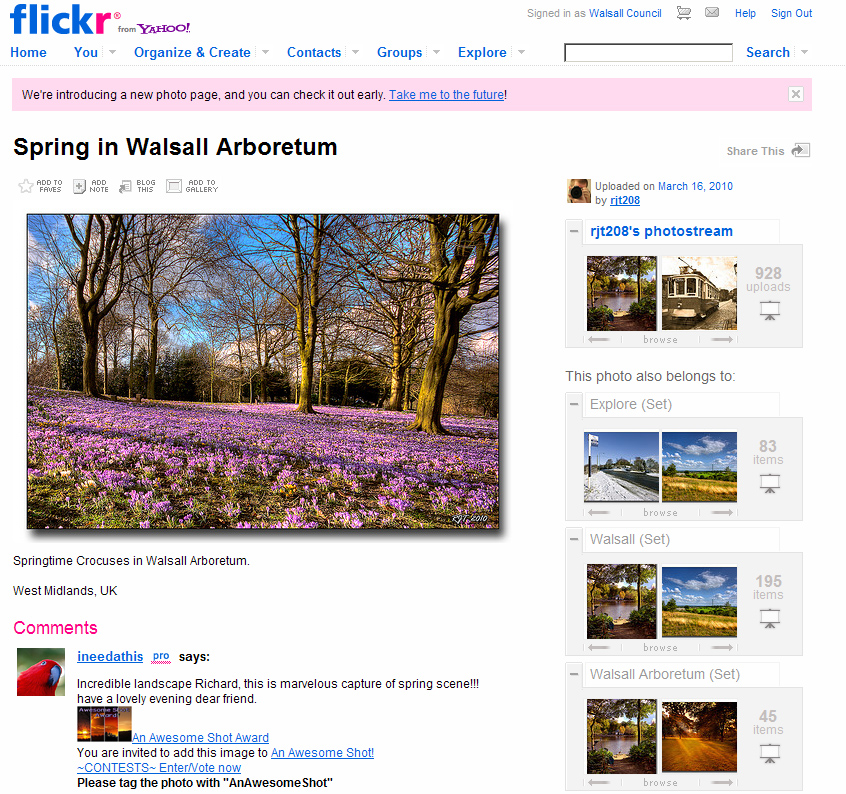
The first shot was a canalside image. By linking back from the council site to the original Flickr image we embraced the web 2.0 approach of sharing.

The image got more than 150 hits in just over two weeks.

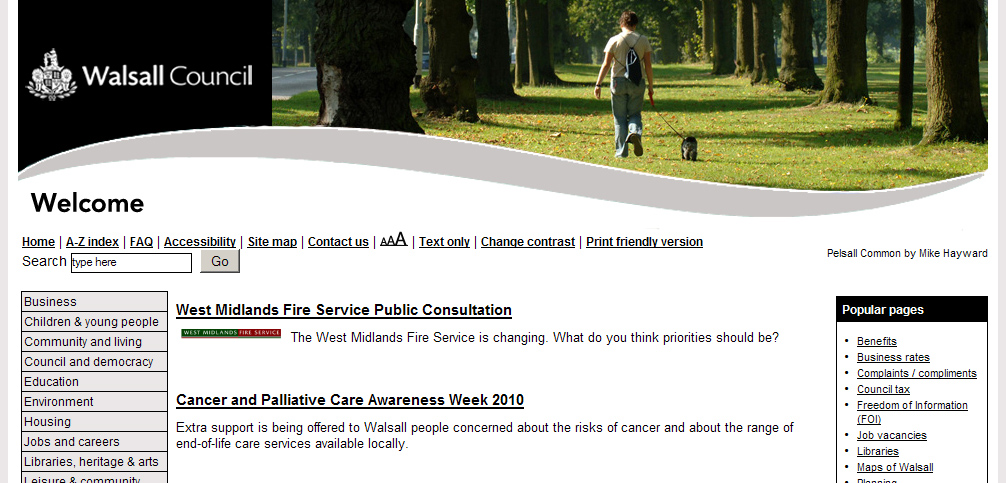
This is the revamped Walsall Council website that celebrates our residents’ work.

SIXTEEN THINGS WE LEARNED…

1. Ask permission. Photographic copyright by default lies with the photographer. Even if there is a creative commons licence available I’d still ask. Just to be on the safeside.

2. Ask permission to name and link back to the original picture too. For some people photography is a hobby they don’t want publicity for.

3. Rotate images. Try and use pictures from around the borough. Not just the photogenic park.

4. Rotate photographers. Share the love around.

5. Use freelance pictures too. But ask permission. The licence you may have originally negotiated may only be for print use, for example.

6. Be seasonal. A cornfield in summer sun looks great in August. It may not be so at Christmas.

7. Change the shot regularly. Two or three weeks is enough to freshen up the site.

8. Stage a competition to encourage participation.  Post a topic.

9. Use Flickr images across the site. A cracking shot of a park would work well on the park pages, for example.

10. Be aware of your policies towards people. Do you need to get permission forms signed in order to use the image for publicity.

11. Join Flickr. Contributing to the Flickr community is a good way to build bridges and understand how it works.

12. Acknowledge using a shot via a comment under the picture from the council Flickr account. Comments are a social part of Flickr and a way to give praise.

13. Create a gallery. A page on the council website to gather the header screenshots.

14. Stage a Flickr meet. Generate content and allow residents to take shots of their landmarks and building.

15. Showcase your area. It’s a chance to really show off.

16. Skill up. Make sure there is the skills base for several team members to add content.

LINKS:

bccdiy.com – A website for Birmingham put together by bloggers that uses Flickr images brilliantly.

Lichfield District Council – Some lovely shots of the Staffordshire city of Lichfield using Flickr.

San Fransisco’s District Attorney’s Office – Great blog on how a US office is now using photo sharing.

LGEO Research – Good blog by Liz Azyan on how Lichfield used user generated content.

Coventry – How Coventry City Council use Facebook to showcase official images.

SPEED DATA: Ideas for local government spending transparency

Only the wisest and stupidest men never change.

Confucius said that. Only, thing was he never worked in local government.

Speed of change in open data is blisteringly fast and getting faster.

In the Spring I thought all this would be important in 12 months time. Wrong. It was important TWO months later.

Local government in the UK has been asked to publish spending over £500 line by line.

A few months back Maidenhead and Windsor Council were hailed as a shining example of how to do this.

A few months on and the shine is wearing. Yes, they deserve praise for innovation but bright people have pointed out that you can do so much more if you publish a little bit more than a handful of categories.

Change was one of the themes of a session in Birmingham by Vicky Sergeant of SOCITM and hosted by Birmingham Council on the subject of publishing spending transparency open data.

It was a chance for people to bounce ideas and was an alphabetti spaghetti of a gathering with SOCITM, LGA and LeGSB.

Will Perrin from the Local Data Panel that helps shape data.gov.uk policy delivered a clear message:

There will be no spoon feeding from on high.

Eighty per cent of problems have been solved with blog posts such as this, he says.

It’s now down to councils to be brave and stand on their own two feet.

In the words of social media pioneers: Just Flipping Do It.

The combined efforts of the groups at the meeting are likely to publish at some stage some valuable advice on how best publishing spend can be put on line. These are things that struck me in the meantime.

Here are 12 key pieces of advice I took from the day

1) Publish open data-related FOI requests. Great idea. Further research shows you’ll have to be careful about publishing personal data not just in the name and address field but also in the text of the response.

2) The size of the dataset would double if it included ALL spend.

3) You can run a programme if you are clever to remove – or redact – at source personal data from social care and children’s services data.

4) You may need to make it clear to suppliers that this change is taking place. Not all are following this whole debate. In fact, I’d be amazed if any of them are.

5) Commercial confidentiality is a grey area. As Will said, the Information Commissioner’s presumption is to publish in the public interest but there is worryingly no case law to show where this has been tested.

6) Publish a unique identifier for your authority when you are publishing open data. Finance people will know what this is. It identoifies the line of data as being from a specific council.

7) Put an email address as a first point of contact for residents queries. Maybe people don’t have to go down a 20-day Freedom of Information response route first to get an answer.

8)Set-up an Open Data Panel in your council to keep-up the pace of publication.

9) Use the licence that can be found at data.gov.uk. It’s been looked at by government lawyers. Creative Commons while great hasn’t really been tested in  law in the UK.

10) There are a lot of codes in local government finance. If you don’t know what a CIPFA BVACOP code is make friends with someone who does.

11) Don’t plough a lone furrow. As a council or an officer don’t be alone. The Communities of Practice website is an excellent place to learn and discuss.

12) Guidance maybe getting drawn-up but don’t let this stop you. The LGA, SOCITM and others are looking what would work best. Don’t wait for them, however.

13) Communications is important. You need to explain it internally as well as to elected members, residents and suppliers.

14) Getting management on board. Yes, local government is being asked to do this. Yes, a enthusiastic volunteer is still better than 10 pressed men.

15) Publish monthly. Some in the web community are baffled as to why publication can’t be done at the end of every working day. As a compromise the Local Data Panel are saying publish monthly but within a month of month end.

Ian Carbutt from the LGA made some excellent points at the meeting. He points out there are three main areas that have several sections to them.

  • What and who its for: Local authority ID code, directorate, goods and services, service department.
  • Payment details: invoices, invoice number, net amount, VAT, gross amount, date of payment.
  • Supplier: name, contract title, supplier company number or VAT reference.

Pick from those three paints a better, more complete picture and may lead to fewer FOI requests.

LINKS:

Pezholio blog on the SOCITM Birmingham local data event. A useful summary and some very useful comments.

Creative Commons

Money: Glamlife

COMMS 3.0: How open data will change the face of news and PR

Robert Peston famously spelt out the future of journalism – and PR – in a landmark Richard Todd lecture.

In a world of 24-hour multi-platform news the blog ‘is at the centre of everything I do’, he said.

His speech covered the role of the print media, TV and Twitter.

Just 12 months on and he’s out of date. Or rather, he needs rebooting slightly.

If web 1.0 was the equivalent of pinning up a digital public notice with web 2.0 we started to learn how to listen.

With web 3.0 we’ll be learning a whole new set of skills. The role of open data will be central to journalism and hand in hand as a consequence with PR. I wrote an idiots guide to it here a few months back and boy, I’m still learning.

With the open data revolution gathering pace reporters must now also be at home navigating a data store as they are on the Town Hall press benches. Press officers must do likewise.

Why? Because the avalanche of public information that will be released has the potential to sweep all before it and drown the unprepared.

Mathew Ingram, the communities editor of The Globe and Mail in Toronto, famously has said “the golden age of computer assisted reporting is at hand.”

Open Data logo

Data journalism is a phrase that will become as familiar in journalism colleges as Teeline shorthand and exam favourite The Oxdown Gazette. What is data journalism? It’s the use of apps and mash-ups to mine for news amongst released data. Isn’t that for geeks? No. Where once a council committee report would bear fruit the data set is the new news source.

Open data brings transparency and openness.

Think of it as FOI turbo charged and you’re not even close.

Hyperlocal bloggers who are at home on the web are light years ahead in the interpretation of open data compared to print journalists.

Some journalism courses understand this. The excellent Birmingham City University gets it in spades.

So where does this leave the press officer?

The fashionable thing to say is the press officer as gatekeeper will be redundant by web 2.0 and buried by web 3.0. For me, that’s hooey.

But the old-style press officer who has served time as a hack and can only write a press release is a dead man walking.

What is needed to keep pace with the information arms race are new skills.

The ability to work with or create a mash-up will become as important as having a notebook or a sharp pencil.

Will the press officer for web 3.0 be an allrounder? Definitely. Will they have to have the command of every skill? No. But the team he belongs to sure as hell collectively will have.

At the risk of sounding in years to come as a BBC Tomorows’ World clip, here is how the web 3.0 communications team needs to look:

In the days before the web the press office needs to:

  • Have basic journalism skills.
  • Know how the machinery of local government works.
  • Write a press release.
  • Work under speed to deadline.
  • Understand basic photography.
  • Understand sub-editing and page layouts.

For web 1.0 the press office also needed to:

  • Add and edit web content

For web 2.0 the press office also needs to:

  • Create podcasts
  • Create and add content to a Facebook page.
  • Create and add content to a Twitter stream.
  • Create and add content to Flickr.
  • Create and add content to a blog.
  • Monitor and keep abreast of news in all the form it takes from print to TV, radio and the blogosphere.
  • Develop relationships with bloggers.
  • Go where the conversation is whether that be online or in print.
  • Be ready to respond out-of-hours because the internet does not recognise a print deadline.

For web 3.0 the press office will also need to:

  • Create and edit geotagged data such as a Google map.
  • Create a data set.
  • Use an app and a mash-up.
  • Use basic html.
  • Blog to challenge the mis-interpretation of data.

But with web 3.0 upon us and the pace of change growing faster to stay relevant the comms team has to change.

Data journalism links

What is data journalism? A good introductory piece from The Guardian..

Mapped: the UK’s road cycling hotspot A mash-up of accident data by The Times.

Oil and Gas Chief Execs Are They Worth It? Lovely Financial Times data visualisation – needs a sign-up.

Is It Better To Rent Or Buy? New York Times data visualisation.

How to guides

What is a mash-up? Great advice from the BCU journalism lecturer Paul Bradshaw.

Creative Commons credits:

Open Data logo

Mobile phone

I LIKE: How Local Government can do Facebook

Heard the one about the council Facebook group with two friends?

It’s up there with forgetting the rings on your own wedding day for how not to do it.

Back in the day you had to be a fan of a council if you wanted to see what your council was doing on Facebook. Thing is, not everyone did.

As a platform, it’s a behemoth. Theres 500 million registered globally and more than 20 million in the UK.

Today there’s some brilliant examples of how Local Government can use it.

If you believe in the argument that you go where the debate is – and everyone sensible does – then Facebook is a must.

How to do it well as an organisation?  Go to Coventry. They do it brilliantly. Look, observe and learn.

The story of just how they do it is well covered in this blog by Steve Woodward from a talk given by Ally Hook at the Coventry and Warwickshire Social Media Cafe. There’s also this natty video of her talk if you want it direct.

Ally Hook is one of the good people on Twitter. I’d spoken to her before launching our own council’s Facebook fan page.

What’s her secret? Simple. The main messages I took are:

  1. Use the language of the platform.
  2. Be laid back.
  3. Don’t call yourself  ‘Council.’ Call yourself  after the area you represent, if you can.
  4. Don’t have a logo. They switch people off.  Have a nice picture of the place you represent.
  5. Don’t update too much. People will get bored and stop ‘liking’ you.
  6. You can delete abusive posts.
  7. Use a fan page not a Facebook group. You’ll get a breakdown of amazing stats on people who like you.
  8. Interact. Talk to people. They’ll talk back.

Coventry went from 300 to 11,000 in weeks when they started to use Facebook as an outlet for school closure updates.

There are other examples of good work too. Check out this exhaustive study by Ben Proctor . Belfast City Council do good things, as Ben quite rightly points out.

Should this be the only way Local Government uses Facebook? Of course not.

For venues and events it works brilliantly. Anywhere where there is a community it can work. People respond strongly to bricks and mortar far more than they do to institutions. Have a look at the Warwick Arts Centre, New York Public library or Solihull libraries.

Enjoy…

Creative commons: Facebook wants a new face SM Lions 12

Exit mobile version