There’s no escaping that a lot of public sector communicators are worried about their futures right now.
In England, swathes of local government are looking to merge which may mean smaller looking organisations. In addition, UK Government has announced plans to scrap NHS England and make a series of changes. Arms length bodies may be next under the microscope.
When I was 21, in my first job within two weeks the newspaper I was working on got put up for sale and everyone was told their jobs were now at risk. This was a learning curve for working in local government.
In all this turbulence, I thought I’d offer some advice from my own experience. This is purely my own experience rather than legal advice and if you are in any doubt seek independent advice.
Speaking of which…
Join a union
A union knows the law backwards and can give you clear advice. They can represent you and sit in on meetings with you. They are an insurance policy against bad employers. My first experience of this on a newspaper was the printer’s union rep making mincemeat of plans made up on the back of an envelope which were illegal.
I’ve been a member of the NUJ for 30 years and I wouldn’t leave home without it. This TUC union finder may come in handy. If you are already in a process this may be too late.
Oh, and a reminder, HR aren’t there for you. In fact, you are the last people they are for.
Stop listening to rumour
This is tricky because it’s a natural reaction to want to try and have your ear to the ground. However, by doing just that you’ll end up listening to a load of dog mess.
Every time I’ve seen this play out, following rumour has been tiring, time-consuming and unproductive.
It’s useful just to summarise your understanding of that meeting by emailing the person you met with with a recap. This can also capture a point that may have been made. They are keeping a written record on your file? Great. So are you.
Think of what’s best for you
As someone once said, if you want loyalty buy a dog. They’ll be the most loyal pal you can imagine. Don’t expect loyalty from your employer because it’s unlikely to happen. No accountant decided to keep someone on because they worked late that time.
Seek someone removed from the process
If you have a network of friends or relatives now is the time to lean on them a little. People away from your work colleagues or immediate family are the best people for this. They’re not being directly affected by what’s coming down the track.
Chat to work colleagues and you may find yourself talking to people who may end up going for the same job as you.
Whatever happens
Whatever the outcome, it’s unlikely to be the end of the road for you in life. There will be other things that you can do whether you depart for pastures new or stay where you are. There will be new things to learn and new skills to acquire.
If you go, go with good grace without burning bridges. You’d be surprised how paths cross and while that TikTok of you working your notice dressed in a clown’s outfit ‘just to fit in’ may be good for clicks in the short term it may fluff up the soul of your shoe further down the line.
So many of the skills you have are transferable and you can pack-up and take with you. In six months time I’ve ever confidence you’ll be sat somewhere better relieved that all this happened.
Picture credit: By Holy Island – 1983 by Helmut Zozmann, CC BY-SA 2.0.
They were right, there will be no memorials in every village and town.
It was too traumatic and was too painful.
In the early days of the COVID-19 I looked back to Spanish Flu to see how the pandemic would play out. It will be awful, I read. People will die. But once it eases we won’t want to look back.
In the years after the First World War, 220,000 people died in Britain. There are no memorials and no great art was created.
During COVID even more people died – 232,000. I got my calculator out to work out some sombre facts. Stack their coffins end to end and you will travel the 307 miles from London to Carlisle just passing pandemic victims. I began to work out how long that giant funeral cortage would take if it drove at 20 mph but I’d had enough. I got the point.
Five years today as I write this, it is the national memorial day to the victims of the pandemic. There are no church services in the borough I live in but the council is lighting up the Council House. The post to announce this on Facebook attracted 11 comments. Twice as many have commented about temporary traffic lights in Amblecote.
Too Soon?
When I posted a COVID-era image to a Facebook group I’m admin of the post was met with a reaction the same as if I’d punched a cracked rib.
‘Too soon,.’ one person wrote.
‘Instant PTSD.’
‘no, no. no, no, no.’
Wondering if this was just the public sector comms community I asked my daughter what her memories of lockdown was.
“Bad,” she replied. “All bad.”
It was too traumatic and too painful.
When the theatres re-opened after the plague in Shakespeare’s day there were no plays marking the subject.
It was too traumatic and too painful.
The impact of COVID on public sector communicators
I kept a tracker survey up during the height COVID that measured the impact on public sector communicators.
In the macabre league table, police PR and comms were the most stressed group with civil servants having least faith in their leadership.
I think all those who took part would be quick to say that those who died and their families had it far worse. It would be trite and thoughtless to say any different. My work colleague lost her Mum and I can’t imagine how hard that must have been.
But there’s no doubt that COVID had an impact on teams. Overnight, people had to work from home, wear masks and work a 16-hour-a-day treadmill without end.
People walking off the job burnt out became commonplace.
After lockdown eased and things opened up I was struck by the number of teams who had new staff. A team of 10 may have two or three veterans who had worked through the pandemic and the rest were new.
Me? I went down with COVID in the first wave. My wife was briefly hospitalised and I suffered mild long COVID symptoms that saw me unable to work a full day for nine months.
A common purpose
One thing the survey at the time captured was a lasting sense that people were working for a common purpose.
Without public sector communicators so many more people would have died.
I hope people can bring themselves to remember that when they look back.
Creative commons credit: North John Street, 1988 by Keith Edkins CC BY-SA 2.0
Now, a few years LinkedIn was often derided as being ‘Facebook for accountants.’
But since Twitter changed into X with the attendant issues that’s brought the Microsoft-owned platform has become one of several ports in a storm.
LinkedIn is the platform for professional people and guards against some of the worst excesses of other platforms by asking people to add to their profile their online CV.
So, how to use it as an organisation?
Using LinkedIn effectively
As an organisation, there’s two routes. Firstly, encourage your staff to use it as themselves. That’s particularly useful for staff who may well be contacting business people as part of their job.
A bloke called Dan when I worked in local government used it brilliantly. His job was to connect businesses in the borough we worked. He told me he would get answers far quicker by going through LinkedIn and finding the buyer than he would going through the company’s generic email address.
But more than that, the chief executive or even comms person sharing the good work and contributing to discussion on LinkedIn is an advocate for the place they work just as they are for themselves.
Encourage people in your organisation to use LinkedIn but know that it’s not mandatory. But beyond that, asking an accountant to share a corporate health and safety message aimed at engineers is the wrong way to go about it.
What content works?
There are many more tools available to a LinkedIn page admin than any other channel.
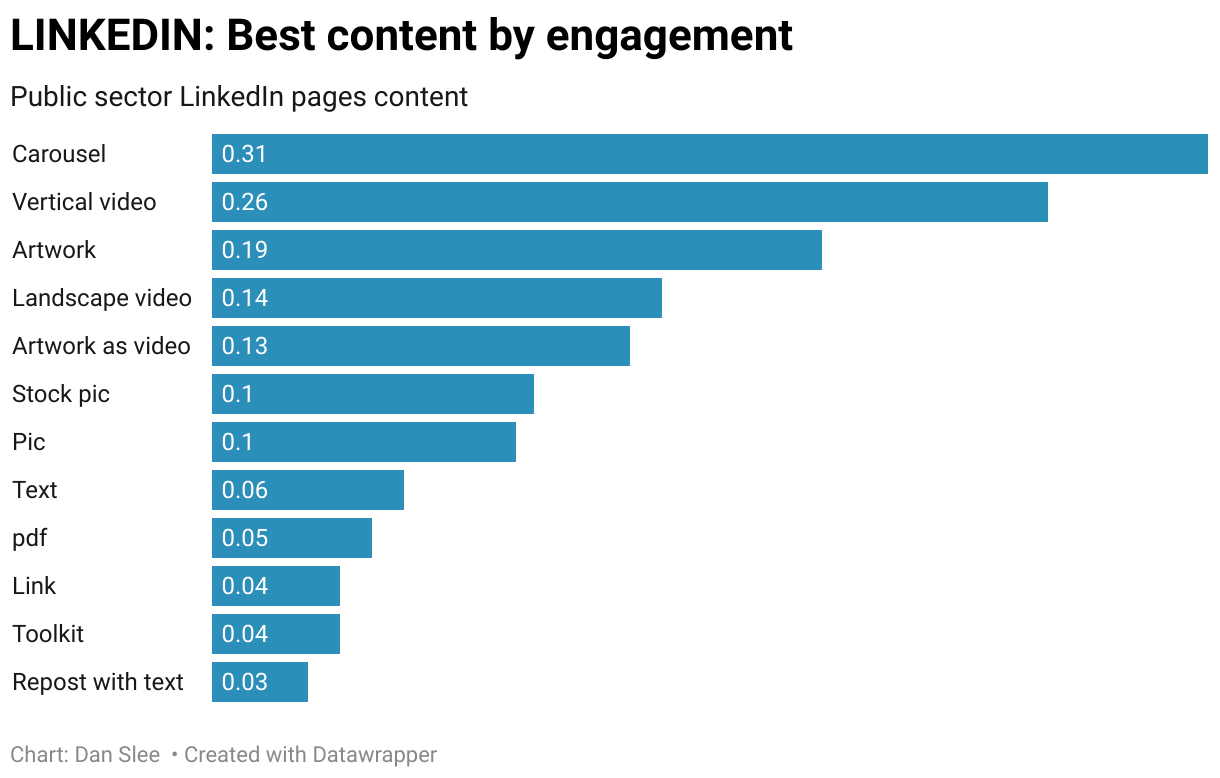
You’re probably aware of being able to post a picture, a text update and maybe a video. But did you know you can post a pdf, a landscape video, a vertical video and also post artwork and text as a video? You can repost too which mimics the retweet function.
Here’s the data from 250 posts as a cross section of the public sector.
What surprised me is that carousel content – that’s a spread of three or more pictures – topped the charts. That’s exactly the same as the 2025 numbers for Facebook and Instagram.
Take a look…
The carousel of images certainly makes sense. It’s visually interesting, and it’s likely to hold the scroller’s attention for longer.
What is surprising to me is that artwork is comparatively high. It’s third in the table. At the bottom is toolkit content. No surprises there but the repost function also didn’t connect that well.
Here’s an example of a carousel. In this case, Manchester City Council has used images with permission from Instagramers. They post to Instagram and I’ve also seen them post to Facebook.
Here, the images celebrate Spring. The lack of call to action is a strength. It’s just good content that encourages engagement. By posting things that aren’t selling you are tapping into what social media really used to be. It’s a conversation rather than a marketing technique. Besides, the algorithm will show that important update to more people next time around if people are engaging.
I’m not surprised that NHS England have created a good example of the vertical video genre. For me, their LinkedIn page is one of the best. It celebrates staff as well as communicating big picture messages. As a result, almost 800,000 people follow it.
Landscape video isn’t rewarded as much as vertical. This should inform your future content.
In addition, there is the genre I detected of artwork as video. This is text on a screen or designed images to make a point. As the scrolling passer-by, this seems maybe less likely to reach a wider audience. But if its for your niche then it can work.
Please, post jobs as a separate jobs post
You may be wondering why jobs aren’t featured in this review.
That’s because jobs are a separate stream from routine updates. When you post using LinkedIn’s own jobs functionality you are adding the position to a large pool that users can search. For example, there are 800 jobs on LinkedIn 40 kilometres from where I live. That’s an entirely separate thing. Please, don’t post jobs into the main posts. Few people will see it. Far more will look at the jobs stream and look what’s there. It’s the difference between using a trawler and a kid’s fishing net in the canal.
Good content
Of course, what this analysis doesn’t factor in is the nature of the content. It doesn’t differentiate between the story of the daughter following in the footsteps of her mother to be a paramedic illustrated with a picture or the picture of the building where the training happens. One is more engaging than the other.
For me a good LinkedIn page needs to celebrate staff, celebrate success, celebrate partner’s success as well as promote jobs using LinkedIn’s jobs functionality.
Pages included in the review
I looked at 25 posts on 10 UK public sector pages including NHS Fife, NHS England, NHS Supply Chain, Local Government Association, Manchester City Council, Powys Council, Metropolitan Police, Police Service Northern Ireland, Dorset & Wiltshire Fire Service and Scottish Fire and Rescue.
Half of news run through an AI assistant has ‘significant issues’
In the study, the BBC found that:
51 per cent of all AI answers to questions about the news were judged to have significant issues of some form.
19 per cent of AI answers which cited BBC content introduced factual errors – incorrect factual statements, numbers and dates.
13 per cent of the quotes sourced from BBC articles were either altered or didn’t actually exist in that article.
People may think they can trust what they are hearing from AI assistants but they clearly can’t.
A new metric is emerging for AI tools
Once we had readership and ABC figures showed how many people were reading newspapers and magazines. How many column inches of coverage you were producing was a significant measurement.
Then came the internet and where you sat in search rankings were coveted. The SEO industry was born.
Now it seems that a new measurement that maps how you appear in AI tools is being born. ‘Share of Model’ is a term being used to show if you are cutting through to AI-tools like ChatGPT or Copilot.
This path is leading us to a fundamental shift.
It looks like we could be at the start of a new era in communication. We’ve had the print and the electronic eras, and the tectonic plates are now shifting from the digital to the generative AI (GenAI) era.
– Tom Roach, Marketing Week, 2024.
As the the wonderfully titled Brilliant Noise agency observed in a recent newsletter brands that dominate AI-generated answers could win market share simply by being the name the AI remembers.
That’s such a fascinating point.
But it leads us back to the question about how we deal with inaccurate content generated by AI.
Challenging AI produced by news sites
When I was asked the question of how to deal with news sites using AIU tools for inaccurate information at the LGComms session this struck me as being tricky.
On reflection, this is probably as easy as its ever going to get.
Under old school rules, people challenged inaccuracies in the paper by ringing up the journalist. The Editor’s Code of Conduct meant they were obliged to give house room to your objections.
Today, Reach plc and others are using AI tools to generate stories. Or rather ‘content’ as perhaps we should call it. How easy would it be to contact the out-of-town business park or back bedroom in Guildford where these content producers now sit? I’d say it would be pretty tricky and I’m not sure those AI-wielding uber journos would give a stuff about your objection anyway.
This leads to the need to challenge inaccuracies in public using social channels. In other words, calling out that publication directly.
That’s the easy bit.
Sometimes, people are hesitant to do this for fear it would jeopardise a relationship. That’s a fair point. But the question that needs to be asked is this. What relationship do you now have?
Quite how you challenge inaccurate content produced by one man’s Siri or one woman’s Bixby I have no idea.
Welcome to 2025, there are a lot of blank spaces that need filling.
Ever wondered what content gets the most views on public sector TikTok?
Then look no further because I’ve gone through the numbers for 12 public sector accounts and looked at more than 250 posts.
The surprising answer is that meme content performs best for public sector accounts.
Meme content often comes from editing in Capcut to take advantage of the tool’s templates that allow you to tailor a moment of pop culture with your own message.
Here’s the numbers.
However, meme content isn’t always the easiest to achieve. Ephemeral and flippant this plus into the audience but isn’t always recognised by senior people as being content befitting of the organisation.
On this, they are both right and wrong. To them, they are right. But often senior people just don’t like TikTok. The answer to that is that they’re not the audience. Yes, you can create something that is inappropriate using a meme. But more often than not it can land with a younger demographic.
What a meme looks like on TikTok
This clip from West Sussex Council shows the meme of Gary Barlow taking selfie video saying ‘This is my idea of a good day out.’ You can then add an image or footage. Here’ the background is a polling station.
What original content looks like on TikTok
In this clip, A& E staff deliver a warning message that A&E is nearing capacity. Original content can either have a piece to camera delivered like this, record ambient noise or have a voice over added.
What music looks like on TikTok
Music is where TikTok gets its reputation, of course. Universal struck a major deal with the platform to allow 15-second clips be used by creators. However, be warned. If you have a public sector account it would be advised if you converted to a business account. This way you’ll only be shown the tracks that have been licensed for commercial use.
This South Wales Police TikTok uses music to good effect.
In summary
TikTok will have a different audience from the rest of your channels. They will demand Tiktok-shaped vertical content that is entertaining, easily digested, grabs attention and doesn’t bore.
What was striking was that the reach of TikToks was greatly higher than the follower numbers. The research here looked at follower numbers and then looked at how many people had viewed. North Lanarkshire Council, for example, has less than 3,000 followers but produced video routinely that was clearing 60,000 views. That’s incredible and credit to them.
This shows that the cut through on TikTok can be much different to on other social channels. But no wonder. TikTok’s algorithm is about interests not friends and family. So, if you produce content that echoes other people’s interests then you’ll be seen by more people.
As part of the study I looked at Oxford City Council, North Lanarkshire Council, West Sussex Council, Metropolitan Police, South Wales Police, Dartmoor National Park Authority, Great Western Hospitals NHS Trust, Sandwell & West Birmingham NHS Trust, Peterborough City Council, London Ambulance Service and South Yorkshire Fire & Rescue.
Underlying trends can be hard to map which is why the Edelman Trust Barometer is such a useful document. Simply, it looks at who UK people trust and the answer can often be ‘not the public sector.’ In this blog post Nicola Todhunter sets out five key pieces of learning you absolutely need to reflect on.
Each year, the Edelman Trust Barometer delves into public attitudes towards the media, business, NGOs, and government. It’s an annual, global survey of 33,000+ people. It’s by no means perfect, and we shouldn’t take it as gospel. (It’s run by the world’s biggest PR firm, with some ethical quandaries and questions.)
But it remains a thought-provoking read. It offers a clear breakdown of detailed data. It’s full of insights that we can make practical use of (and a respected source to back us up when we need it).
Here are my five takeaways for public sector communicators from the 2025 Edelman Trust Barometer UK report.
Five takeaways
People are finding it harder to know who to trust
More than ever believe that leaders are intentionally misleading them. And most people still feel it’s hard to tell whether news is from a reputable source. This hasn’t changed since 2021.
People increasingly feel that the media is driven by attracting a large audience or pushing a particular ideology, rather than informing the public of things they need to know. Of course, in our polarised world, people often mean very different things by ‘what they need to know’.
In fact, people in the UK don’t have trust in any type of media. Feelings are merely ‘neutral’ towards search engines and traditional media. There’s significant distrust of social media and ‘owned media’ such as companies’ own websites, newsletters, etc.
We need to work with the traditional media to help them rebuild trust. We can offer unique opportunities to cover the things that matter to local people.
We can provide spokespeople that their audience will sit up and listen to. Scientists are far and away seen as the most trustworthy group, trusted by 76 per cent of people. I think it’s a fairly safe assumption to extend that to clinical professionals like nurses and doctors. No prizes for guessing that government leaders and journalists bring up the rear, trusted by only 34 per cent.
With a high turnover of reporters who are often under a lot of pressure, it can be tough to build relationships and help reporters fully understand what large, complex organisations and systems actually do. But we must keep trying – when it pays off, everybody wins.
And we need to ensure that people know they can turn to our channels for reliable information. That means using trusted voices like scientists and people who our audience can identify with. Everything we share must be accurate and clear.
Younger people are willing to try more extreme tactics to change things
The majority of young adults – 6 in 10 people aged 18-34 – approve of ‘hostile activism’. That’s things like attacking people online, threatening violence, or damaging property.
We’re likely to see the impact of this online and in person. Expect even more online hate targeted at organisational accounts. Online campaigns may spill over into vandalism of our sites. Forewarned is forearmed.
People feel angry and cynical, and it’s ‘us’ versus ‘them’
Most people – 70 per cent – feel a moderate or high level of grievance against businesses and the government.
Among this group, most people felt that that anything that benefits other groups who don’t share their politics must come at a direct cost to them. A large part of society is starting to see things as a ‘zero-sum game’.
We are going to need to make it clear to people how initiatives and changes will make things better for them specifically. We can’t rely on a warm and fuzzy understanding that ‘a rising tide lifts all boats’.
People’s high level of trust in their own organisation’s CEO has stood out in the last few Barometer surveys. And although it has decreased, it’s still up there
Internal communications are still a trusted and influential source of information. Don’t underestimate that. We need to make sure leaders understand this, and think carefully about how to use this influence. We cannot take people’s trust for granted.
The Edelman Barometer survey isn’t all doom and gloom
It also helps us to understand what is needed to try and reverse these trends. Two things stand out.
To regain trust, leaders need to show that they genuinely understand what people want and need. And they must show how they are taking real action to change things for the better.
Our communications need to reflect this. The words we use can sometimes put up walls. Instead, we can help leaders to understand the importance of talking to people in clear language, which they can understand and relate to. We must focus on showing, not just telling, and words which are backed up by actions.
In the ever shifting landscape that is 2025 what do we do with a thing like Facebook?
Well, there’s certainly been some bumps in the road of this mega-platform and yes, it’s time to tweak your approach to the platform.
But first, we have to acknowledge a lurch to the right for Mark Zuckerberg. The tech billionaire said everything that the new US President would have wanted him to say. Some friends have decided to exit the platform on the back of this. I respect their decision but is it too soon to pull the plug on your corporate page? Maybe, but that’s probably one for a watching brief.
I’ve decided to look at the data.
The numbers are there for Facebook
The platform in the UK remains a strong force. Almost two thirds of the UK population use Facebook and two thirds of them can be expected to use Facebook groups. These carved out areas away from the noisy Town Square can be relatively useful spaces depending on the admin.
For much of the public sector, Facebook is where big solid chunks of audience are. Stopping connecting here may prove problematic day-to-day but especially in an emergency.
But how should you use it?
Links are back… but only if you use a microscope
I’ve been banging a drum for a long time that banging out links from pages is an entirely busted flush. In early 2024 Facebook produced data that said that 0.0 per cent of people’s timelines are made up of links to pages.
From looking at Facebook data released in late 2024, links are back. But before you get too excited they have moved from zero to 1.0 per cent. This remains way down on the comparatively heady days of 2021 when 6.6 per cent of people’s timelines was made up of pages with links.
The data is here:
A third of Facebook is unconnected, so experiment
What’s really interesting is that Facebook has never been less about friends, family and brands you like. Those elements that made Facebook Facebook have become less important. We’re used to the idea that we may be friends with that lad from GCSE German but because we don’t interact we don’t see content from them. Now, our more close friends are being squeezed out further.
The origins of this move can be traced back several years. Facebook looked at what TikTok were doing and were somewhat envious. Basically, TikTok had moved away entirely from the friends and family algorithm and had embraced your interests. This explains why you see recipes in your timeline if you’ve been engaging with recipes. As a user, this has proved useful and other users have remarked that the algorithm tailors for them beautifully. Of course, being Meta they couldn’t outright admit they were stealing the idea. So, instead Facebook called it a ‘discovery engine.’
Looking at the data, a third of the platform is now unconnected to friends and family.
Content from friends is less than a fifth.
In my own timeline, I’ve seen friends complain that they’re getting a lot more irrelevant stuff appearing. Looking at my own timeline and I’m seeing this. So, as a result you’ll see as you scroll things maybe adjacent to your interests from pages and groups.
How can you make best use of this?
I’d maybe start experimenting with broader posts. So, if half term is coming up maybe there’s worth in piecing together a post for parents to keep their children occupied with a range of bulletpoints with things to do. You may only be trying to push a couple of things but if you pack out the post with other free things this may build the wider worth of the post. Would this stand a chance of landing in the timeline of someone remarking that there was nothing to do in Dudley at half term with children? Maybe. It’s something I’d experiment with. I’d also be using broader language. So, an event at a leisure centre in Dudley is likely to get less reach than a package of ‘ideas for parents to keep their children occupied in Dudley during half term’.
I don’t have the data for this but this is where I’d be experimenting.
Facebook groups are still a thing
Also, the data shows that Facebook groups are remarkably constant with around 15 per cent of people’s timelines. That’s not much change from the last three or four years so the strategy of sharing content in key groups still makes sense.
The news that fact checking is being abandoned on Facebook does not fill many sane people with confidence. Facts are sacred, opinion is free. Or as Winston Churchill once said, ‘United wishes and good will cannot overcome brute facts. Truth is incontrovertible.’
X, formerly Twitter, abandoned fact checking and look where that got them.
Under the alternative Meta plan, fact checking is being replaced with community notes, In this system, people write what they think of the fact underneath it. So, a piece about vaccines could theoretically play host to a vaccine denier’s opinions.
One route would be to post nothing controversial. But sometimes, that information is the most valuable to put out.
It’s likely this move will make Facebook even more toxic and embolden people with loud voices. For me, this means doubling down on supporting your staff and maintaining standards. Have that set of social media house rules. Communicate them and stick to them. Remind people they exist. Set the standards you want to see.
Plan ahead for flash points
One thing I’ve learned over the last few years is that organisations like the Royal British Legion counter misinformed snark brilliantly. So, they have a plan in place when the ‘they’re banning the Poppy’ nonsense starts. Spoiler alert: no, they are not. So if something is coming down the track, think through what the worst people can say is and think through how to respond. Come up with some form of words that can support you as well as having the social media house rules. It’s better to plan in peace time rather than when cars are on fire.
Here’s a picture that captures in time perfectly a newsroom that didn’t know what was coming.
Seven reporters in a district office of the Express & Star in West Bromwich taken around the time of the Millennium. You can see the desktop Apple machines, the tide of newspapers, letters and council agenda papers that filled gaps on desks. In the corner of the room, a portable TV with Ceefax keeps an eye on the cricket score.
It was the newsroom I worked in from 1998 to 2005.
I know all of those reporters in the picture. I loved working with all of them. From left to right in newspaper caption fashion, that’s Jo, Nina, Paul K looking straight at the camera, Anne with her back to the shot, chief reporter Ken there in the distance, the late Marion and then Paul F.
What did a good newsroom teach you?
You learned by osmosis. People rang in with stories so you overheard how others perfected their phone interview technique. ‘Getaway,’ Ken would exclaim down the phone at least three times a day to coax out more information.
Or you could bounce an idea off a colleague. Or you could pick their brains. Or they could cadge a phone number off you.
I’m not being sentimental in saying that people learned far more by being in a room with more senior colleagues.
Good times
When it was good, it was very, very good. When it was bad the Express & Star was an indescribably unpleasant place to work. The culture that emanated from parts of the Wolverhampton head office then was often vile.
But I much prefer to remember the good memories.
Dave, who sat next to Ken at the back of the office, would crack the same jokes over and over. ‘They’ll never sell any ice creams going at that speed,’ he’d say everytime a siren went past. ‘I’ll get this,’ when his phone rang. Bored after deadline, Dave would embellish stories, stir the pot or create rumour.
He should have been throttled but we put up with it because it was Dave.
See that clock on the wall?
That clock ruled my life. First edition deadline, the shedder – the schedule – Dudley edition, Wolverhampton edition, Sandwell edition, afternoon schedule and five other edition’s deadlines.
See that fax machine under the window on the left?
That was where press releases were sent. We didn’t have an email address or the internet. The Victorian management at Queen Street thought we’d just mess about if we had those. They also thought that the internet was a fad which just like CB radio would fade away.
What didn’t we know was coming?
Well, nine years after that picture was taken the print works at the back of the building closed. The newsroom limped on with fewer staff until that too closed.
I count myself very lucky to have worked in the finest office of the biggest selling regional newspaper when newspapers were a cornerstone.
Seeing this picture – thanks Paul Pickard – made me smile.
A few weeks back I looked at Facebook to see what content works best and now it’s the turn of Instagram.
Seeing as the algorithms are ever changing I took a look at a snapshop of public sector accounts across the UK.
What’s engagement?
That’s the likes and comments that are publicly displayed.
This is valued because it shows that users have responded to the content. This in turn means more people will see it and those who have clicked have told the algorithm: ‘more, please.’
Here’s the league table.
Instagram best content by engagement showing a carousel of images first with 0.96 percent engagement, Reels 0.73, a single image 0.72, artwork 0.31, traditional video 0.21 and toolkit content 0.07 per cent.
What’s changed?
The snapshot I took looked at 10 local government, NHS, fire & rescue and police accounts and 250 posts in total.
While the survey was limited in number it was striking how much less toolkit content there was on local channels compared to last year. What’s toolkit content? Nationally created assets shared to organisations across a wide area.
What the numbers mean
I looked at the account’s follower numbers then measured the comparative reach for engagement. So, if an account has 100 followers and one engagement that’s a one per cent engagement rate.
1st – The carousel of pictures is king of content
Just like on Facebook, the mini-collection of images is the best performing. This isn’t just one image, it’s a collection on a theme.
Manchester City Council are one organisation who are adept at this. They re-publish images from photographers with their permissiomn and credit the image. In effect local people can be taking pictures to celebrate the area and are shared by that area’s council.
It makes sense for a collection of images to prosper if you think about it. More pictures is more chance for the user to stop and peruse. There’s more chance of liking something, too.
2nd – Reels video
You have to admire the brassneck of Meta. They saw TikTok and its vertical video coming over the horizon and they took the idea and applied it to an existing platform.
So, Reels has prospered and half of all time spent on the ‘Gram is spent on videos like Reels.
3rd – a single image
Instagram was built on single images that celebrate. So, food, a landscape or fashion originally thrived on the platform.
The single image has fallen out of favour as the best performing but still remains as an option.
4th – artwork
Fourth in the list of most effective is artwork. This is an image with some element of design be that a logo or a call to action.
It’s a third as effective at gaining engagement compared to a carousel of images
5th – Traditional video
Some accounts still post traditional video.
This has become far less effective as an option. No surprises, really.
Much of the trad video viewed was repurposed video from elsewhere. As it came from elsewhere it didn’t use the techniques and tricks that people are used to with say, Reels.
6th – Toolkit content
Propping up the pile as least effective is toolkit content.
These are national campaigns sent out with a request to be re-posted locally. The theory behind it is sound. People are busy so give them something on a plate. However, the theory collides with users who don’t find it engaging.
Just 0.07 per cent of a follower number engage with it. Insincere, inauthentic and unpopular this ticks a box and nothing else. Sadly that box is marked ‘it doesn’t work.’
How that compares
Compatred to the Facebook analysis of engaging content there’s a lot of similarities. Carousels work well, Reels are second and the single image is third. However, there is a limit on the type of content seen. So, no GIFs or AI was seen just yet.
Look, I know you’re probably worried about AI but I want this to be a plain English run through of what Keir Starmer’s announcement means for you if you work in public sector comms.
You may have seen that the Prime Minister has made a significant policy announcement about AI and the future direction of the country.
Here, I’ll run through the basics of it and I’ll also run through what this means for you if you work in public sector comms. If ever my strapline ‘future comms made easy’ comes into play in my work its for this post.
What did the Prime Minister say?
In short, Keir Starmer says that the future of the UK will be shaped by how well we can be at the bow wave of Artificial Intelligence. That means encouraging innovation but it also means demanding the public sector use AI more effectively.
“AI is the defining opportunity of our generation. The battle for the jobs of tomorrow is happening today.” – Keir Starmer.
Why bother?
Two reasons. First, the economic argument is that using AI to its potential would add 1.5 per cent onto UK growth a year bringing an extra £47 billion into the economy ever year for 10 years. Secondly, security. By developing tools in the UK we are less exposed to the whims of hostile powers. I’m thinking China in this but I’m also thinking potentially of the USA.
That’s fine, what does this mean for the public sector?
If you think this is an announcement for boffins in lab coats, tech bros, data scientists and it won’t affect you you’d be wrong. Yes, it was partly aimed at people working in the AI space because their investment will help shape how fast the UK will travel. But it’s also something aimed at all of us and definitely something public sector communicators needs to pay attention to.
“It will make public services more human.” – Keir Starmer.
The move will allow people on the coalface of the public sector to speed-up processes they already have.
That’s things like:
Better pothole detection.
Better diagnosis.
Better at fighting tax avoidance,
Faster processes for planning applications.
Less time for social workers on paperwork.
So, there’s elements there for central government but also local government and NHS. Fire and rescue and police weren’t mentioned directly but I think you’d very easily come up with scenarios where AI could help or hinder people on the frontline.
All this, the announcement said, was about doing a better job and freeing up more time.
Comms, I’ve got a job for you understanding AI, explaining it and advocating for it
“Our plan for change also sets down a gauntlet for public services and the blunt truth is we’ve got to be much bolder. I’ve seen this fear myself as a leader of public services and this is entirely human so we have to change that mindset.” – Keir Starmer.
This will partly be the job of public sector communications.
The announcement recognises that fear is one of the reasons that change is not happening faster. It would be remiss of Government simply to clap their hands to make it go faster.
The scan, pilot and scale approach may be one thing to reassure people. This means that AI won’t be just chucked at everything.
So, if AI tools that can make pothole detection and repair faster then that needs to be understood by the comms team and also communicated to a sceptical public.
One observation from delivering training is that when people see the benefit they absolutely want more of it. Once, I was showing people in a training session an AI tool and an attendee spoke about how she was frightened of AI and wished it could be uninvented.
So, we ran a task from her to do list through ChatGPT. The task was to write a webpage giving advice on how to stay safe in extreme hot weather. Advice was for the reader but also vulnerable people such as neighbours or relatives. Within 30-seconds, the tool had come up with content and bullet point advice that was eighty per cent on the money. It needed some topping and tailing but the main points were there.
“This is amazing,” the once sceptical comms officer reacted, “We really should be using more of this.” They had turned 180 degrees in the spaceless than a minute once they saw it could help them with their job.
Move that out to the pothole example, how could you explain the benefits to residents? The good news is you don’t need to code to do this. You just need to bring your existing skill set. You may, for example, need to ask for the data on how faster this will make things. If the machine can do 10 repairs in a day instead of five then set that out.
It feels like AI-literacy has become very important
Talking to comms people in late 2024, there’s maybe a feeling that AI is for the geeks to understand. It probably won’t land on the team and there maybe people who can swerve learning about it.
I’m taking a punt here, but it feels like when the internet emerged there were people who opted out. I don’t think that will be a long term strategy for people who would like to work in the sector in the next five years.
What if people don’t understand AI?
To the credit of the announcement, this is recognised. UK Government through the Department of Science, Innovation and Technology will look at the skills gap and how best to fill it. I’d like to think that the skills gap in comms may also play a role in this.
What about AI and comms as a job?
There’s nothing in Keir Starmer’s announcement directly about public sector comms. But the benefits have been spoken about elsewhere. Using AI to better evaluate, for example. Or using AI tools to tailor and personalise content is certainly very achievable. Give it the main points and ask it to produce something to a different audience. The tools for this are here already.
This part is really down for all of us to explore.
What other practical things does the announcement herald?
There was a substantial number of references to places across the UK. Data centres in Liverpool and Northumberland, for example. But also AI Growth Zones. These will be areas where growth around the AI sector will be targeted. The first was announced at Culham in Oxfordshire where the UK Atomic Energy Authority currently is. More will follow. If you work in local government, your chief executive and Leader may be getting excited about this prospect.
What about open data?
There’s other parts of the announcement about a policy to make more data open to the public. Also, government will look at how the data will be collected in the first place. Will this have an impact on public sector comms? Well, comms may have to communicate it but overall this feels very high level.
What about comms people who are too tired or too scared for all this?
This is a huge challenge.
Teams never really recovered or paused from the worst of COVID. Many people are on their knees or burnt out. That’s understandable. Maybe they feel too long in their careers to pick up new skills. They are being asked to take a leap into the unknown with AI and it’s understandable to be worried. For a head of comms or manager this is going to be a real challenge.
Many teams are also well over 40 and are not savvy with AI tools. This on its own is not the immovable obstacle it could be. My 16-year-old daughter hates the idea of AI. So does my wife who is in her 50s. I can absolutely get that. I can only go back to the point about showing how AI can help you with your job before people start getting on board. Answer the ‘what’s in it for me?’ question and you have a chance.
The only advice I can offer is to make it as easy as possible. Hold the door open for everyone and if people want to go through the door and learn new things that’s a plus.
For my money, the line that AI on its own won’t necessarily take all jobs. But a comms person who is savvy to understand AI, communicate it and use it will replace those who can’t.